Yes, monstera can grow in an aquarium, but not fully submerged. What actually works is a semi-aquatic or paludarium-style setup where the roots sit in or near the water while the stems and leaves stay above the surface. Think of it like a riparian plant: roots wet, foliage in the air. Get that distinction right from the start and you'll avoid the single biggest mistake people make, which is dunking the whole stem and wondering why it rots within two weeks.
How to Grow Monstera in an Aquarium: Step-by-Step Guide
Marcus Holloway
17 Apr 2026
Can monstera actually grow in an aquarium?
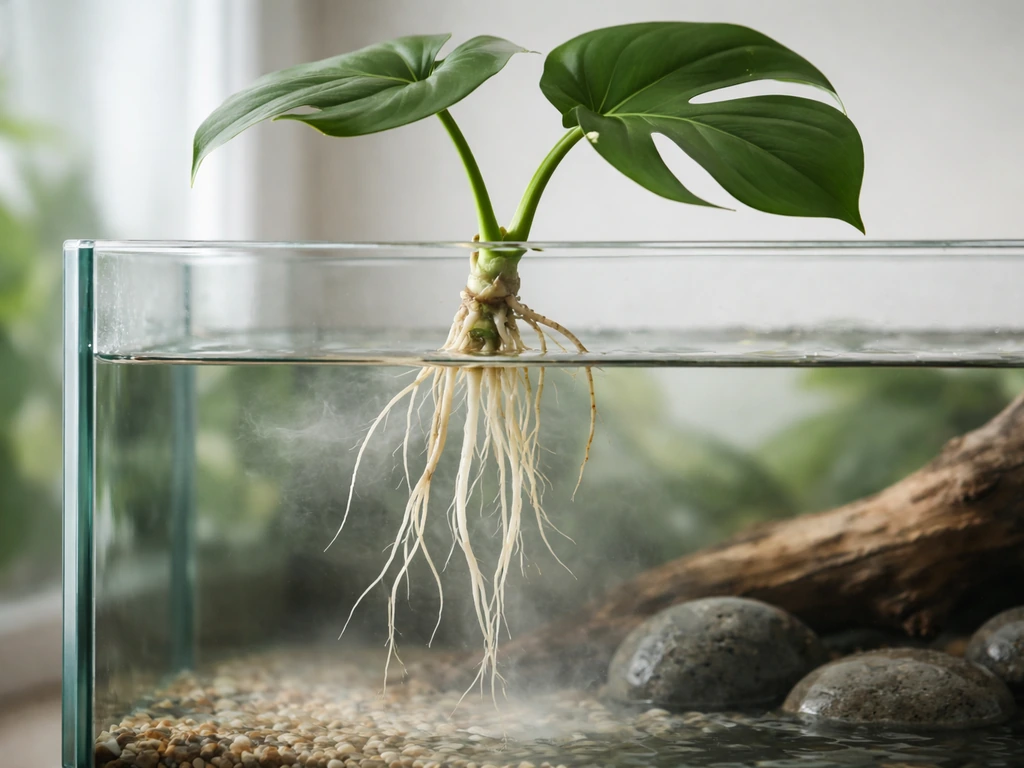
Monstera is a blank" rel="noopener noreferrer">hemiepiphyte, meaning it spends part of its life clinging to trees with roots dangling in humid air or touching moist soil. That biology is actually well-suited to a water-contact setup, but only at the root zone. The stems and nodes need oxygen. When you submerge a node in stagnant, low-oxygen water, you get the 'swamp effect': anaerobic conditions that kill root tissue fast. Hobbyists who've tried fully submerged monstera cuttings almost always end up with the same story, mushy stems, black rot, and a dead cutting within a couple of weeks.
The good news is that monstera aerial roots are genuinely adapted to absorb water and even dissolved nutrients from their environment. Placing an aerial root into well-oxygenated water can actually trigger new growth responses like fresh shoots and leaves. So the plant isn't fragile about water contact, it just needs that water to be clean, moving, and oxygenated. Get those three things right and monstera thrives in aquarium-adjacent conditions better than most tropical houseplants.
Choosing your species and cutting
Monstera deliciosa is the easiest species to start with for aquarium and semi-aquatic setups. It roots reliably in water, typically showing small white roots within about a week and a usable root system in around three weeks, and it handles the humidity fluctuations of a tank environment without complaining. Monstera adansonii is a solid second choice: it's smaller, which is a real advantage in a tank setup where you don't want a plant taking over the room, and it handles moist conditions well as long as the root zone isn't anaerobic.
Monstera albo and other variegated varieties can work, but they're slower-growing and more sensitive to root stress, so I'd recommend getting comfortable with the technique on a deliciosa or adansonii first before risking an expensive cutting.
How to pick and prep your cutting
You need a cutting with at least one node, that's non-negotiable. A node is the bump or joint on the stem where leaves and roots emerge. A cutting with an existing aerial root at the node is even better because that aerial root will transition to water roots faster than a node with no root tissue at all. Cut just below the node with a clean, sterilized blade, let the cut end callous for about 30 minutes in open air, then it's ready to go into your setup.
Setting up the tank
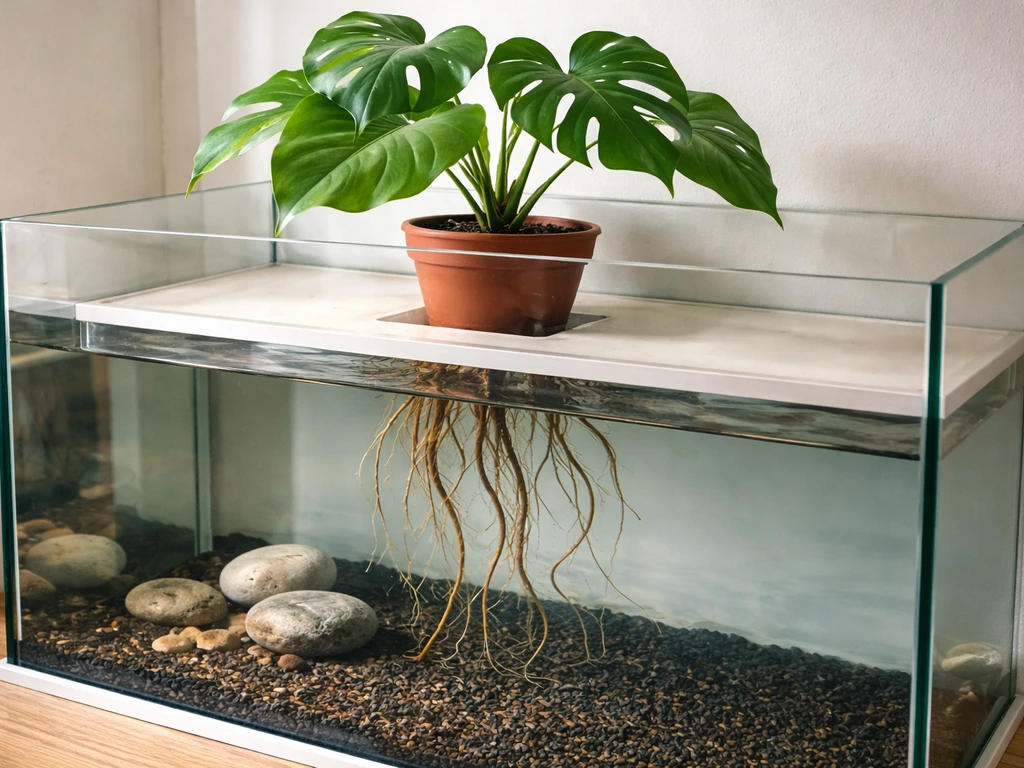
The most practical aquarium setup for monstera is a paludarium or a standard fish tank with a shelf, ledge, or overflow section built or placed at the waterline. The plant sits above the water with its roots trailing down into it. A 20-gallon tank (roughly 75 liters) is a good starting size, big enough to maintain stable water chemistry but small enough to manage easily. Taller tanks (18–24 inches high) give you more room for the monstera to grow upward and also provide better vertical separation between the water zone and the plant canopy.
If you have fish or shrimp in the tank already, that's actually a benefit: fish waste provides a natural nitrogen source that the monstera roots will use. Just be aware that heavy bioload can spike ammonia and nitrates faster than the plant can consume them, so you'll need to monitor water quality more closely in a stocked tank.
Hardware you'll need
- A tank with a lid or open top: open tops work well if humidity isn't a concern; a partial lid helps maintain moisture around roots in drier climates
- A shelf, net pot holder, or overflow section positioned at the waterline to support the plant above water
- An air pump and air stone: this is not optional — oxygenating the root zone is the single most important factor in preventing rot
- A sponge or hang-on-back filter to keep water circulating and prevent stagnant pockets
- Net pots or small mesh baskets (2–4 inch diameter) to hold the cutting and any inert media
- Leca (lightweight expanded clay aggregate) or perlite to fill the net pot — these hold the cutting upright while allowing water and oxygen to reach the roots
- A grow light positioned above the tank for plant canopy lighting
Place the air stone directly below or adjacent to where the roots will hang. You want visible bubbling in the root zone, not just somewhere in the tank. This keeps dissolved oxygen high exactly where it matters most and mimics the aerated environment that monstera roots evolved in.
Water, light, and oxygen: the conditions to hit
Water parameters
| Parameter | Target Range | Why It Matters |
|---|---|---|
| Temperature | 68–82°F (20–28°C) | Monstera is tropical; cold water slows root development and increases rot risk |
| pH | 6.0–7.0 | Slightly acidic to neutral; keeps nutrients available and matches natural habitat |
| Dissolved oxygen | As high as possible, ideally >6 mg/L | Low DO is the primary cause of root rot in aquarium setups |
| Nitrate (NO3) | 5–20 ppm | Provides nitrogen for growth; higher end fine with active plant uptake |
| Potassium (K) | 5–20 ppm | Supports cell function; often the limiting nutrient in planted tank setups |
| Ammonia/Nitrite | 0 ppm | Toxic to roots; keep cycled if housing fish |
Light
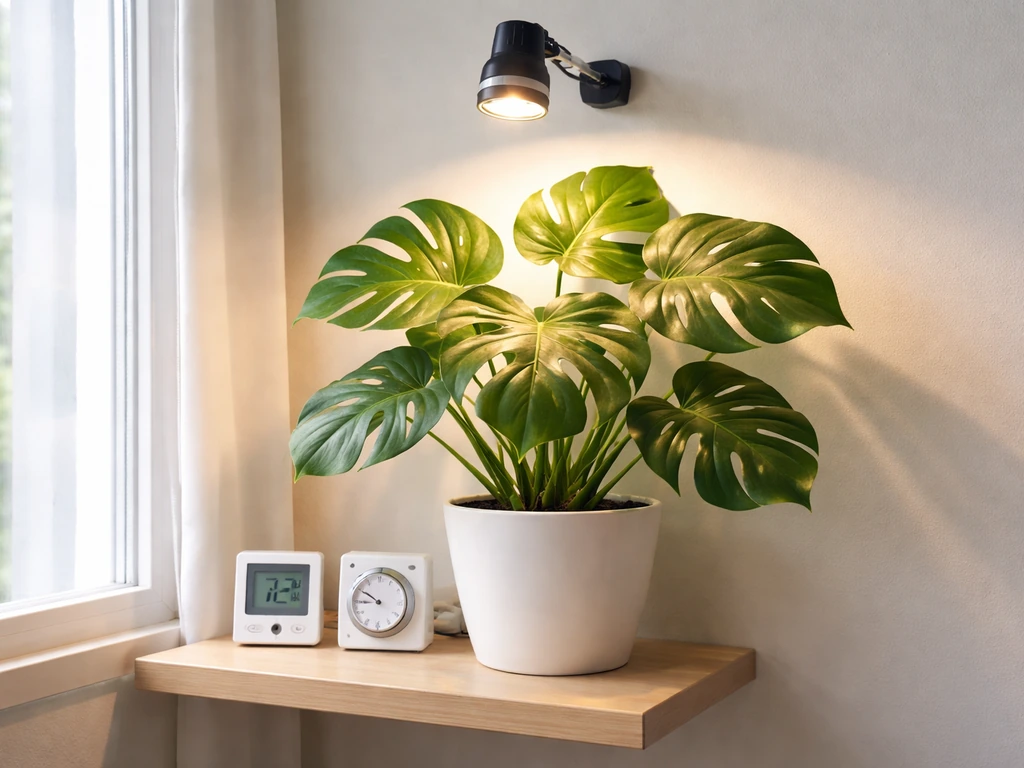
Monstera needs moderate to bright indirect light above the waterline. A full-spectrum LED grow light positioned 12–18 inches above the plant canopy works well. Run it on a timer for 10–12 hours per day. Avoid intense direct light for more than an hour or two, it'll bleach leaves and, more relevantly for the aquarium, it accelerates algae growth in the water below. If you notice algae competing with your monstera (more on that in the troubleshooting section), trimming the photoperiod to 10 hours and reducing nutrient levels is usually the first fix to try.
Oxygenation
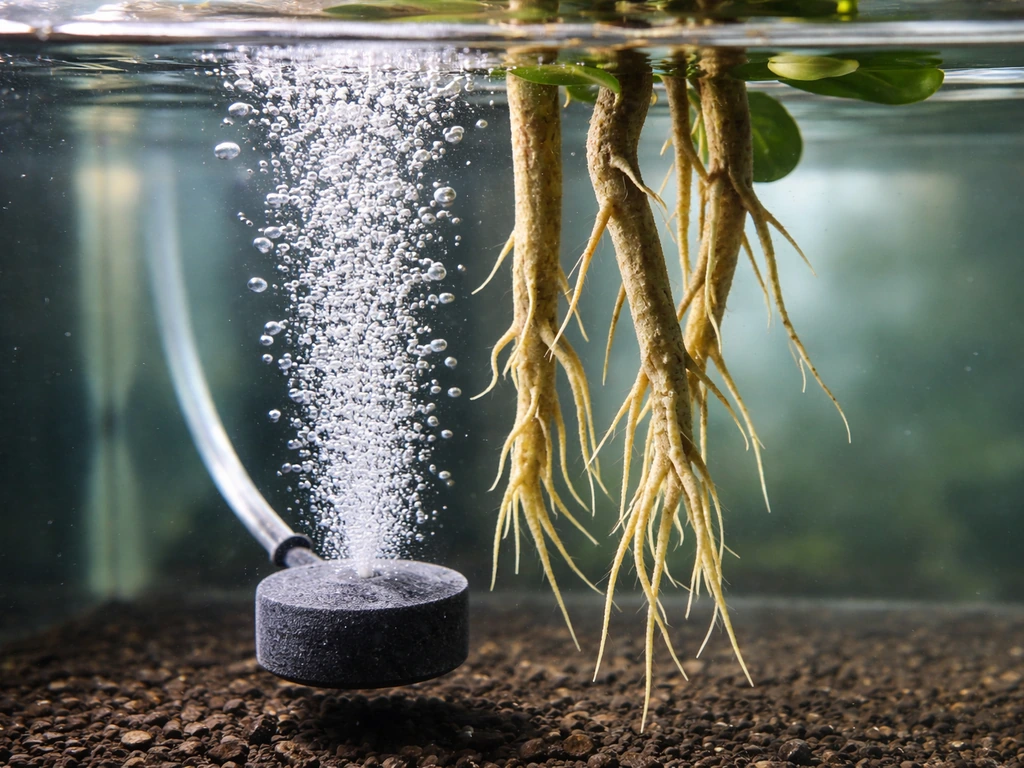
I can't stress the oxygen piece enough. Rot in aquarium monstera setups is almost always an oxygen problem, not a water problem. Root zone hypoxia, where the roots are sitting in water with insufficient dissolved oxygen, creates anaerobic conditions where rot bacteria thrive. Running an air stone under the root zone, keeping a filter running for water circulation, and avoiding dense, compacted media in the net pot all work together to prevent this. If you're ever troubleshooting rot and you haven't addressed oxygenation first, start there.
How to plant and root monstera in an aquarium
Full water rooting vs. semi-aquatic setup
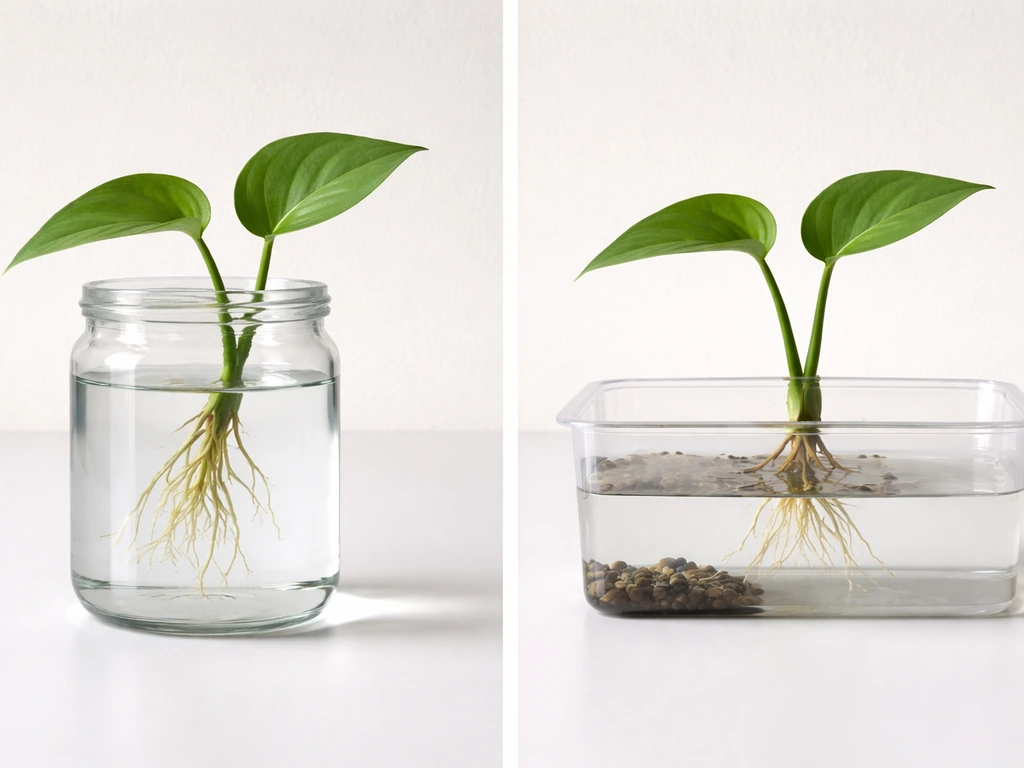
There are two main approaches, and they're worth comparing directly before you commit to one.
| Setup Style | How It Works | Pros | Cons | Best For |
|---|---|---|---|---|
| Full water rooting (propagation stage) | Cutting submerged only at root/aerial root zone, node and stem above water, in a jar or net pot over the tank | Simple, low equipment cost, fast to set up | Must transition eventually; node must stay above water | Starting a cutting before integrating into the tank |
| Semi-aquatic / paludarium | Plant mounted or potted in net pot above waterline; roots trail into tank water | Long-term viable, plant can grow indefinitely, works with fish tanks | Requires shelf or mounting hardware, needs consistent water level | Permanent aquarium monstera setups |
| Leca/perlite hybrid | Cutting potted in leca in a net pot, net pot positioned so bottom third is submerged in tank water | Great oxygen/water balance, easy to check root progress, stable | Leca needs rinsing; slightly more setup time | Most reliable all-around method |
The leca hybrid approach is my go-to recommendation. Fill a 3–4 inch net pot with rinsed leca, press your cutting in so the node sits about 1 inch above where the waterline will hit the pot, then lower the pot so the bottom third sits in tank water. The roots grow down through the leca, hit the water, and continue growing into the aquarium. The node and stem stay in humid air above the waterline, which is exactly what they need. Just as growing Monte Carlo in an aquarium requires careful placement to get the right balance of light and substrate contact, monstera in a net pot needs that same precision in positioning relative to the waterline.
Step-by-step planting process
- Take your prepared cutting (node present, cut end calloused) and place it in a rinsed leca-filled net pot with the node above the intended waterline
- Lower the net pot into position on your shelf or holder so the bottom 1–2 inches of leca are submerged in tank water
- Confirm the air stone is running and positioned to bubble near the root zone
- Leave it alone for the first week — resist pulling the cutting out to check roots, as this disrupts early root initiation
- After 7–10 days, gently check for small white roots emerging from the bottom of the net pot
- Once roots are 1–2 inches long and actively growing (usually 2–4 weeks), the cutting is established and you can start your regular feeding and water-change routine
Feeding, nutrients, and water changes
Monstera is a heavy feeder once it gets going, but the dosing strategy for an aquarium setup is very different from what you'd do with houseplant soil. You're working with dilute, measurable concentrations rather than slow-release granules. Think in ppm (parts per million), not tablespoons per gallon.
A practical starting point for a fish-free setup: use a liquid aquarium plant fertilizer dosed at roughly 10 ml per 100 liters per week, targeting approximately 5 mg/L nitrate, 0.4 mg/L phosphate, and 2.5 mg/L potassium as a baseline. If you have fish, their waste will contribute nitrogen, so reduce or skip nitrogen dosing and monitor nitrate levels with a test kit before adding more. Potassium is often the limiting nutrient in planted aquarium setups, targeting 5–20 ppm potassium specifically can noticeably improve monstera leaf size and growth rate. Dennerle likewise positions potassium supplementation as a targeted dosing need in planted aquariums, for example when tap water potassium is too low blank" rel="noopener noreferrer">Potassium is often the limiting nutrient in planted aquarium setups. The principle here is test-and-adjust, not set-and-forget. This kind of dialed-in approach is similar to how experienced growers think about growing bacopa in an aquarium, you start conservative and increase as you observe plant response.
Do not use standard houseplant liquid fertilizers (like 20-20-20 at full label dose) directly in your tank. The concentrations are far too high for aquarium water and will cause an algae explosion within days. Stick to fertilizers formulated for aquarium plants, or use dry salts (like potassium nitrate and monopotassium phosphate) if you're comfortable measuring small quantities precisely.
Water-change schedule
- Fish-stocked tank: 25–30% water change weekly, more often if nitrates climb above 20 ppm before the weekly change
- Fish-free planted setup: 20–25% water change every 7–10 days, timed to coincide with fertilizer dosing (change water first, then dose)
- Always use dechlorinated water at or near the same temperature as the tank to avoid shocking roots
- After each water change, test pH and nitrate before dosing anything
- Top off evaporation with plain dechlorinated water (not fertilized water) to prevent nutrient concentration buildup between changes
Troubleshooting common problems
Root or stem rot
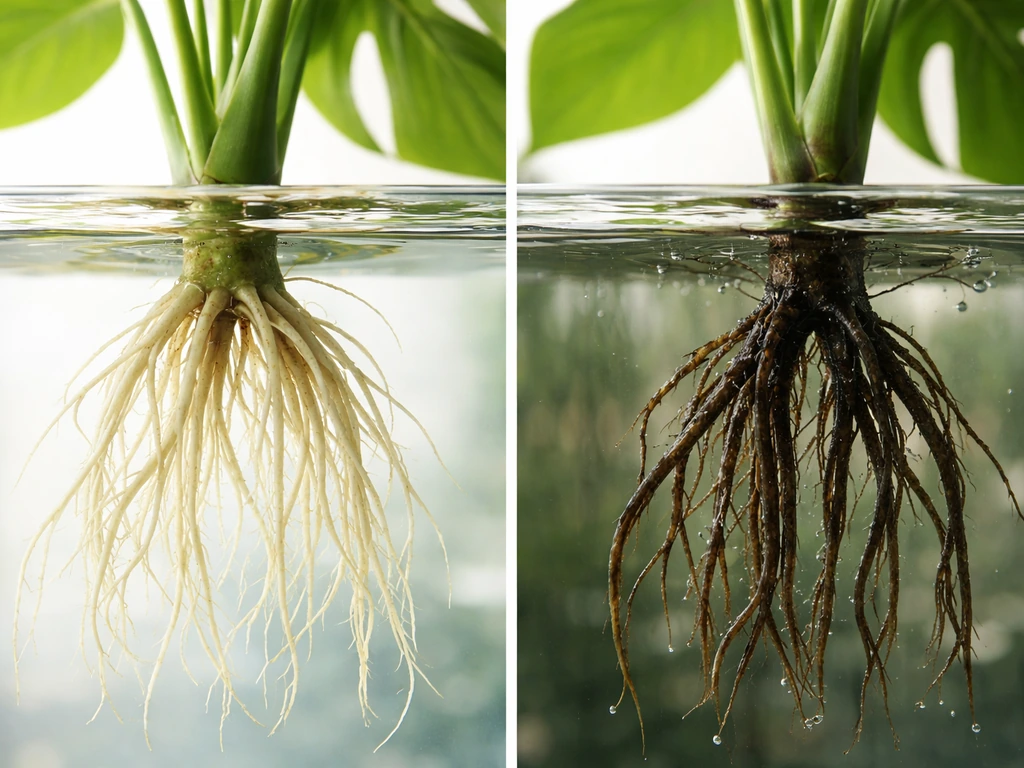
This is the most common failure and it's almost always an oxygen problem. Mushy, brown, or black roots and a soft, dark stem at the waterline mean the root zone went anaerobic. First response: pull the cutting, trim all rotted tissue back to clean white or green tissue with a sterilized blade, let the cut end dry for 20–30 minutes, then reintroduce it to a better-oxygenated setup. Add or reposition the air stone directly under the root zone. Make sure your net pot media (leca, perlite) isn't compacted, it should have visible gaps for water and air movement. If you're running into recurring rot, the fix often involves an approach similar to what growers do when managing biofilm in an aquarium: improve circulation, reduce organic waste buildup around the root zone, and keep water moving.
Yellow leaves
Yellow leaves on aquarium monstera usually point to one of three things: nitrogen deficiency, too little light, or root damage from rot. Check your nitrate levels first, if they're below 5 ppm in a fish-free tank, dose nitrogen. If you're in a stocked tank and nitrates are fine, look at the roots. Healthy roots are white or light tan. Brown, slimy, or sparse roots mean the plant isn't absorbing nutrients effectively regardless of what's in the water. Fix the roots first, then reassess leaf color over 2–3 weeks.
Drooping or wilting leaves above the tank
Counterintuitively, drooping in a water-adjacent setup is often not a hydration problem, it's a root function problem. If the roots are rotting or underdeveloped, they can't move water up to the leaves even if the tank is full. Check root health first. If roots look fine, check that the water level is high enough for roots to actually reach the water; leca and perlite can wick moisture upward a bit, but if roots are only in dry media and not reaching water, the plant will droop.
Algae and biofilm on roots or tank walls
Some algae and biofilm in an aquarium is normal and even beneficial for certain tank inhabitants. But heavy algae growth on monstera roots can block oxygen exchange and compete for nutrients. The root cause is almost always too much light reaching the water surface combined with excess nutrients. Reduce your photoperiod to 10 hours, dial back fertilizer dosing, and do an extra water change to bring nutrient levels down. Shrimp are a great natural cleanup crew here, they'll graze on biofilm around roots without damaging the plant tissue. If you're interested in using that biofilm productively, there's actually a helpful intersection with how growers deliberately cultivate biofilm in a shrimp tank to feed their colony.
Slow or stalled growth
Monstera is a slow-growing plant by aquarium plant standards, don't compare it to fast growers like grass species. That said, in a well-running setup you should see a new leaf unfurling every 3–6 weeks once established. If growth has stalled beyond 6–8 weeks with no new leaves, run through this checklist: Are roots actively growing and healthy? Is the photoperiod hitting 10–12 hours? Are potassium and nitrogen in range? Is the water temperature above 68°F? Is the node exposed to humid air rather than sitting in water? Usually one of those five is the culprit.
How this compares to other aquarium plants
It's worth being honest: monstera is not a submersible aquarium plant. It won't carpet your tank floor or grow underwater like true aquatics do. If you're looking for plants that go fully in the water, you're in different territory entirely, for instance, growing seagrass in an aquarium is a fully submerged approach that requires different parameters and species selection. Monstera is a semi-aquatic accent plant, best used to create a dramatic above-the-waterline element in a paludarium or open-top planted tank. Its large, fenestrated leaves look spectacular hovering over an aquascape, and the root system works as a natural biological filter for the water column, which is a genuine functional benefit, not just aesthetics.
If you want a lower-maintenance comparison point, growing grass in an aquarium is a much simpler starting project for beginners since true aquarium grasses are fully submersible and don't require the semi-aquatic shelf setup that monstera needs. But if you want something with real visual drama above the waterline and don't mind managing the root zone carefully, monstera delivers in a way few other plants can match in a tank environment.
What success actually looks like (and the timeline to expect)
Week 1–2: Cutting sits in leca over the tank. No visible roots yet, but the node is firm and the leaf (if present) is still green and turgid. Good sign. Week 3–4: White roots emerge from the bottom of the net pot and begin entering the water. You might see the first signs of a new leaf unfurling. Week 5–8: Root system is established in the water column, possibly 4–8 inches long. New leaves are appearing on a regular cycle. This is when you move to your full feeding schedule. Month 3 onward: Monstera is actively growing, roots are dense in the water column, and the plant is functioning as a genuine biological filter. You're doing regular water changes and nutrient dosing on autopilot.
The setup that gets you here reliably is not complicated, but it does require attention to the oxygen detail that most beginner guides skip. Run that air stone, keep the node above water, use leca or perlite instead of dense soil, and do your weekly water changes. Those four habits cover the vast majority of what can go wrong. If you're also growing carpeting plants in the submerged zone of the same tank, the approach to growing carpet grass seeds in an aquarium shares some nutrient and lighting overlap, both benefit from consistent photoperiods and controlled nutrient dosing, so a well-managed tank can support both simultaneously.
FAQ
How do I tell if my monstera cutting is rotting versus just still rooting?
In the first 1 to 2 weeks, you should see the node staying firm (not collapsing) while roots are not yet visible, and the existing leaf stays turgid. Rot usually shows up as a soft, dark stem at the waterline, a foul smell, and root tissue turning brown or slimy. If the node itself turns mushy, treat it as rot, trim back to clean tissue, and re-seat the cutting higher so the node stays in humid air, not in the water.
Can I grow monstera in an aquarium with no air stone or only a small filter?
You can, but it raises risk, because oxygen in the root zone is the key failure point. If you skip an air stone, make sure the root zone has strong surface agitation or direct circulation so dissolved oxygen stays high right where the roots hang. As a decision aid, if you cannot see active bubbling or you notice heavy biofilm on the leca, add aeration or improve flow before you reintroduce a rot-prone cutting.
What water temperature works best for monstera root growth in a tank?
Aim for typical tropical aquarium temperatures that stay comfortably above cool room conditions, ideally roughly 68°F or higher. Cooler water slows new root growth and can extend the time the cutting spends in a vulnerable, oxygen-limited state. If your room gets cold at night, use a heater and let the water temperature stabilize for at least several days before judging the cutting.
How much water level adjustment should I make as the roots grow longer?
Keep the node and lower stem consistently above the waterline. As roots lengthen, you do not need to keep lowering the pot, but you should avoid submerging the node. If you use a net pot, check weekly that the bottom of the pot is in the water while the node remains in humid air. A simple rule is, the waterline should land around the lower third of the root mass, not at the node.
Can I use perlite instead of leca in the net pot?
Yes, perlite can work, but it compacts more easily and can reduce oxygen exchange if it is packed too tightly. For best results, use loose perlite with visible gaps, and rinse first to remove dust. If you frequently see algae or persistent biofilm around the root zone, that is a sign the medium may be too dense or stagnant, and switching to leca or increasing aeration usually helps.
Should I root monstera in plain water first, then transfer to the aquarium setup?
It often increases success, especially for delicate cuttings. Root in clean, oxygenated water until you see several light-colored roots (not just one), then move the cutting to the semi-aquatic position where the node stays above water. If you transfer too early, the cutting spends longer recovering in lower-oxygen aquarium conditions, which is when rot commonly starts.
Do fish or shrimp change how I should fertilize monstera?
Yes. Fish waste supplies nitrogen, so you typically reduce nitrogen dosing and rely more on measured nitrate. Also, shrimp and other clean-up organisms can lower biofilm buildup, but they do not replace the need for potassium and other nutrients. A practical approach is to test nitrate and phosphate at least weekly for the first month, then fine-tune dosing rather than switching to a heavy fertilizer schedule.
How do I prevent algae from growing on or around the monstera roots?
Algae usually escalates when light reaches the water surface too long and nutrients are high. Reduce the photoperiod and consider floating plants or relocating the light so less glare falls directly into the water. If algae is carpeting the root zone, do an extra water change and reduce fertilizer strength temporarily, then reassess after 7 to 14 days rather than making multiple rapid dosing changes.
Will monstera leaves bleach if my aquarium light is too strong or too close?
Often yes. Bleaching shows as pale or washed areas on leaf surfaces, and it usually means the light intensity is too high above the waterline. Move the light farther away or lower the intensity, then keep the photoperiod consistent. Bleaching is not just cosmetic, it can slow growth, making you more likely to wait too long for new leaves while the root system is still adapting.
Is it normal that monstera is slow in aquariums, and how long until I should expect new leaves?
It is normal for growth to be slower than many fully submerged aquatic plants. Once established, you typically see new leaf emergence every few weeks, but a delay of 6 to 8 weeks can happen if one key factor is off. If no new leaf appears beyond that window, prioritize a quick check of node position (humid air), oxygenation (aeration and circulation), and root health (white or tan versus brown and slimy).
What should I do if my cutting refuses to grow roots after several weeks?
First confirm the cutting has at least one node and that the node is not sitting in the water. Next, inspect the lower stem and roots for early rot signs, even subtle softening. Then improve the root-zone oxygen (air stone directly under or adjacent to where roots hang) and ensure water is clean enough for good oxygenation. If everything looks correct but nothing changes, trim back to firmer tissue and restart the callus-to-setup process so the cutting begins with clean, healthy cells.