You can grow sago pondweed (Stuckenia pectinata, still widely listed as Potamogeton pectinatus) in a backyard pond, a large aquarium, or a dedicated grow-out tank by giving it a nutrient-rich muddy substrate, water temperatures between 10 and 30°C, moderate light around 50–60 µmol PAR, and a pH in the 7–9 range. Propagate from rhizome sections, leafy shoot cuttings, or fleshy tubers planted 5–10 cm deep in the sediment, and you will see new growth within two to four weeks under good conditions. It is one of the most forgiving submerged aquatics you can cultivate, but it spreads assertively, so containment planning is not optional.
How to Grow Sago Pondweed: Complete Pond & Aquarium Guide
Marcus Holloway
23 Jul 2026
What sago pondweed actually is (and the best time to start growing it)
Stuckenia pectinata is a cosmopolitan submerged aquatic that turns up on every continent except Antarctica, from freshwater ditches to brackish coastal lagoons. Published work such as "Physiological Responses of the Submerged Macrophyte Stuckenia pectinata to High Salinity and Irradiance Stress (Water, MDPI, 2021)" reports survival and growth across a broad salinity range (0–16.5 ppt) and notes growth often declines above roughly 6–9 ppt, with tolerance varying by strain and population. Most North American sources still call it Potamogeton pectinatus, and both names appear on seed packets and restoration supplier lists, so do not let the taxonomy trip you up. 'Sago pondweed' and 'fennel pondweed' are the two standard English common names you will see in USDA/NRCS materials. The 'sago' reference comes from the starchy tubers that ducks, geese, and shorebirds pull out of the sediment by the ton every autumn.
The best time to plant outdoors is late spring once your water temperature climbs above 10°C and is trending upward. Rhizomes break dormancy at that threshold and push shoots quickly once temperatures hit the 15–20°C range. For aquarium or indoor pond setups you can start any time of year because you control the temperature. My own first attempt was a mid-October pot planting in an outdoor tub pond that stayed cold all winter. The plants sat dormant but survived and exploded in growth the following April, which tells you the tubers are genuinely tough.
How to identify sago pondweed (and avoid mixing it up with look-alikes)
Getting the ID right before you buy or collect material saves a lot of frustration. Sago pondweed has a very distinct look once you know what to check.
Quick ID checklist
- Leaves: fully submerged, threadlike (filiform), 2–12 cm long and only 0.2–1.5 mm wide — they look like a bundle of green hair
- Leaf texture: each leaf has a deep longitudinal groove or channel running its length — run your fingernail along one and you will feel it
- Stipules: fused to the leaf base (sheathing), not free — this is the single most reliable ID character
- Flowering spike: a slender spike that projects above the water surface in summer; individual flowers are tiny and wind-pollinated
- Seeds: small, olive-shaped druplets (fruitlets) that ripen on the emergent spike and drop into the sediment
- Roots/rhizomes: white, creeping rhizomes with small fleshy oval tubers; rhizomes can penetrate to roughly 1 m depth in soft mud
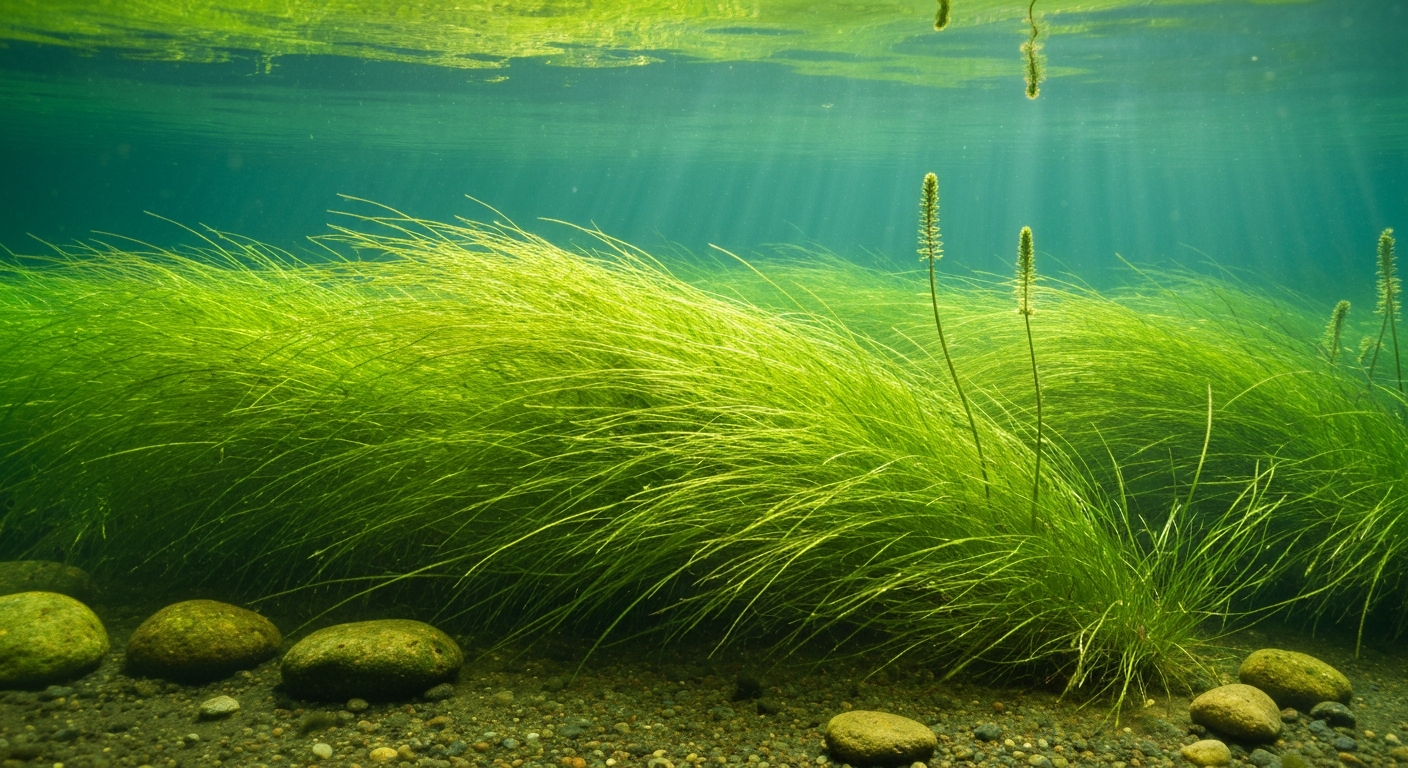
- Growth habit: forms dense, swaying underwater meadows rather than upright clumps
Common look-alikes to watch for
The biggest confusion is with other Potamogeton species, particularly P. pusillus (slender pondweed) and P. berchtoldii (Berchtold's pondweed). Both have narrow leaves but lack the strongly fused stipule sheath of S. pectinata. Widgeon grass (Ruppia maritima) shares similar brackish habitats and very narrow leaves but has distinctly different flower and fruit architecture. Hornwort (Ceratophyllum demersum) looks superficially similar in a tank but is rootless and has whorled, forked leaves. If you are buying material from a supplier and you want to verify, look at the stipule attachment point at the base of each leaf, that fused sheath is your confirmation.
What sago pondweed is good for (more than you might expect)
This plant pulls serious weight in multiple contexts. In wildlife ponds it is arguably the single most valuable waterfowl food plant in North America. Dabbling ducks, diving ducks, geese, swans, and shorebirds all consume the tubers, seeds, and shoots. The USDA Natural Resources Conservation Service has promoted it specifically as a wildlife habitat planting for that reason. In aquaria it provides dense cover for fry, shrimp, and shy fish while also processing nitrates efficiently through root uptake from the sediment. In garden ponds and water features it stabilizes soft sediments, reducing bank erosion and turbidity. For sustainable food producers, the dense biomass can be harvested and composted or used as a high-nutrient mulch.
- Wildlife pond: primary food plant for waterfowl (tubers, seeds, shoots), breeding and refuging cover for fish and invertebrates
- Aquarium: natural-looking background or midground plant, excellent biological filtration through sediment rooting, fry shelter
- Garden water feature: erosion control and sediment stabilization in shallow margins
- Brackish/estuarine setups: one of very few submerged macrophytes that performs in salinities up to about 6–9 ppt reliably (with provenance-matched stock)
- Sustainable growing: fast biomass producer suitable for green compost, biofilter media, or livestock forage supplement experiments
- Ecosystem restoration: used in Chesapeake Bay and other SAV restoration programs to re-establish submerged aquatic vegetation beds
Legal and ecological responsibilities before you plant
Here is the thing most beginner guides gloss over: sago pondweed is not invasive in regions where it is native (most of North America, Europe, and large parts of Asia), but it can behave invasively when introduced to water bodies outside its natural range or when it escapes contained systems in sensitive catchments. Some Australian states, for example, manage it as a concern in irrigation networks. Before you plant outdoors, spend ten minutes checking three things.
- Check your state or provincial noxious weed or aquatic invasive species list — search '[your state] aquatic invasive species list' or contact your local cooperative extension or equivalent agency
- Check whether your pond or water feature is hydrologically connected to a natural waterway — if runoff or overflow reaches a creek, stream, or lake, you need containment barriers or you need to choose a native alternative
- Check local permits — some jurisdictions require a permit to introduce any aquatic macrophyte to open water, even native species
For contained indoor aquaria and sealed backyard ponds with no watercourse connection, the risk is minimal if you manage plant waste responsibly. Never dump tank water, substrate, or plant trimmings into natural waterways or storm drains. Bag all removed material and dispose of it in household waste or compost. Rhizome fragments as small as a few centimeters can re-root if they reach suitable habitat.
Measurable parameter targets at a glance
| Parameter | Target range | Notes |
|---|---|---|
| Water temperature | 15–30°C (optimal 23–28°C) | Growth stops above ~37°C; dormancy below ~10°C |
| pH | 7.0–9.0 | Tolerates mild alkalinity well; below 6.5 growth slows |
| Water hardness (GH) | 5–20°dGH | Soft water acceptable; moderate hardness preferred |
| Light (PAR) | 50–100 µmol photons/m²/s | Low-light adapted; 12–16 h photoperiod in culture |
| Water depth (planting zone) | 20–150 cm | Best establishment 20–60 cm; survives to 6 m in very clear water |
| Water flow/current | <0.5 m/s optimal | Tolerates up to ~1 m/s; growth declines above that |
| Salinity | 0–9 ppt (provenance-dependent) | Some strains tolerate up to 16.5 ppt but growth declines above 6–9 ppt |
| Planting season (outdoor) | Late spring (water >10°C) | Northern hemisphere: April–June optimal |
| Harvest season (tubers/biomass) | Late summer–early autumn | Tubers mature as temperatures drop; shoots harvestable year-round in warm systems |
Equipment and materials checklist
What you need differs quite a bit depending on whether you are setting up a pond or an aquarium. Here is a practical breakdown for both scenarios. For a step-by-step setup and troubleshooting guide, see how to grow pond weed (c15052bd-c059-40f0-8a36-079c66e55602).
Outdoor pond setup
- Pond liner (EPDM rubber, 45 mil minimum) or preformed pond shell, minimum 150 cm deep in at least one zone
- Underlay fabric beneath liner to prevent puncture
- Pump and filter rated for the pond volume (recirculating flow, not river-like current)
- Loamy or clay-based topsoil or aquatic planting compost for substrate (avoid potting mixes with perlite or bark)
- Coarse sand or fine gravel (2–5 mm) for a 1–2 cm cap layer over the soil to reduce turbidity
- Planting crates or mesh baskets if you want to limit root spread
- Aquatic plant fertilizer tablets (slow-release root tabs, not liquid water-column fertilizer)
- pH test kit or digital pH meter
- GH/KH test kit
- Thermometer (submersible or floating)
- Plant scissors or aquatic pruning shears
- Predator/waterfowl exclosure netting for new plantings if birds are a concern
Aquarium setup
- Tank: 75 liters (20 gal US) minimum for a meaningful planting; larger is always better for stability
- Hang-on-back or canister filter with gentle output — strong powerheads create too much surface turbulence
- Aquarium substrate: 5–8 cm layer of nutrient-rich planted tank substrate (e.g., commercial aquasoil or a 2:1 mix of mineralized topsoil and coarse sand)
- Gravel cap (1–2 cm of fine gravel over the base substrate) to reduce cloudiness
- Full-spectrum LED light rated for planted tanks, ~50–80 PAR at substrate level (easy to achieve with mid-range planted LED fixtures at 20–30 cm height)
- Timer for consistent 12–14 h photoperiod
- Heater with thermostat (if ambient room temperature drops below 18°C)
- CO2 injection optional — sago pondweed grows fine without it but responds positively to supplemental CO2
- Root fertilizer tabs (insert near rhizomes, not dissolved in water column)
- Liquid all-in-one fertilizer for micronutrient supplementation (very low dose; sago pondweed is not a heavy water-column feeder)
- pH, GH, ammonia/nitrite/nitrate test kit or strips
- Plant scissors and long-reach aquascape tweezers
Planning your pond or tank: size, depth, placement, and density
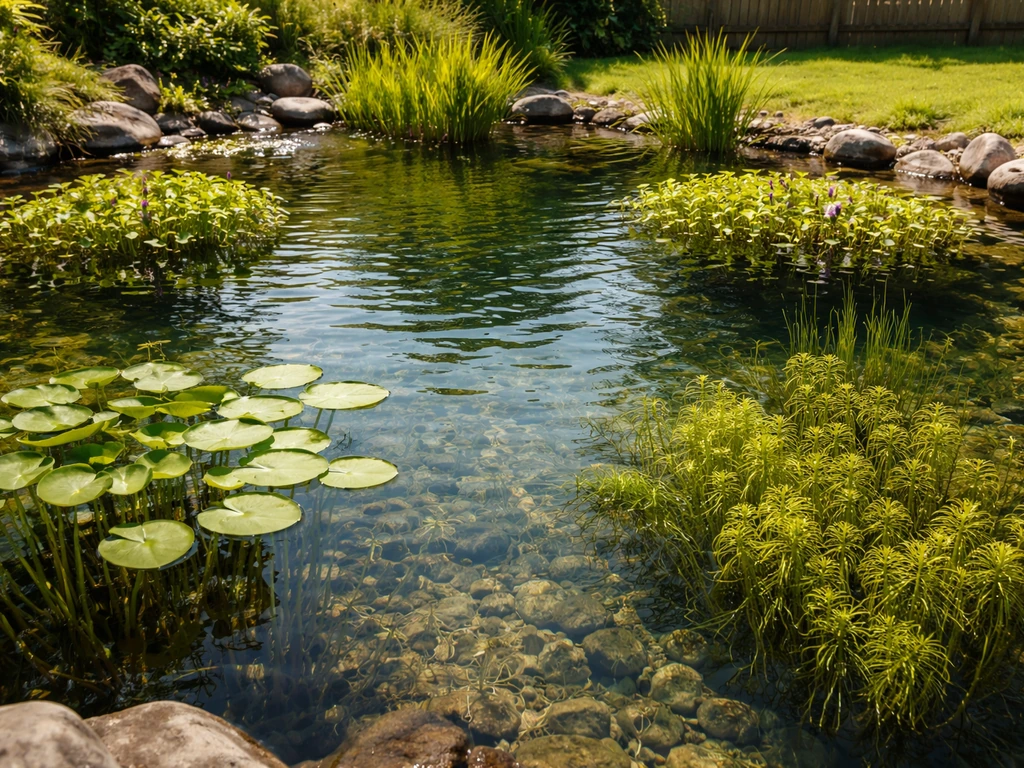
For an outdoor wildlife pond intended for waterfowl habitat, aim for a minimum surface area of 4–6 m² and a planting zone that stays 30–60 cm deep over at least half the area. Sago pondweed does not perform well in very deep, turbid ponds where light cannot penetrate to the sediment. If your water is naturally murky, it will need to clear before the plants establish. Position the pond in full or partial sun. The plants do not need blasting light but they will struggle in full shade under trees, and fallen leaves decompose to create anaerobic sediment that suppresses rooting.
For an aquarium, a 75–150 liter tank gives you enough room to establish a genuine planting bed that demonstrates the plant's natural growth habit. Deeper tanks (50 cm or more) let you grow taller shoots that look spectacular swaying in the gentle current. Place the tank away from south-facing windows in the northern hemisphere to avoid temperature spikes and algae explosions from direct sunlight.
Stocking density at planting: restoration literature uses transplant densities of roughly 25–64 shoots per square meter, and I have found the lower end (one shoot every 15–20 cm, forming a loose grid) works well for initial establishment with less competition stress between plants. Small-scale SAV restoration trials in Chesapeake Bay planted bare-root shoots and small potted units at densities of roughly 25–64 shoots·m−2, and reported that exclosures for predator and waterfowl protection substantially increased short-term survival Small‑scale SAV Restoration in Chesapeake Bay — SAV Restoration Manual (Chesapeake Bay Program / CBP SAV Working Group). Dense planting looks great immediately but the plants can mat out and shade each other's root zones within a single growing season if not managed.
Substrate, anchoring, and planting media
Substrate is where a lot of people go wrong. Sago pondweed is a deep-rooting, sediment-feeding plant. Its rhizomes can push down to roughly 1 m in soft mud in natural settings. If you plant it into clean washed gravel with no nutrition, it will survive in a stunted way but never thrive. Give it something to eat.
Recommended substrate options
| System | Substrate base | Depth | Cap layer | Fertilizer |
|---|---|---|---|---|
| Outdoor pond | Heavy clay-loam or aquatic planting compost | 10–15 cm | 1–2 cm coarse sand or pea gravel | Slow-release root tabs every 30 cm² at planting |
| Large tank (>150 L) | Commercial aquasoil or mineralized topsoil + coarse sand (2:1) | 6–8 cm | 1–2 cm fine gravel | Root tabs quarterly; trace liquid fert weekly at half dose |
| Small tank (<75 L) | Commercial planted-tank aquasoil | 5–6 cm | Optional thin gravel cap | Root tabs every 3–4 months |
| Contained pond basket | Aquatic basket compost or heavy loam | Fill basket to within 3 cm of rim | Thin gravel cap on surface of basket | One or two root tabs per basket at planting |
To prepare outdoor pond sediment: dig out the planting zone to the desired substrate depth, line with the clay-loam mix, firm it well to reduce floating, then add the sand or gravel cap before filling slowly. If you are retrofitting an existing pond, the best approach is to push rhizome sections or tubers 8–10 cm deep into the existing sediment using a dibber or gloved finger, then cap the disturbed area with a handful of pea gravel to anchor the sediment surface. This is much less disruptive than draining and re-laying substrate.
Propagation methods: seeds, rhizomes, tubers, and cuttings
There are four practical ways to propagate sago pondweed. Rhizome sections are the most reliable for backyard growers. Seeds (druplets) are used in large-scale restoration work but require patience.
Rhizome and tuber propagation (recommended for beginners)
Dig up a clump from an established plant or purchase rhizome sections from an aquatic nursery. Each section should be at least 5–8 cm long with at least one growth node visible. Tubers (the small fleshy oval structures on the rhizome) can be planted individually at 5 cm depth in moist substrate. Place them horizontally and they will send up a shoot within 2–3 weeks at 20°C or warmer. Rhizome sections with visible buds can be laid horizontally 5–8 cm deep and covered. I have also had good success just pushing a tuber into substrate with my thumb and covering it, low-tech works fine here.
Shoot cuttings
Take apical cuttings (the top 10–15 cm of an actively growing shoot) and push the cut end 4–5 cm into substrate. No rooting hormone needed. In warm water (22–26°C) with good light, cuttings will root and begin pushing new growth within 10–14 days. This is the fastest method for rapidly filling a tank or pond zone from a small starter plant.
Seed (druplet) propagation
Seed propagation is slower and needs some patience with temperate-origin material. Druplets often have a physical and physiological dormancy. Classic protocols from restoration literature suggest drying seeds in sediment for around three months, then storing them in cool water for up to 14 months before expecting reliable germination. Cold-water storage over winter (2–5°C) can break dormancy effectively for material from northern climates. For indoor growers in a hurry, seed propagation is not the best starting point. Stick with rhizomes or cuttings for your first grow and use seeds only once you have an established source plant to experiment with.
Step-by-step planting procedure
- Test your water: check pH (target 7–9), GH (5–20°dGH), temperature (above 15°C for outdoor; 20–26°C for aquarium), and ammonia/nitrite (both should be zero before planting into an aquarium)
- Prepare substrate: lay your soil or aquasoil layer to the recommended depth (see table above), firm it down, add the cap gravel, and fill the system slowly to avoid disturbing the bed
- Let the water settle: give a new outdoor pond 24–48 hours for the substrate to settle and the pump to run; give a new aquarium a full nitrogen cycle before planting (2–4 weeks with fish, or use a fishless cycling method)
- Prepare planting material: rinse rhizome sections or shoot cuttings in clean dechlorinated water to remove pests or algae; trim any dead or brown tissue cleanly with sterile scissors
- Plant at the right density: space individual shoots or rhizome sections 15–20 cm apart (roughly 25 plants per m²) in a loose grid; for aquarium planting, use long tweezers to push the base 4–5 cm into substrate without disturbing the cap layer
- Insert root tabs: place one slow-release root fertilizer tab every 15–20 cm within 5 cm of the planted rhizomes; do this at planting time and you will not need to re-dose for 3–4 months
- Protect new plantings: for outdoor ponds where waterfowl or koi could uproot new plants, drape a fine mesh exclosure net over the planting zone for the first 4–6 weeks until roots are well established; field trials have shown this substantially improves survival
- Monitor for the first two weeks: check that shoots stay anchored (re-push any that float loose), watch for cloudiness caused by substrate disturbance, and verify water parameters are stable
Routine care and feeding schedule
Sago pondweed is not high-maintenance once established, but it does reward a consistent routine. Here is what the schedule looks like for a typical aquarium setup. Scale timing for outdoor ponds based on your growing season.
| Frequency | Task |
|---|---|
| Daily | Check that light timer is running correctly; glance at plant color (healthy plants are mid to bright green) |
| Weekly | Trim any shoots that have reached the surface or are crowding neighbors; add trace liquid fertilizer at half the manufacturer's dose; check temperature |
| Monthly | Test pH, GH, nitrate; remove dead leaves and any algae accumulating on older foliage; assess overall coverage and thin if density exceeds roughly 60–70% of the planting zone floor |
| Every 3–4 months | Replace root tabs near established rhizome zones; thin rhizome spread if plants are pushing past intended boundaries |
| Annually (outdoor pond) | Divide overcrowded clumps in early spring before new growth begins; remove accumulated dead biomass from the pond floor before it drives down oxygen levels; inspect pond liner for root penetration if using containment baskets |
One feeding note from my own experience: I overdosed liquid fertilizer in an aquarium tank early on, thinking the plants would benefit from more nutrients in the water column. Within a week I had a filamentous algae explosion that outcompeted the young sago pondweed shoots. The plant prefers sediment nutrition from root tabs, not high water-column nutrient levels. Keep your water column lean and your root zone rich.
Controlling spread and containing rhizome growth
In a fertile pond or large aquarium, sago pondweed will try to colonize every available inch of sediment. The rhizomes are vigorous and will push under any loose substrate barrier. Containment baskets are the most practical solution for aquaria and small formal ponds: plant into mesh baskets filled with your substrate mix and sink the baskets into the pond floor or bury them in the substrate layer. The basket walls do not stop rhizomes forever but they slow spread to a rate you can manage with quarterly division. In ponds with a natural sediment floor, plan for significant spread and build annual division into your maintenance calendar rather than trying to stop it entirely.
Troubleshooting: common problems and fixes
| Problem | Likely cause | Fix |
|---|---|---|
| Shoots floating free, not rooting | Substrate too loose or coarse; cap layer disturbed | Re-plant deeper (5–6 cm) and add a heavier gravel cap; reduce water movement during establishment |
| Yellow or pale green leaves | Nutrient deficiency (iron or nitrogen most common); pH outside range | Add root tabs; check pH and adjust to 7–8.5; add trace element liquid fertilizer at low dose |
| Algae smothering leaves | Excess water-column nutrients or too much light | Reduce photoperiod to 10–12 h temporarily; cut back liquid fertilizer; increase plant density to outcompete algae |
| No new growth after 3+ weeks | Temperature too low (<15°C) or substrate anaerobic/compacted | Raise temperature; gently probe substrate for sulfur smell (rotten-egg indicates anaerobic zone); loosen and re-lay substrate if needed |
| Rapid die-off in outdoor pond | Waterfowl or fish uprooting plants before they establish | Install exclosure netting for 4–6 weeks post-planting; use deeper planting in heavier substrate |
| Stunted, sparse growth | Insufficient root nutrition; excessive current or turbulence | Add more root tabs; reduce pump output or redirect flow away from planting zone; check current does not exceed ~0.5 m/s |
| Plants growing out of control | Normal — this plant spreads aggressively in good conditions | Thin monthly; use containment baskets; harvest excess and compost |
| Brackish tank: plants dying back | Salinity above 9 ppt or using non-brackish-adapted provenance | Source provenance-matched brackish strain; keep salinity below 6–9 ppt; reduce salinity gradually if spiked |
Harvesting and using the plant
In aquaria and contained ponds, you will be harvesting purely to manage growth. Remove shoots with scissors, cutting at the base of the stem rather than pulling, which disturbs the substrate. In outdoor wildlife ponds, harvest timing matters: if you want to support waterfowl, leave the tubers and late-season shoots in place through autumn and winter so birds can forage on them. Tubers mature as water temperatures drop in late summer and early autumn. If you are harvesting biomass for composting or mulch, the best window is mid to late summer when plant mass is maximum but before the plants invest energy back into the rhizome system for winter storage.
Harvested shoots are high in organic matter and nutrients. They break down quickly in compost or can be laid directly as a mulch on garden beds. Do not add freshly harvested material to any natural waterway, storm drain, or even a water butt that drains outside your property.
Wildlife interactions: who will visit your sago pondweed
In an outdoor pond setting, sago pondweed will attract interest quickly. Dabbling ducks (mallards, teals, pintails) target the tubers and seeds. Diving ducks (scaup, canvasbacks, redheads) will dive for the submerged shoots and rhizomes. Swans use their long necks to reach the rhizomes in deeper water. In a fishpond, carp and tench will graze the shoots and disturb the rhizomes, which is worth anticipating: either exclude fish from the planting zone during establishment or expect that heavy stocking will strip the plants back faster than they can grow. Smaller fish (sticklebacks, native minnows, gudgeon) use the dense shoot beds as spawning and refuge habitat without causing the same damage. Invertebrates, including aquatic insects, snails, and in brackish systems certain amphipods, colonize sago pondweed beds quickly once the plant is established.
How sago pondweed compares to similar species you might consider
If you are deciding between sago pondweed and other submerged or marginal aquatics, the comparison below covers the species most likely to come up in your research. Growing general pondweed, pickerel weed, or pearl weed alongside or instead of sago pondweed are all legitimate choices depending on your goals. For care of the similarly named houseplant, see how to grow blue pearl chlorophytum.
| Plant | Growth habit | Light needs | Best use | Wildlife value | Invasive risk in cultivation |
|---|---|---|---|---|---|
| Sago pondweed (Stuckenia pectinata) | Fully submerged; dense filiform shoots; vigorous rhizomes and tubers | Low to moderate PAR (50–100 µmol) | Wildlife ponds, aquaria, brackish systems, SAV restoration | Very high (waterfowl tubers, seed, cover) | Moderate — spreads assertively, needs containment planning |
| General pondweed (Potamogeton spp.) | Submerged to floating-leaf depending on species; broader leaves on most spp. | Moderate to high | Mixed pond planting, native habitat gardens | High (similar to sago pondweed for many species) | Species-dependent; some broad-leaved spp. less aggressive than sago |
| Pickerel weed (Pontederia cordata) | Emergent marginal; upright spikes to 90 cm; heart-shaped leaves above water | High (full sun preferred) | Pond margins, pollinator gardens, rain gardens | Moderate (seeds eaten by ducks; cover for amphibians) | Low in native range; non-native planting should be checked locally |
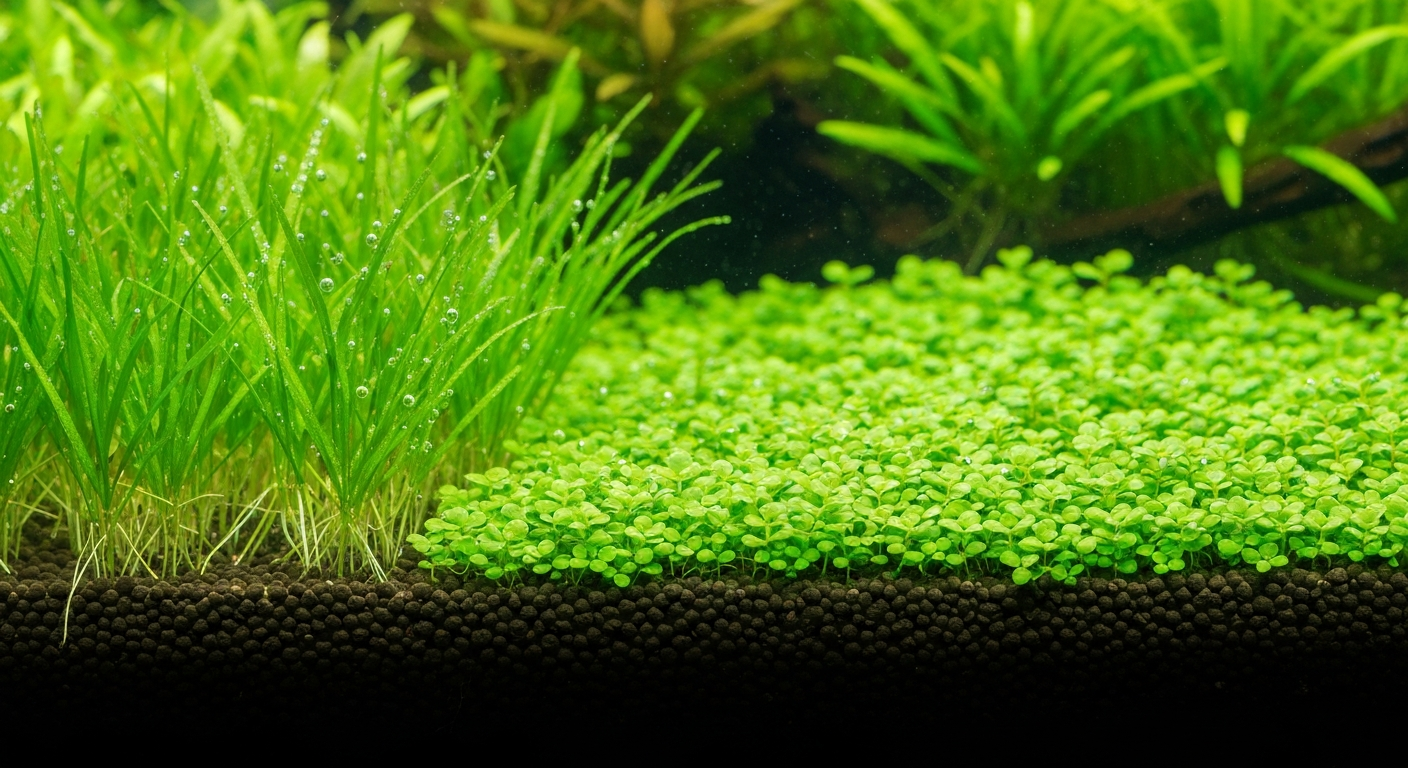
| Pearl weed (Hemianthus micranthemoides) | Fully submerged aquarium foreground plant; tiny paired leaves; low, spreading mat | High PAR (80–150+ µmol) | Planted aquarium foreground, nano tanks | Negligible (aquarium only, not wildlife pond context) | Low — does not establish outdoors in temperate climates |
The short version: choose sago pondweed if your primary goal is waterfowl habitat, native aquatic restoration, or a low-light submerged plant for a large pond or aquarium. Choose pickerel weed if you want emergent structure at the pond margin with pollinators in mind. For step-by-step guidance on establishing and caring for pickerel weed at the pond margin, see a short practical guide on how to grow pickerel weed (internal resource). Choose pearl weed if you want a fine-textured carpet plant in a high-light planted aquarium. For practical steps and care tips on how to grow pearl grass, see our guide on how to grow pearl grass. If you want detailed instructions on cultivating a dense carpet of pearl weed in a high‑light planted aquarium, see how to grow pearl weed. See our guide on how to grow freshwater pearls for cultivation details. General pondweed occupies a middle ground and is worth exploring alongside sago pondweed for mixed native plantings.
Final checklist before you start
- Confirmed sago pondweed is legal to grow in your jurisdiction and that your setup is not connected to a natural waterway (or you have a permit if it is)
- Water parameters tested and within target range (pH 7–9, temperature >15°C for outdoor planting, GH 5–20°dGH)
- Substrate prepared with a nutrient-rich base layer and a gravel cap
- Root fertilizer tabs on hand (sediment feeding is non-negotiable for good results)
- Planting material sourced: rhizome sections, tubers, or apical cuttings from a reputable nursery or an established controlled planting
- Exclosure netting ready if outdoor planting is at risk from waterfowl or large fish
- Light timer set to 12–14 h photoperiod for aquarium; outdoor system assessed for shade
- Maintenance tools ready: aquatic scissors, long tweezers, containment baskets for managed spread
- Waste disposal plan in place — all trimmings go to compost or household waste, never waterways
FAQ
What is sago pondweed and how do I identify Stuckenia pectinata reliably?
Sago pondweed (accepted name Stuckenia pectinata; synonym Potamogeton pectinatus) is a submerged aquatic macrophyte with threadlike, linear leaves 2–12 cm long and 0.2–1.5 cm wide, often with a distinct longitudinal groove. Leaves appear filiform and are attached with stipules fused to the blade. Reproductive spikes (flowers/fruit) project above the water on a stalk. Key ID tips: check leaf width and channeling, fused stipules, and the above-water spike; compare with regional pondweed keys to avoid confusion with other Potamogeton species.
Why would I grow sago pondweed — benefits and common uses?
Benefits: robust underwater cover for habitat, high-value food for waterfowl and fish, oxygenation and nutrient uptake in ponds, erosion control on soft bottoms, and potential use in sustainable food/wild-harvest systems (seeds/druplets eaten by birds historically). Uses: wildlife habitat beds, restoration of submerged aquatic vegetation (SAV), low-maintenance plantings in garden ponds and large aquaria, and research/cultivation for seed/tubers in small-scale systems.
What tank/pond sizes and depth ranges are suitable?
Ponds: shallow to moderately deep ponds are ideal—most success in depths 0.2–2.5 m; survives to greater depth only in very clear water. Small ornamental ponds and wildlife ponds (≥0.5 m depth with shallow margins) work well. Aquaria: larger tanks (≥40 L) are preferable for stable parameters; small tanks can work but plants will need frequent maintenance. Depth rules: ensure tips reach adequate light—plant where light at the bed is sufficient (see PAR target ~50–150 µmol·m−2·s−1 depending on strain).
What substrate and root conditions does sago pondweed prefer?
Substrate: flexible—mud, silt, sand, or mixed substrates all work. Best performance when rooted into organic-rich sediment with some fine material. Provide at least 5–10 cm of sediment over firm base for rhizome growth; deeper sediment (15–30 cm) supports robust rhizome/tuber formation. Nutrients are primarily taken from sediment, so localized root fertilizer (root tabs) is often more effective than water-column dosing.
What light, temperature, pH, hardness, and flow parameters should I target?
Light (PAR): aim 50–150 µmol·m−2·s−1 at the bed; 12–16 h photoperiod in culture. Temperature: dormancy breaks and shoots start near ~10 °C; optimal growth commonly 20–30 °C for many strains. pH: tolerant across ~6.5–8.5; neutral to slightly alkaline is fine. Hardness/salinity: freshwater to brackish—many strains tolerate 0–16 ppt salinity; expect growth decline above ~6–9 ppt for many provenances. Flow: best in low to moderate flow <1 m·s−1; survival possible in stronger flows but beds are less stable.
What equipment and supplies do I need to cultivate sago pondweed?
Basic equipment: planting trowel or dibble, substrate (mud/silt or aquatic planting soil), root fertilizer tabs, planting weights or mesh if used, fine-mesh protective exclosures (to exclude waterfowl), labeled planting stakes if in pond, aquarium lighting that provides PAR targets, thermometer, pH meter/test strips, KH/GH test kit, water flow control (pump), sieves or containers for holding propagules, and gloves. Optional: aquascaping tweezers for tanks, mesh trays for containment, sediment oxygen probes for research.