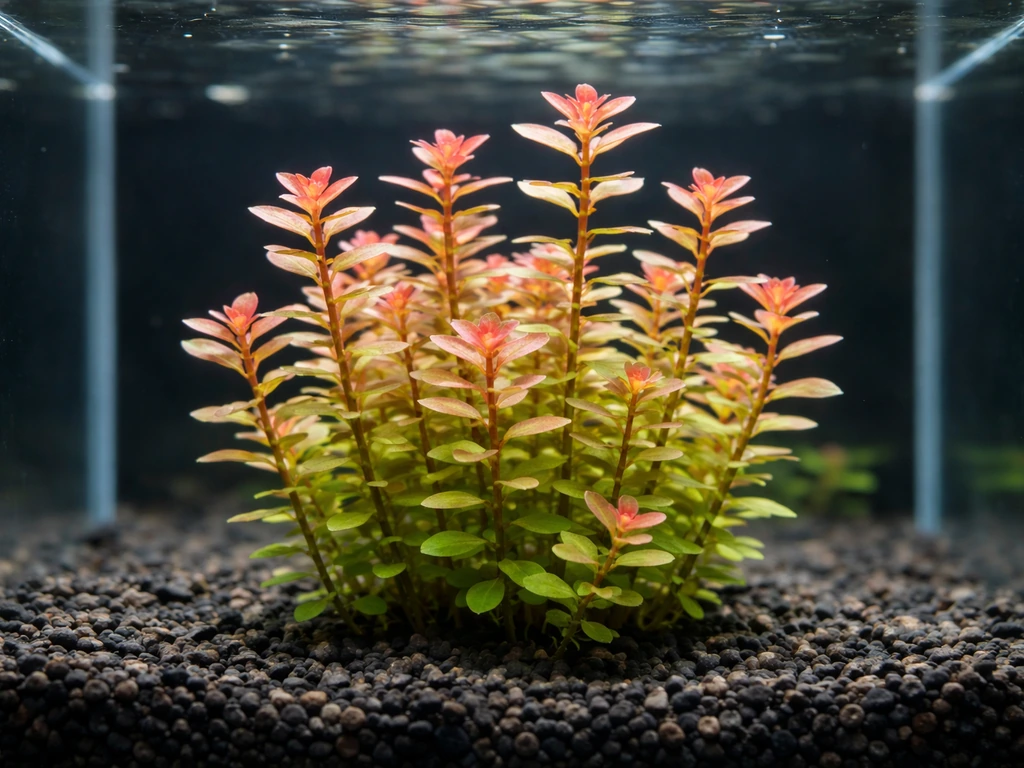
Rotala rotundifolia grows fast, stays healthy, and turns a gorgeous pink-to-red when you give it bright light, stable water parameters, consistent fertilization, and regular trimming. The core setup is straightforward: fine-grain substrate, blank" rel="noopener noreferrer">temperature between 20–28°C (68–82°F), pH 6.0–7.5, moderate-to-high light at 50+ PAR, CO2 at 20–30 ppm if you want fast growth and color, and a weekly trim routine to keep stems bushy rather than leggy. Get those five things dialed in and you'll have lush stems within a few weeks.
How to Grow Rotala: Step-by-Step Guide and Troubleshooting
Marcus Holloway
18 Jun 2026
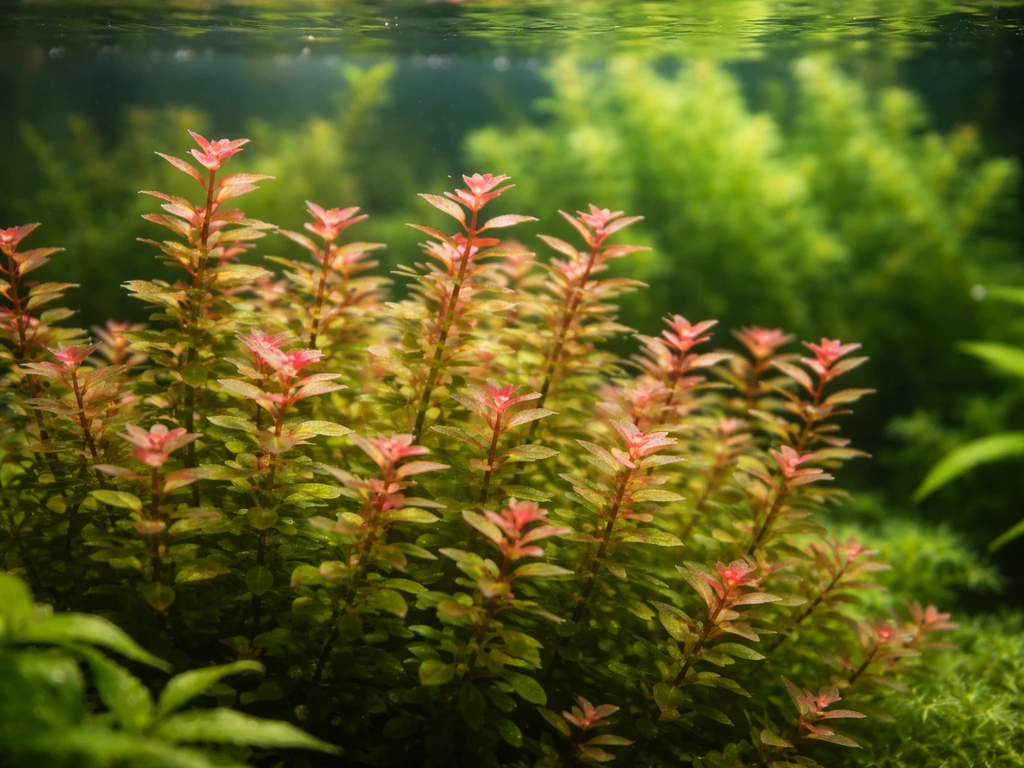
Picking your Rotala: tissue culture, potted, or emersed
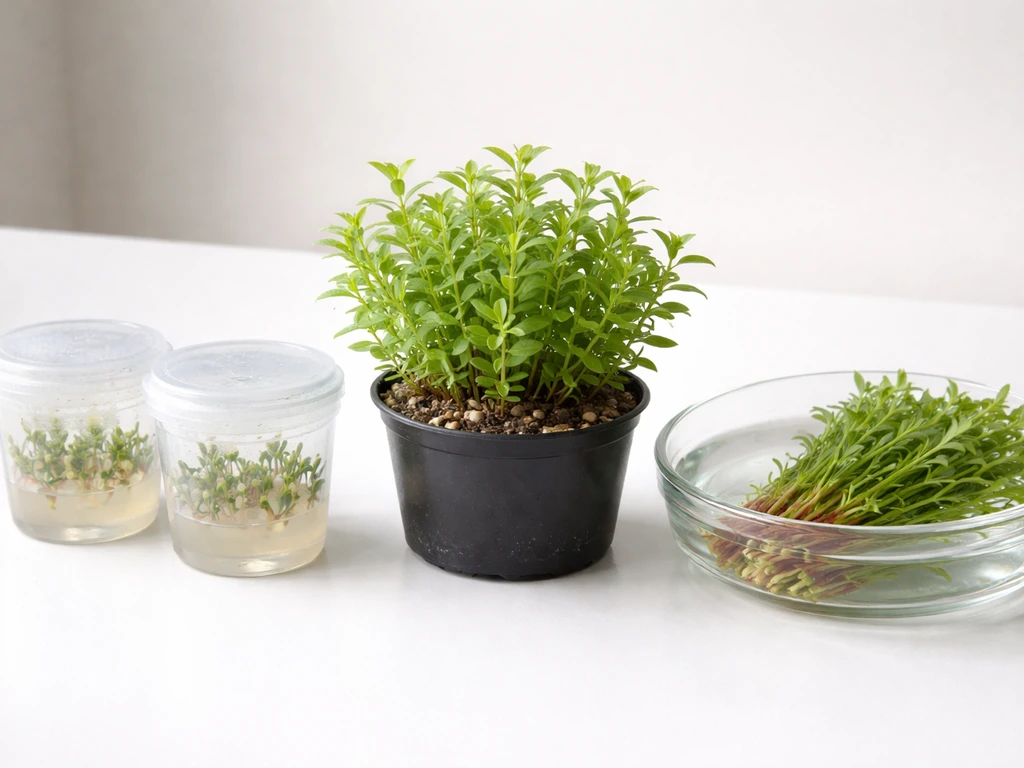
You'll usually find Rotala rotundifolia in three forms at a fish store or online: tissue culture cups (lab-grown, gel-packed), potted plants grown emersed, or loose stems already grown submerged. Each has a slightly different acclimation experience, and knowing what you're buying saves you a lot of confusion in the first two weeks.
Tissue culture cups are grown in a sterile, germ-free environment, so when you drop them into an aquarium full of bacteria and biofilm, they need time to build up tolerance. Expect some minor melt or yellowing on early leaves while the plant adjusts. The upside is that a single cup often contains more plant material than a potted bunch, which makes it economical if you're doing a mass planting or trying to cover a background quickly.
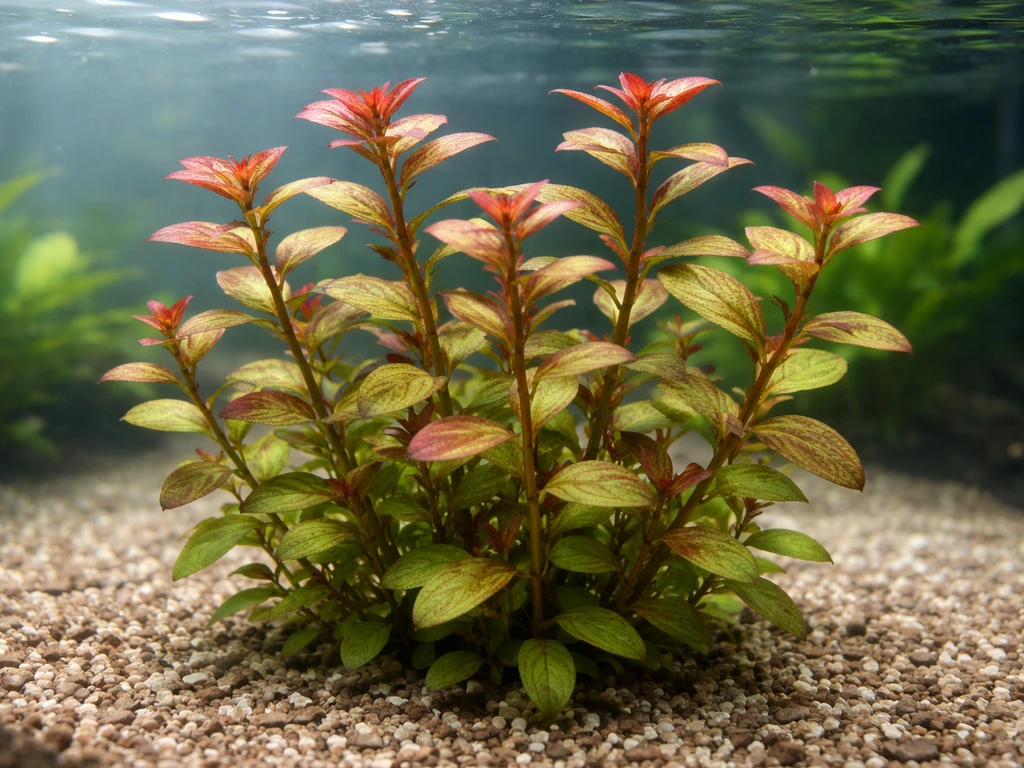
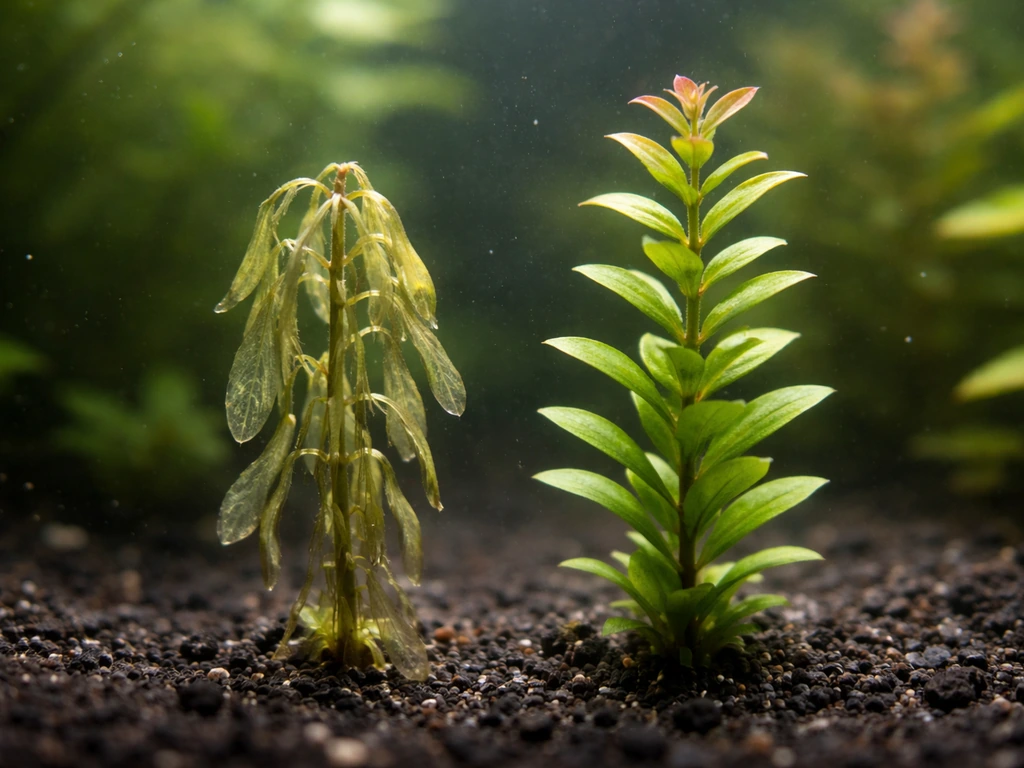
Potted emersed plants (the rock-wool bunches with rounded leaves) are the form most people start with. These can look lush and full on day one, but the emersed leaves literally cannot function underwater. Rotala rotundifolia grows rounded leaves in air and narrower, lanceolate leaves when submerged. That means the existing leaves will melt off over a 4–6 week window while the plant puts out new submerged growth from the stem nodes.
This is completely normal. The stems survive, new growth pushes out, and you'll see proper aquatic leaves forming within 2–3 weeks if conditions are good. If you are wondering are loofahs easy to grow, start by choosing the right structure and giving the vines plenty of sunlight and space to climb leafy. Don't pull the plant in frustration during this window.
If you want to skip the melt phase entirely, source stems that are already growing submerged. They'll acclimate in days rather than weeks. Alternatively, if you're setting up a dry-start or Wabi Kusa style tank, emersed potted plants actually have an advantage because they're already adapted to above-water growth and will transition on your timeline when you flood the tank.
Tank setup and water parameters
Rotala isn't overly demanding about water chemistry, but it does have a sweet spot. Outside that range, growth slows down and you start chasing problems instead of results.
Substrate
Use a fine-grain substrate, ideally an active aquasoil (like ADA Amazonia, Fluval Stratum, or similar) at 3–5 cm depth. Aquasoil buffers pH downward naturally, which lands you in Rotala's preferred range, and the fine grain makes planting and rooting easier. Plain gravel or coarse sand works but you'll rely more on water column dosing since there's less nutritional reserve at the roots.
Temperature, pH, and hardness
| Parameter | Target Range | Notes |
|---|---|---|
| Temperature | 20–28°C (68–82°F) | Stay within this range; extremes slow growth |
| pH | 6.0–7.5 | Lower end (6.2–6.8) favors nutrient uptake and color |
| GH (general hardness) | 4–12 dGH | Soft water preferred; very hard water limits uptake |
| KH (carbonate hardness) | 0–6 dKH | Low KH pairs well with CO2 injection |
| CO2 | 20–30 ppm (30–35 for peak growth) | Strongly recommended; fish respiration only gives 3–5 ppm |
CO2 and filtration
CO2 is technically optional but practically transformative. Fish respiration alone contributes only about 3–5 ppm of dissolved CO2, which is nowhere near enough for fast, compact growth or vivid pink-red color. Aim for 20–30 ppm with a pressurized system and a drop checker for confirmation. If you're running a high-demand setup with intense light, pushing to 30–35 ppm is reasonable. The key is consistency: CO2 swings (especially turning it off at night without a solenoid timer) cause more melt and stress than a slightly lower steady-state level does.
For filtration, you want decent flow but not a current that whips your stems sideways. A canister or hang-on-back filter sized for 5–10x turnover works well. Avoid strong surface agitation when you're injecting CO2 since it degasses the tank. A spray bar angled at the glass rather than the surface keeps the water moving without blowing off your CO2.
Lighting and photoperiod
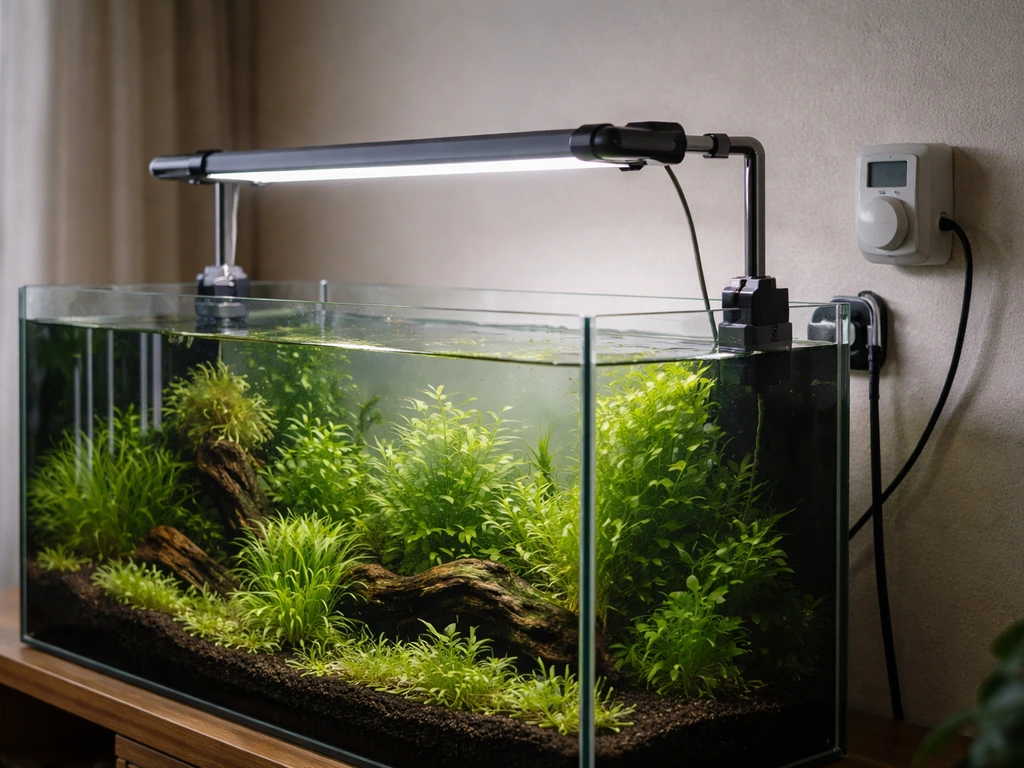
Light drives everything for Rotala. Too little and the stems grow leggy and pale, reaching upward instead of filling out. Too much light with unbalanced nutrients and you'll be fighting algae constantly. The sweet spot is at least 50–70 PAR at the substrate level where your stems are planted, delivered in a controlled daily schedule.
A photoperiod of 7–8 hours per day is the practical target for most setups. Go no longer than 9 hours, especially early in the tank's life. I've had the best results with a midday window: lights on at 11am, off at 7pm. This gives a predictable daily cycle without pushing algae-triggering excess. If algae is already a problem, drop back to 6–7 hours and fix the nutrients first before adding more light time.
Rotala's pink and red color comes from anthocyanin production, which is triggered by high light intensity. If your stems are green when you want red, the first thing to check is PAR at plant level, not just the light rating on the fixture. A cheap PAR meter (or borrowing one from your local aquarium club) tells you exactly what the plant is receiving, not what the light spec sheet claims.
Planting technique and propagation
How to plant stems correctly
Use aquascaping tweezers. Strip the bottom 2–3 cm of leaves from each stem so you're inserting a bare section into the substrate. Push the stem in at a slight angle to a depth where the leafless portion is fully buried. This prevents the buried leaves from rotting and anchors the stem so flow won't pull it out. Don't press straight down because the substrate tends to pop the stem back up when you release the tweezers.
Plant stems in groups of 5–7, spaced about 2–3 cm apart within each group. Groups can be spaced further apart depending on your layout, but tight within-group spacing is what creates the dense, bushy look. Each cutting should have at least three nodes because that gives it multiple points to branch from and root into.
Propagation by cuttings
Rotala propagates entirely by stem cuttings. There's no complicated process here: cut the top 5–10 cm of a healthy stem just above a leaf node with sharp scissors, replant the cutting into the substrate, and the remaining stub will branch from the node you cut above. This is how you turn one stem into many and build the bushy, layered look that makes Rotala so satisfying in a scape.
When you trim, cut just above a leaf node (not between nodes) and replant the healthy tops. Discard or compost the woody lower portions once the base gets too leggy or bare. Keeping 5–10 cm of stem above the substrate after each trim gives the remaining plant enough leaf area to continue photosynthesizing while new side shoots form. Aquasabi’s trimming guidance for stem plants recommends cutting group plants or stem clusters back to about half their original size when they grow too long, and trimming just above the previous dark green cut region cut group plants or stem clusters back to about half their original size.
Fertilization and nutrient dosing
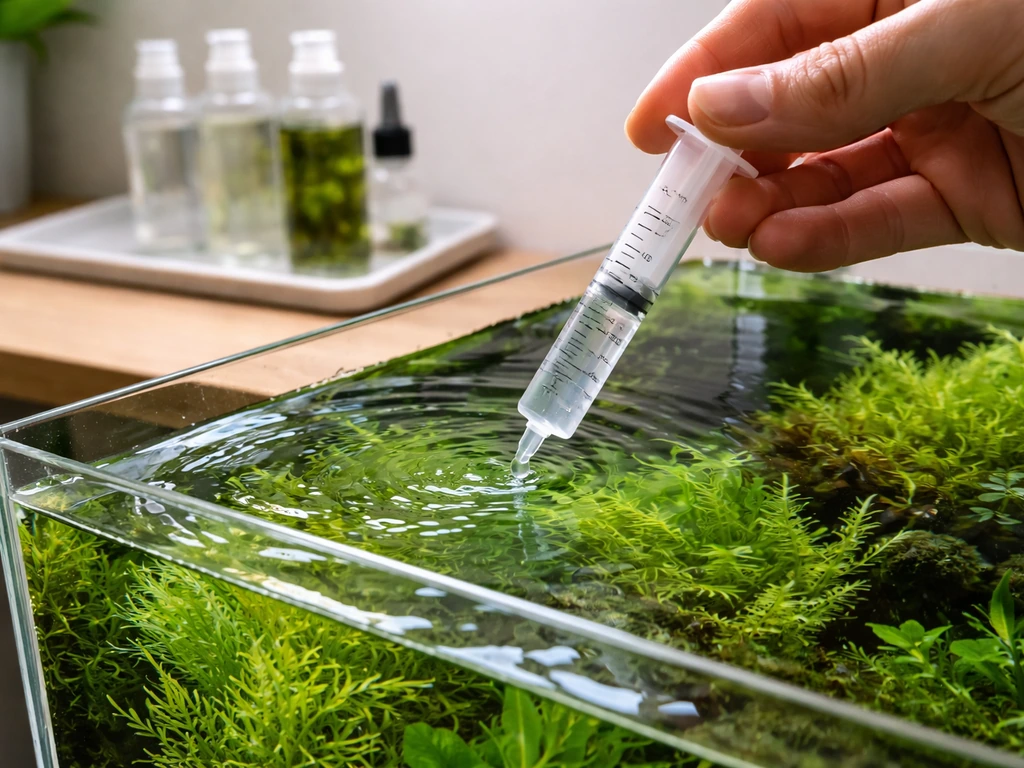
Rotala rotundifolia is primarily a water column feeder. Its fine root structure can absorb nutrients from substrate, but the bulk of its nutrition comes from the water around the stems. This means water column dosing is your main tool, and root tabs play a supporting role at best.
Macros: nitrogen, phosphorus, potassium
For a standard planted tank with CO2, target nitrate (NO3) around 20–30 ppm, phosphate (PO4) around 1–3 ppm, and potassium (K) around 10–20 ppm. If you want to push Rotala toward deeper red coloration, you can experiment with keeping nitrate below 5 ppm, since excess nitrogen tends to keep the plant green. That's a useful color hack, but go too low on nitrogen and you'll see yellowing and stunted growth, so it's a balance. I'd get the plant healthy and growing first before dialing back nitrate for aesthetics.
Micros: iron and trace elements
Iron is critical for Rotala's color and healthy leaf development. Dose a comprehensive liquid micronutrient fertilizer 2–3 times per week and keep iron above 0.05 ppm in the water column. Low iron shows up first as pale or yellowing new growth (interveinal chlorosis), which is easy to confuse with nitrogen or potassium deficiency, so test before assuming.
Root tabs vs water column: the honest answer
Root tabs help if you're using inert substrate like gravel or plain sand and have little nutritional buffer. Push one tab near each planting group every 2–3 months. But if you're using aquasoil and dosing the water column consistently, root tabs are secondary. Don't skip water column dosing thinking root tabs cover everything. They don't, especially for a stem plant that feeds heavily through its leaves and nodes.
Dosing methods
Estimative Index (EI) dosing is a reliable method for beginners because it uses predictable salt doses (KNO3, KH2PO4, K2SO4 for macros; a chelated trace mix for micros) on alternating days with a large weekly water change to reset. It takes the guesswork out of testing and keeps nutrients available without building up to toxic levels. Commercially bottled all-in-one fertilizers (like Seachem Flourish Comprehensive or similar) work for low-tech setups but may need supplementation if you're running CO2 and high light.
Common problems and how to fix them
Melting after planting
This is the most common panic moment, and it's almost always expected. Emersed-grown plants will lose their existing leaves when submerged. Tissue culture plants may melt slightly from bacterial exposure. The fix is patience and stable parameters. For how to grow Riccia fluitans, you’ll want to focus on bright light, calm water, and careful nutrient and CO2 balance to support healthy thalli. Don't change CO2 levels, temperature, or pH suddenly. Keep the lights consistent, dose nutrients, and let the stems push new submerged growth. Remove any rotting leaves promptly to prevent bacterial spread and algae on the decaying matter.
Algae outbreak
Algae and Rotala problems almost always come in pairs. The usual causes are too much light for the nutrient load, CO2 fluctuations, or a sudden large trim that removes too much plant mass at once. When you trim aggressively, you remove a huge portion of your tank's nutrient-consuming biomass. The nutrients don't disappear, so algae grabs them. Fix this by trimming more gradually (no more than 30–40% of plant mass at one session), reducing photoperiod to 6–7 hours temporarily, and keeping CO2 steady. Don't skip water changes during an algae outbreak.
Slow or stunted growth
If Rotala is barely growing after 3–4 weeks in a stable tank, check in this order: CO2 level (is it actually reaching 20+ ppm?), light intensity at substrate level (50+ PAR?), then nutrient levels. Slow growth in decent light and CO2 usually points to a macro deficiency, most commonly nitrogen or potassium. Yellowing old leaves that progresses upward suggests nitrogen. Marginal scorching or browning on older leaves suggests potassium. Add the relevant macro and watch for response within 5–7 days.
Pale or green stems (no red color)
Green Rotala in low light is normal. If you want the pink-red look, you need higher light intensity (70+ PAR), consistent iron and trace dosing, and optionally reduced nitrate. If you’re wondering whether is ludwigia easy to grow, it generally does well when you give it strong light and consistent nutrients like other fast-growing stem plants. Don't reduce nitrate without first confirming the plant is otherwise healthy and growing well.
Stem dieback at the base
Lower stems losing leaves and turning woody or black is normal as the plant ages, especially in dense groups where lower portions are shaded out. The fix is the trim-and-replant cycle: cut the healthy tops, replant them, and discard the depleted bases. Don't try to rescue a completely bare, woody stem base expecting it to bounce back.
Building bushy stems and keeping them that way
The secret to a lush Rotala background is treating trimming as a propagation tool rather than just maintenance. Every cut above a node creates two or more new growth tips from that node. Cut once, get two branches. Cut those again, get four. Within a month of consistent weekly trimming and replanting the tops, a single initial group of 7 stems can become a dense cluster of 30+ stems.
Under high light with CO2, trim weekly. If you want a similar kind of consistent growth with aquarium sponges, keep conditions stable and maintain regular cleaning to prevent clogging trim weekly. Under moderate light without CO2, trimming every 2–3 weeks is usually enough. Always cut just above a node with sharp, clean scissors. Replant the cuttings immediately at 2–3 cm spacing. The cut stub will branch from the node left behind, and the replanted top will root and grow from its base nodes. That double-multiplication is what fills a tank fast.
For water changes, do 30–50% weekly if you're running CO2 and EI dosing. This removes any nutrient buildup, resets TDS, and keeps parameters stable. Consistency here is more important than the exact percentage. A tank that gets a 40% change every 7 days beats one that gets a 70% change every 3 weeks in terms of stability and plant response.
Your practical setup checklist
- Choose your start form: tissue culture for mass planting, emersed potted for dry-start, pre-grown submerged stems for fastest acclimation.
- Set substrate to 3–5 cm fine-grain aquasoil or active substrate.
- Dial in temperature at 22–26°C and pH at 6.2–7.0 before planting.
- Install CO2 with a drop checker and solenoid timer; target 20–30 ppm during the photoperiod only.
- Set lights to 7–8 hours per day at 50–70+ PAR at substrate level.
- Plant stems in groups of 5–7 at 2–3 cm spacing, bare section buried, using tweezers at a slight angle.
- Start water column fertilization immediately: macro salts or all-in-one ferts 2–3x per week, micro/trace on alternating days.
- Do 30–50% water changes weekly.
- Trim weekly once stems reach the surface; replant tops, discard bases.
- During first 4–6 weeks, expect emersed leaf melt and resist the urge to change parameters mid-acclimation.
Rotala rotundifolia is genuinely one of the most rewarding stem plants to grow once you understand its rhythm. It's faster to fill in than something like riccia fluitans and more forgiving with parameters than many red plants. Get the light, CO2, and trim routine consistent, and within 6–8 weeks you'll have more cuttings than you know what to do with. For a different plant with a similar “grow, harvest, and keep it thriving” mindset, see our guide on how to grow luffa sponge.
FAQ
How long does it usually take rotala to start looking good underwater after planting?
If you start with emersed-grown rotala, expect an adjustment period where older leaves shed, then new submerged growth becomes obvious within about 2 to 3 weeks. Growth that stays stalled beyond 3 to 4 weeks usually means the plant is not getting enough light at the substrate, CO2 is not actually reaching target levels, or the nutrient balance is off.
Do I need CO2 to grow rotala successfully?
No, rotala can survive without injected CO2, but it will usually grow slower and stay greener unless light and nutrients are tuned carefully. If you do use CO2, prioritize stable delivery during the photo period (not just the daily setting), because on-off swings can trigger extra leaf melt.
What PAR reading should I aim for when troubleshooting color and growth?
Aim for at least 50 PAR at the substrate where the stems are rooted, and for stronger pink-red, closer to 70 PAR or more is often needed. If your fixture says it is “high output” but the plant-level PAR is low, the plant will stay green even when nutrients are correct.
My rotala is turning green, what should I adjust first?
Check light at plant level first, then verify iron and overall trace dosing before changing macros. After that, consider lowering nitrate only if the plant is already growing well, because driving nitrate too low can cause pale or stunted growth that looks like a nutrient deficiency rather than “better color.”
Can I use root tabs instead of water-column dosing?
Root tabs help more with inert substrates, but rotala is mainly a water-column feeder. If you rely mostly on tabs, you may see initial vigor followed by slower growth and weaker color, especially under high light. A practical approach is tabs for insurance, while keeping water-column nutrients consistent.
How can I tell whether my issue is nitrogen or potassium when rotala looks unhealthy?
Look at where the symptoms start. Yellowing that begins on older leaves and moves upward often points to nitrogen shortage. Browning or marginal scorching on older leaves is more consistent with potassium limitation. Still confirm with tests, because low iron can also mimic other deficiencies through pale new growth.
Is it normal for rotala to melt after trimming or replanting?
Some minor melting can happen after replanting, especially if you handle stems roughly or bury leaf material so it rots. After a normal weekly trim-and-replant, you should see new shoots within days and faster branching over the next week. If you see large decay, remove rotting leaves promptly and improve how deep you plant the leafless portion.
How aggressive can I be when trimming rotala without causing algae?
Avoid removing too much biomass at once. A good safety limit is trimming no more than about 30 to 40 percent of the plant mass in a single session, then return to normal weekly trimming. After a big harvest, reduce photoperiod temporarily (often to 6 to 7 hours) and do not skip water changes.
Why does my rotala die from the bottom, especially in dense clumps?
Shading and older tissue being starved of light can make lower stems go woody, lose leaves, and eventually break down. The fix is not “rescuing” the bare base, it is the trim-and-replant cycle: cut healthy tops above nodes, replant them, and discard depleted sections.
Should I clean my filter or reduce flow when rotala struggles?
Usually rotala benefits from decent circulation, but you should avoid strong currents that whip stems sideways. If you reduce flow to “help” the plant, you can worsen gas exchange and CO2 distribution, which may make symptoms worse. Instead, aim for strong but gentle turnover, and if you inject CO2, minimize surface agitation to limit CO2 degassing.