Yes, Ludwigia is genuinely easy to grow, especially if you start with Ludwigia repens. It tolerates low light, a wide temperature range, and does not need CO2 injection to survive and look good. That said, not every species in the Ludwigia genus is equally forgiving, and a few specific mistakes trip up beginners almost every time. If you can hit the right light level, keep your water parameters in a reasonable range, and plant the stems correctly, you will have a thriving plant within two weeks.
Is Ludwigia Easy to Grow? Complete Beginner Guide
Marcus Holloway
19 Apr 2026
Quick verdict: how easy is Ludwigia to grow?
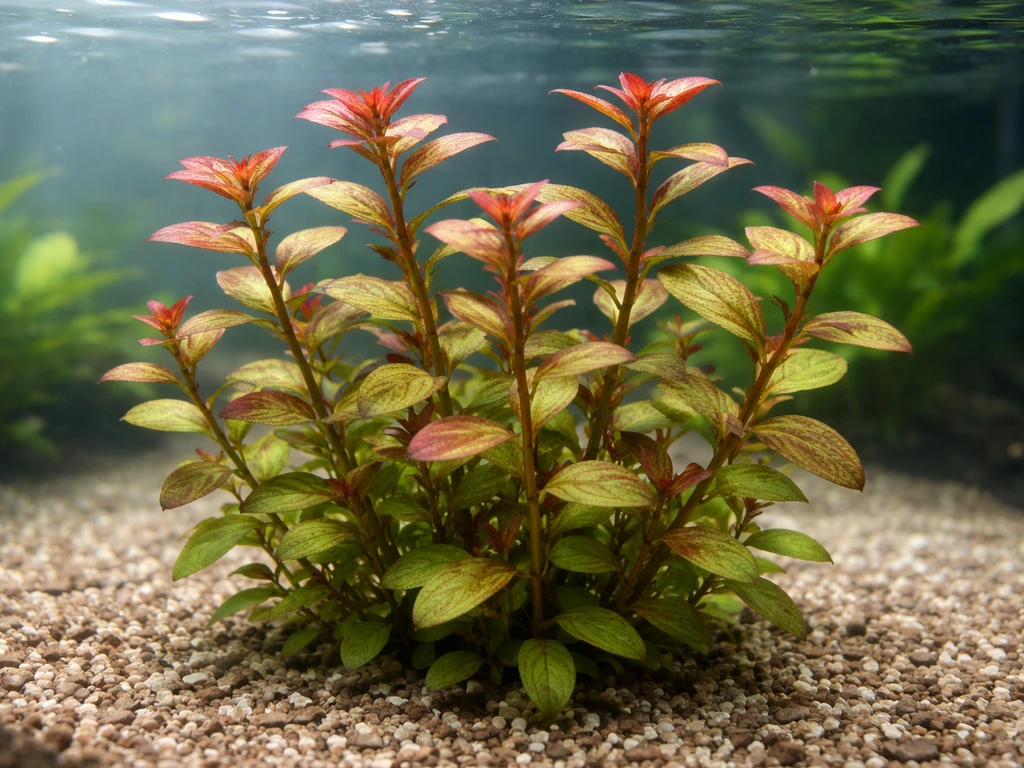
Ludwigia repens sits at the beginner-friendly end of red aquarium plants. It grows well at around 0.4 W/L of light, does not demand CO2 injection, and tolerates temperatures anywhere from about 4 to 28 °C (39 to 82 °F), which means it fits into almost any tropical or temperate setup. That broad tolerance is the main reason it is recommended so often for new planted tanks. If you want a more hands-on comparison for another beginner-friendly project, you can also look at how to grow sponges for a totally different propagation mindset.
The other common species vary more. Ludwigia palustris (medium light, 0. B-Aqua also cautions that Ludwigia palustris tolerates prolonged immersion poorly when temperatures exceed about 22, 23°C and when lighting is insufficient. 5 W/L, CO2 of 6 to 14 mg/L recommended), Ludwigia arcuata (strong light, benefits from CO2), and Ludwigia glandulosa (low light demand but color-sensitive) each have their own sweet spots. If you are just starting out, begin with repens and add other species once you understand how your system behaves.
| Species | Light Demand | CO2 Required? | Temperature Range | pH Range | Difficulty |
|---|---|---|---|---|---|
| L. repens | Low (~0.4 W/L) | No | 4–28 °C (39–82 °F) | 6.0–7.5 | Beginner |
| L. palustris | Medium (~0.5 W/L) | Beneficial (6–14 mg/L) | 18–28 °C | 6.0–7.5 | Beginner–Intermediate |
| L. arcuata | High | Yes (benefits strongly) | 20–28 °C (72–82 °F) | 5.5–7.5 | Intermediate |
| L. glandulosa | Low–Medium | No (but helps color) | 22–25 °C (optimal) | 5.0–7.0 | Beginner–Intermediate |
Best setup: water parameters, light, and planting method
Water parameters
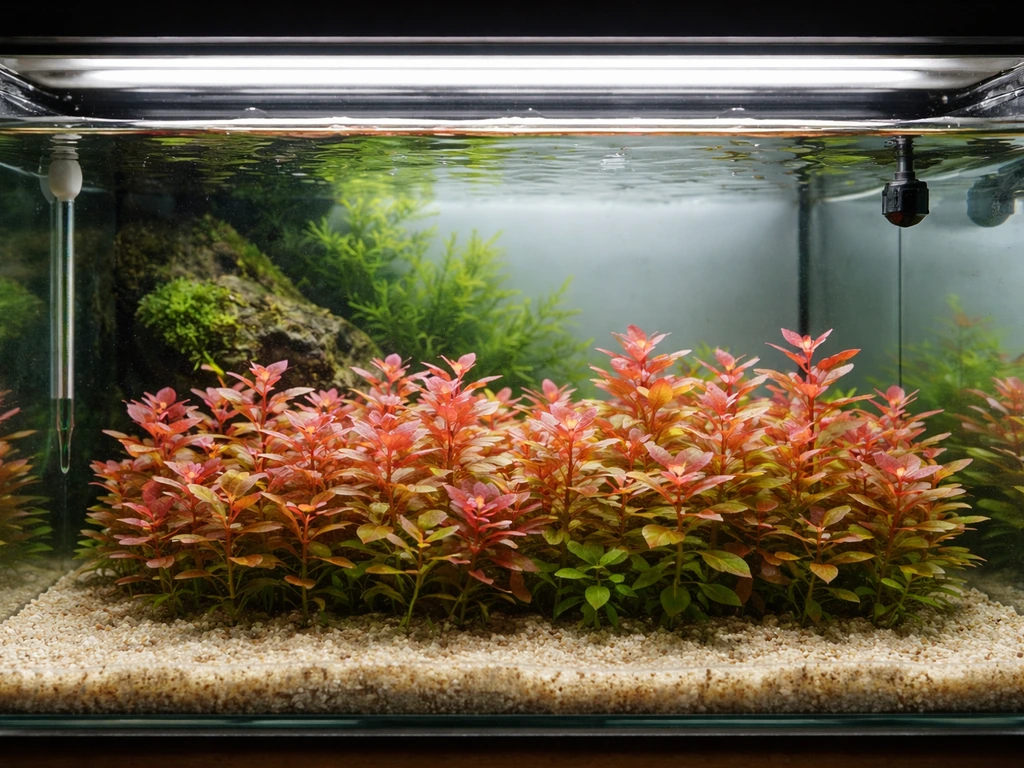
For Ludwigia repens, target a pH of 6.0 to 7.5 and a temperature of 22 to 28 °C (72 to 82 °F). Those are the practical sweet spots, even though the plant will technically survive outside those ranges. For glandulosa, pull pH slightly lower, ideally 5.0 to 7.0, and keep temperatures around 22 to 25 °C for the best coloration. Soft to moderately hard water works for most species. You do not need RO water, but very hard, alkaline tap water will suppress the red pigmentation and slow growth.
Light and photoperiod
For repens, 0.4 W/L is enough and a photoperiod of 8 to 10 hours per day is ideal. More than 10 hours without adequate nutrients and CO2 invites algae, which is one of the most common beginner mistakes I see. For arcuata, you need strong light and CO2 injection to stop it from going leggy or losing lower leaves. Glandulosa is tolerant of lower light but will produce pale, underwhelming color without at least moderate intensity. A simple rule: match your light level to the species, do not just crank it up hoping for faster growth.
How to plant Ludwigia
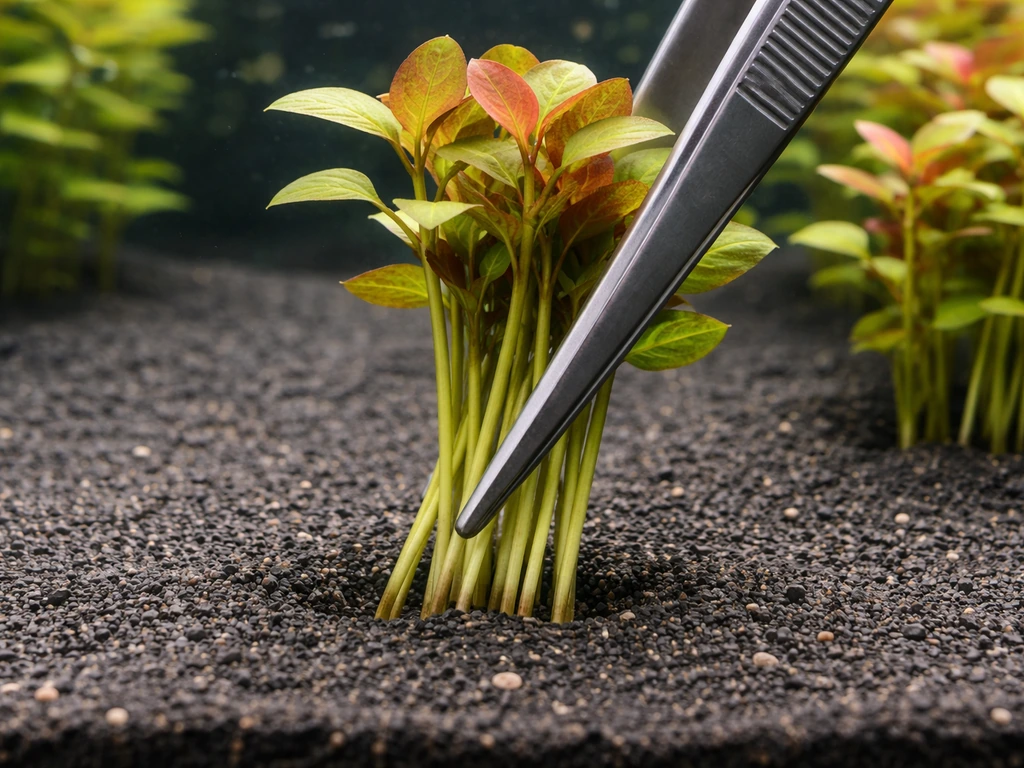
Ludwigia is a stem plant, so planting technique matters more than most people expect. If your stems came with a ceramic ring or a bundle tie, remove it along with any lower leaves that would be buried in the substrate. Strip the bottom 2 to 3 cm of leaves, then insert each stem at a slight angle into the substrate so the substrate weight helps anchor it and reduce buoyancy. Planting straight down in fine substrate works too, but the angle trick from Aquasabi is genuinely useful when roots are minimal. A fine-to-medium grain substrate (2 to 3 mm grain size) holds stems better than coarse gravel.
For emersed or semi-aquatic setups, Ludwigia palustris in particular is commonly grown in an emergent form and handles high humidity and wet substrate very well. In a paludarium or riparium, plant stems directly into a moist, nutrient-rich substrate and keep them consistently moist. Emersed growth tends to be bushier, the leaves are often more compact, and the plant will flower given enough light. The care logic is similar to the aquarium version: good light, consistent moisture, and regular trimming.
Water column vs substrate care: roots, stems, and propagation
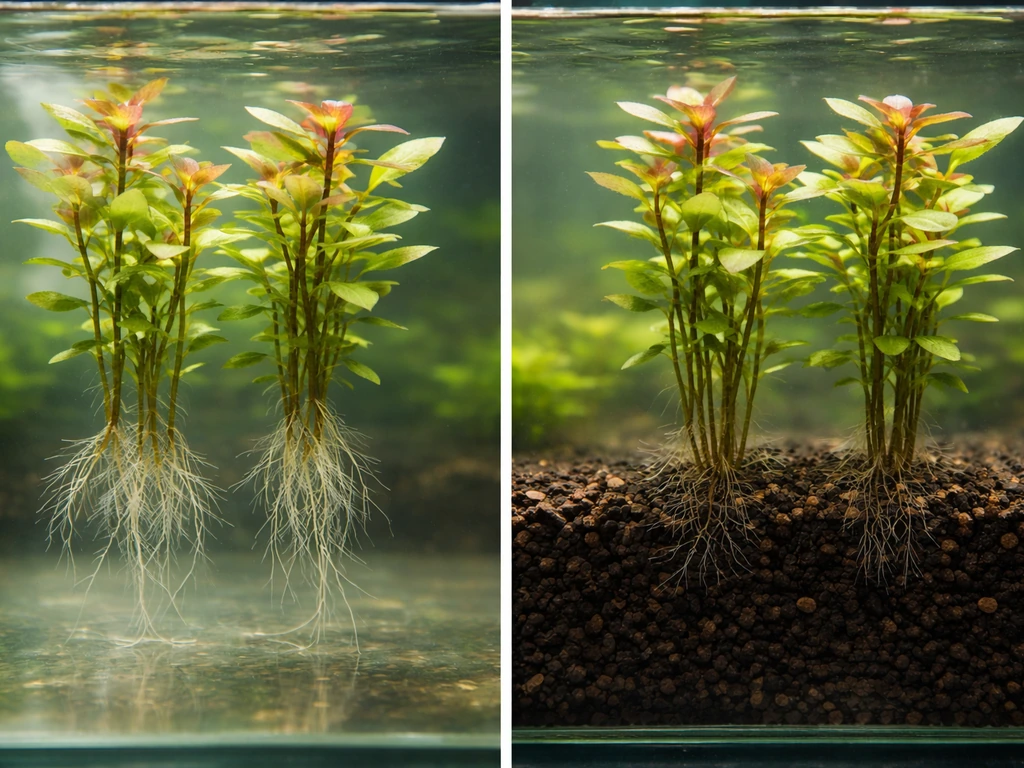
Ludwigia absorbs nutrients through both the water column and its root system. In a tank with a rich substrate (like an active soil or capped nutrient substrate), root uptake does a lot of the heavy lifting. In a bare-bottom tank or hydroponic setup, liquid fertilization of the water column becomes more important. Either approach works, but you need to pick one and commit. Deficiencies show up faster in lean systems when liquid dosing is inconsistent.
The stems themselves are where most of the action happens. Ludwigia grows from the top (apical growth), so the lower stems gradually lose leaves and can look bare over time if you never trim. This is normal, not a sign of disease. The fix is regular pruning, which also triggers lateral branching and gives you a fuller, denser plant.
How to propagate Ludwigia from cuttings
- Choose a healthy stem that is at least 8 to 10 cm long with several intact leaf nodes.
- Cut just below a leaf node using clean scissors or a blade.
- Remove the bottom 2 to 3 leaves so you have a clean section of bare stem to insert into the substrate.
- Plant the cutting at a slight angle in the substrate to anchor it, or attach it temporarily to a piece of driftwood or hardscape with a rubber band until roots develop.
- Under good conditions (stable temperature, adequate light, nutrients present), new root and shoot growth typically appears within 1 to 2 weeks.
- Once roots are visible and the top is actively growing, the cutting is established and you can treat it as a full plant.
Do not be afraid to cut the plant down aggressively. Replanting the healthy tops and discarding the bare lower stems is the standard method for keeping Ludwigia looking good long-term. I have cut repens down to within a few centimeters of the substrate and had it bounce back with new growth in under two weeks.
Common growth problems and how to fix them fast
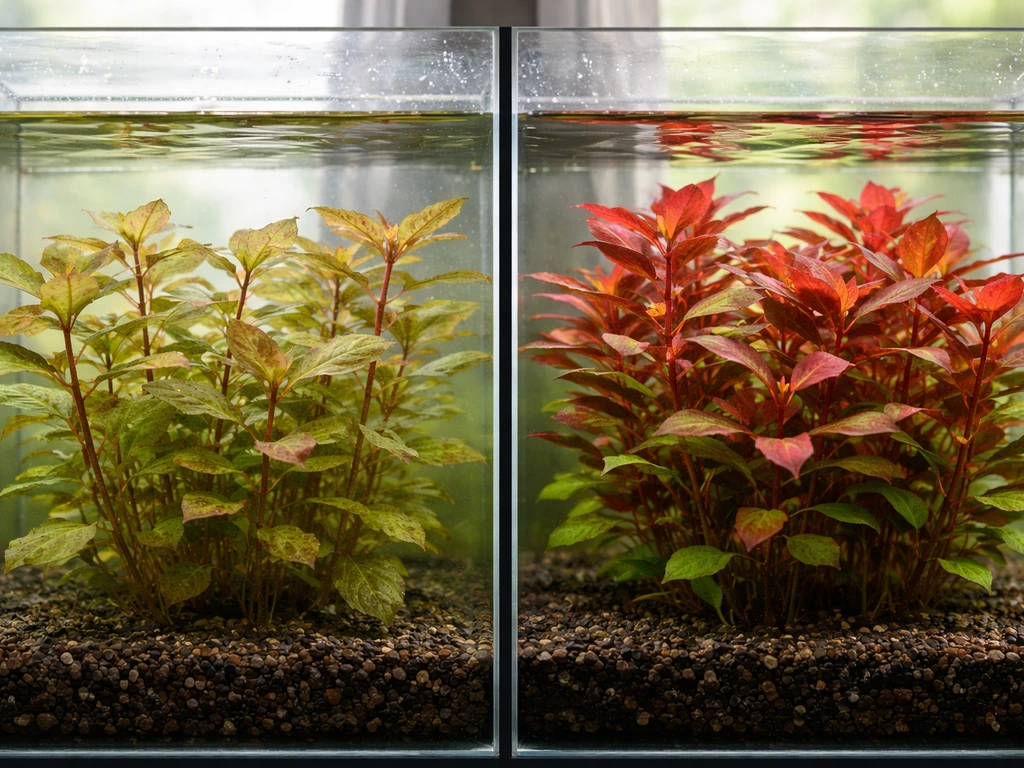
Most Ludwigia failures trace back to one of five causes. Identifying which one is happening to you is the fastest way to fix it.
| Problem | Likely Cause | Fix |
|---|---|---|
| Faded or pale color (especially red turning green) | Low light or iron deficiency | Increase light intensity or add iron-rich liquid fertilizer |
| Leggy growth with large gaps between leaves | Insufficient light or infrequent trimming | Boost light, shorten photoperiod if algae is present, trim more often |
| Melting or dropping leaves after planting | Transplant shock or nutrient imbalance | Leave it alone for 1–2 weeks, keep parameters stable, do not replant immediately |
| Algae coating leaves and stems | Nutrient imbalance, excess light, or poor flow | Reduce photoperiod to 8 hours, check nitrate and phosphate levels, improve circulation |
| Stunted tops not growing | Inconsistent CO2 or micronutrient deficiency | Check CO2 levels if injecting, add a complete trace element supplement |
| Stem rot at substrate level | Buried too deep, poor flow, substrate compaction | Replant shallower, increase surface agitation, stir substrate gently around base |
Melting after transplant is the one that worries beginners the most. Plants grown emersed look different from submerged Ludwigia, and when you put emersed stock into your tank, it will often drop its old leaves as it converts to underwater growth. That is not the plant dying, it is adapting. Give it two weeks of stable conditions before making any changes. If the growing tips are still green and intact, it is going to be fine.
For yellowing on older leaves with the veins staying green, that is a classic nutrient deficiency pattern, most often magnesium or iron. A yellowing that spreads from the newest leaves outward points more toward calcium or general nutrient lockout from pH being too high. Always check pH before assuming deficiency. If you are also looking for a plant to grow outside the aquarium, you can use similar beginner mindset with how to grow luffa sponge as a related, hands-on option. Hard, alkaline water above 7.5 will block nutrient uptake no matter how much fertilizer you add.
Routine maintenance: pruning, fertilizing, and managing growth rate
Ludwigia repens is a fast grower under good conditions, and some species like arcuata can add several centimeters per week with CO2 injection and strong light. That speed is a benefit and a management task at the same time. Without regular pruning, stems become leggy, shade their own lower sections, and crowd out neighboring plants.
Pruning schedule
- Trim every 2 to 3 weeks under moderate light and no CO2.
- Trim every 1 to 2 weeks if you are running CO2 injection and stronger light.
- Cut stems back to about half their height when pruning, not just topping them.
- Replant healthy tops as new cuttings, compost or discard the bare lower sections.
- After trimming, do a water change to remove any debris and dissolved organics.
Fertilizing in aquatic systems
For a low-tech tank (no CO2), a complete liquid fertilizer dosed once or twice a week is enough for repens. Focus on a product that includes both macronutrients (nitrogen, phosphorus, potassium) and trace elements (especially iron and manganese). Red pigmentation in Ludwigia responds directly to iron availability, so if your reds are turning green, iron is usually the first thing to check. In a high-tech system with CO2 injection, you will need to scale up fertilization to match the faster growth rate, because faster growth means faster nutrient consumption.
In hydroponic or water-based systems without traditional substrate, dosing the water column is your only nutrient pathway. Use a hydroponic nutrient solution formulated for aquatic plants and monitor EC (electrical conductivity) if possible to avoid overfeeding. Algae in these setups almost always signals an imbalance between nutrients and light, not simply too much of either one alone.
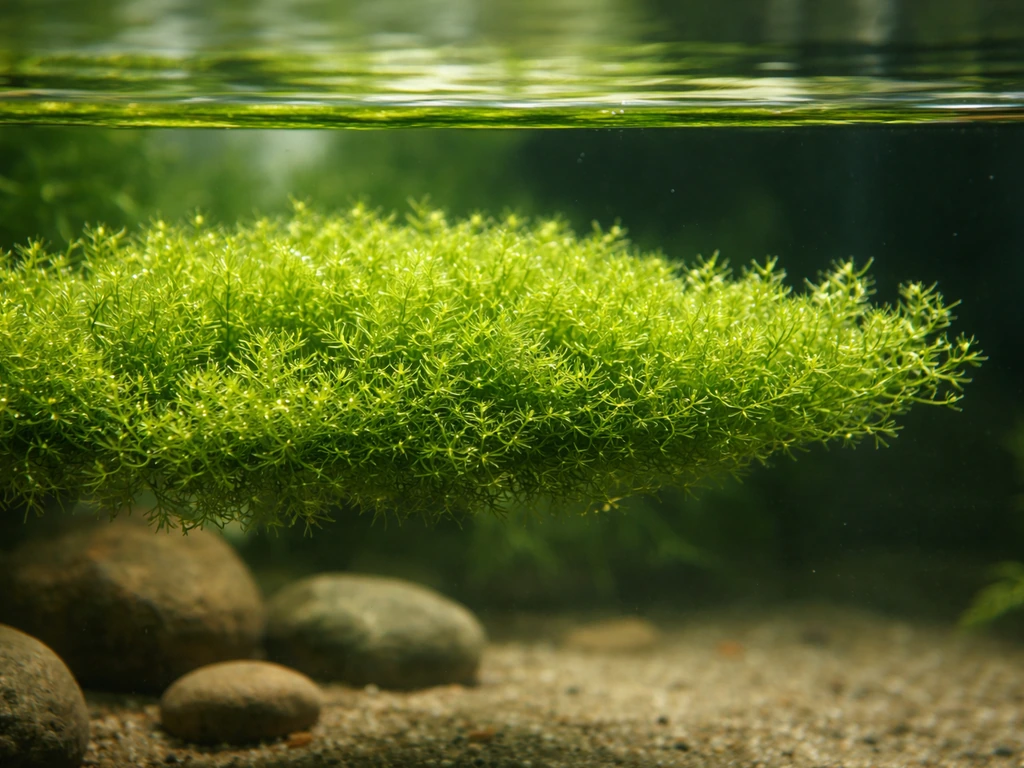
Compared to other stem plants like Rotala rotundifolia, which can be similarly beginner-friendly but more demanding about CO2 for good coloration, Ludwigia repens gives you more leeway on nutrients and light from the start. If you are trying to grow rotala next, the key is matching light and nutrients to your CO2 and then pruning early to prevent leggy growth Rotala rotundifolia. If you are building your first planted tank and want a red plant with minimal equipment overhead, Ludwigia repens is the right call. Once your system is stable and you understand how it behaves, branching into higher-demand species becomes much more approachable. If you want to try Riccia fluitans next, the same idea applies: give it strong, stable light and keep nutrients and flow appropriate for a healthy mat.
FAQ
Why does my Ludwigia melt after I plant it in a new tank?
Yes, but expect a different look at first. If you buy Ludwigia grown emersed, the plant often melts or drops older leaves when submerged. Keep light and water stable for about two weeks, and judge success by whether the tips stay green and push new underwater growth.
How long should I leave the light on for Ludwigia?
For Ludwigia repens, aim for a middle-of-the-road light schedule (about 8 to 10 hours daily) and increase only if growth is slow and algae stays controlled. Going longer than 10 hours in a low-nutrient or low-CO2 setup commonly triggers algae before the plant noticeably benefits.
If my Ludwigia is growing slowly, should I just increase the light?
Not exactly. Ludwigia needs enough light to support photosynthesis, but color and growth depend on both light and nutrient availability, plus CO2 for some species. If you raise light without matching nutrients, you often get algae, and the reds may still stall.
Will hard or alkaline tap water ruin Ludwigia?
In general, soft to moderately hard water is easiest. Very hard, alkaline water (especially above about pH 7.5) can suppress red pigmentation and slow growth by reducing nutrient availability, even if you dose fertilizer.
My Ludwigia is yellowing. How do I tell what nutrient is missing?
If the newest leaves are turning pale or yellow while older leaves look worse first, it usually points to nutrient imbalance or light issues. If older leaves yellow while veins stay green, check magnesium or iron patterns, but confirm pH first because lockout can mimic deficiency.
What’s the best way to plant Ludwigia stems so they root quickly?
Root rooting matters more than people think. Remove any bundle ties or ring, bury the bottom 2 to 3 cm of stripped stems, and insert at a slight angle to help anchor stems and reduce buoyancy, especially when substrate grains are fine to medium (around 2 to 3 mm).
Is it normal for Ludwigia to lose lower leaves?
It is normal for lower leaves to drop because Ludwigia grows from the top. If the stems become bare or leggy, that is a management signal, not disease. Regular pruning and replanting the healthy tops keeps it dense.
How sensitive is Ludwigia to temperature and pH swings?
Expect adaptation, then adjust gradually. Ludwigia can survive outside narrow ranges, but the fastest, healthiest growth usually happens around the recommended temperature and pH bands. Sudden swings are more likely to cause setback than staying slightly off target.
How should I fertilize Ludwigia in a low-tech tank?
In low-tech tanks, inconsistent liquid dosing is a common failure mode. Repens often does well with a complete fertilizer approach (macros plus trace elements) dosed once or twice weekly, but if you skip weeks or heavily overcorrect, deficiencies and algae can alternate.
Do I need to change fertilizer if I add CO2 or stronger lighting?
For fast-growing Ludwigia in higher-light or CO2 setups, nutrients must be scaled up to match growth rate. If you run CO2 and stronger light but keep the same dosing as a low-tech tank, growth can slow and color can suffer from nutrient limitation.
How do I feed Ludwigia if I use bare-bottom or no substrate?
Yes. In bare-bottom tanks or hydroponic-like setups, liquid fertilization is your main nutrient pathway because roots cannot access nutrients in the substrate. The practical takeaway is to monitor plant response and avoid large swings in dosing.
Which Ludwigia species is easiest for a first-time planted tank?
Start with repens unless you specifically know your equipment and light level. Palustris, arcuata, and glandulosa have different sweet spots, and the beginner-friendly tolerance you want can disappear quickly if you choose a higher-demand species for your current lighting and CO2 situation.
Can I cut Ludwigia back hard, or will it stunt?
Yes, aggressive pruning is part of normal Ludwigia care. Cut the plant back to a few centimeters above the substrate, replant the healthy tops, and discard or keep only the healthiest lower portions. With good conditions, new growth is typically fast.
My tank has algae after introducing Ludwigia. What should I change first?
Not usually. Most Ludwigia algae issues are tied to imbalance (light too high for nutrients and CO2, or nutrients too low while light is strong). Aim to correct the ratio rather than treating algae as a separate problem.