Yes, you can grow mangroves in a freshwater or low-salinity aquarium setup, but there is one important truth to get out of the way first: mangroves are not true freshwater plants. They tolerate very low salinity and even pure freshwater for stretches of time, but they perform best with at least a small amount of salt in the water. The good news is that "low salinity" is easy to achieve in any aquarium, and with the right species, a modest brackish-to-freshwater setup can keep mangroves growing for years. Here is exactly how to make it work.
How to Grow Mangroves in Freshwater Aquariums
Marcus Holloway
13 Apr 2026
Choosing the right mangrove species for your aquarium
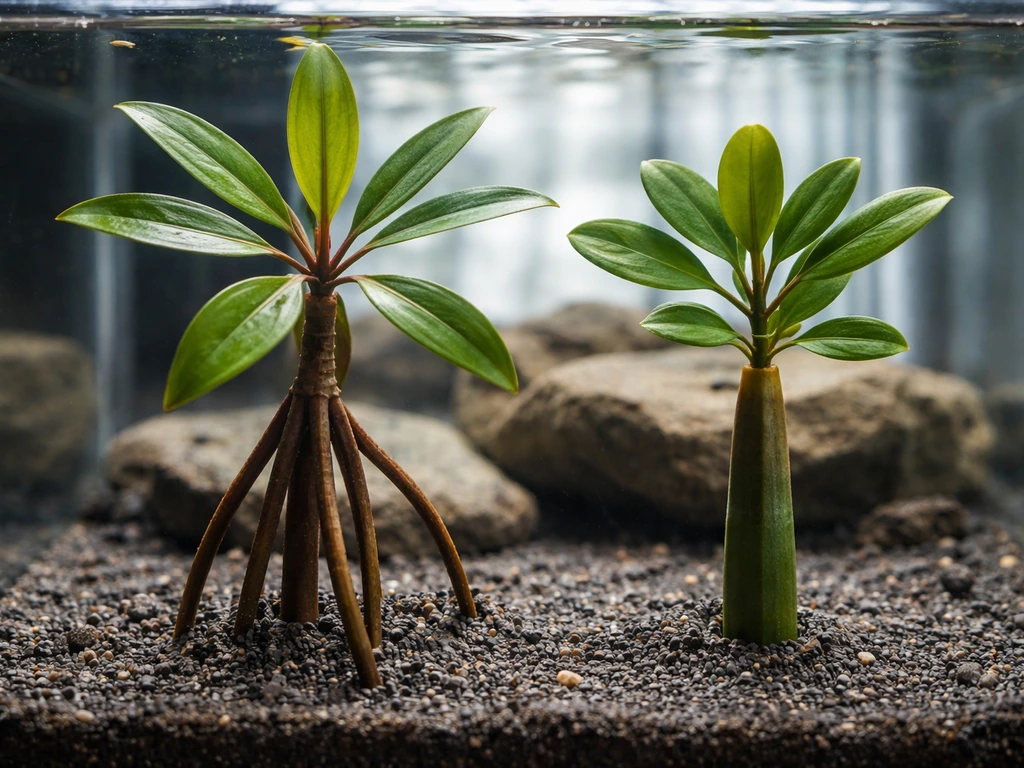
Not all mangrove species are equal when it comes to aquarium tolerance. Two species stand out as genuinely practical for home setups.
Rhizophora mangle (the red mangrove) is by far the most popular aquarium species and the one you will find most easily as a propagule or seedling. Research on seedling performance shows that Rhizophora mangle grows optimally at a salinity of around 10 PSU (roughly 10 g/L of salt), meaning near-freshwater conditions actually support healthy early growth. It produces those iconic arching prop roots that look spectacular in a display tank, and it tolerates a wide salinity swing when properly acclimated.
Bruguiera gymnorrhiza (the large-leafed orange mangrove) is a strong second choice. Reputable aquarium mangrove nurseries specifically describe it as a species that can be grown in freshwater, brackish, or full saltwater aquariums, recommending a target of 10 to 25 g/L of non-iodized sea salt for best results. It has a slightly different root structure (knee roots rather than prop roots) and tends to grow a bit more upright, which suits taller tanks.
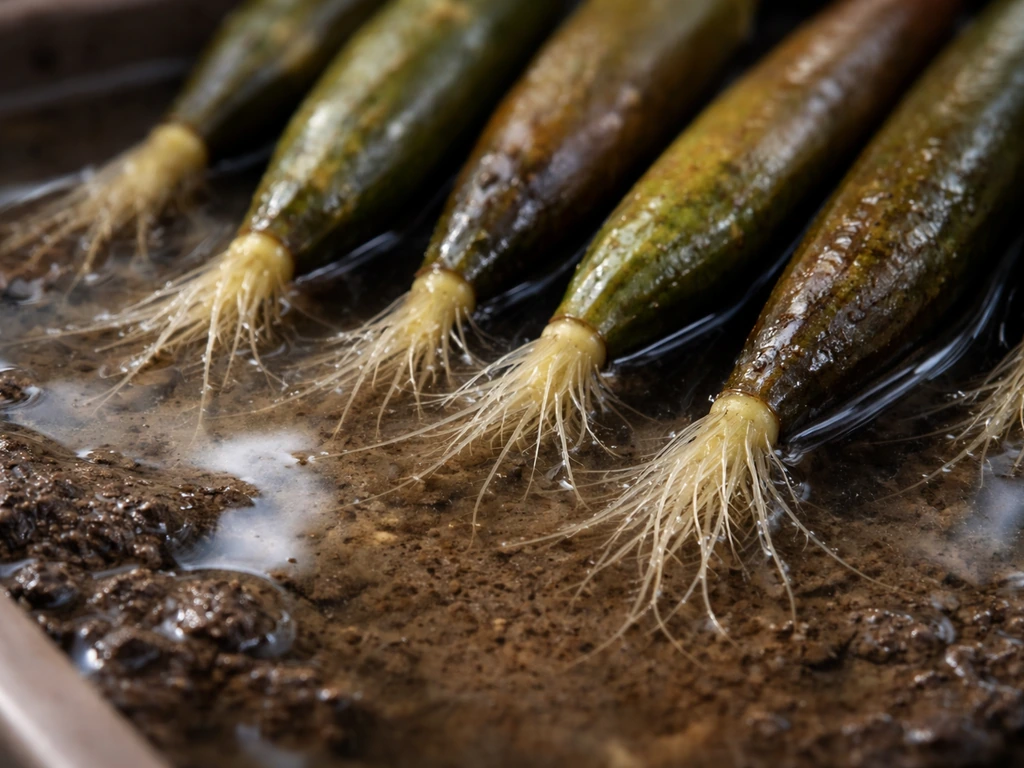
Other species like Avicennia marina or Laguncularia racemosa occasionally show up in the hobby, but they are harder to source and have less documented aquarium track records. For a first attempt, stick with Rhizophora mangle or Bruguiera gymnorrhiza. Both are available as propagules, which are the easiest starting point. If you want the full walkthrough on starting from scratch, the guide on how to grow mangrove propagules covers germination and early setup in detail.
Setting up the aquarium: tank size, substrate, and salinity
Tank size and configuration
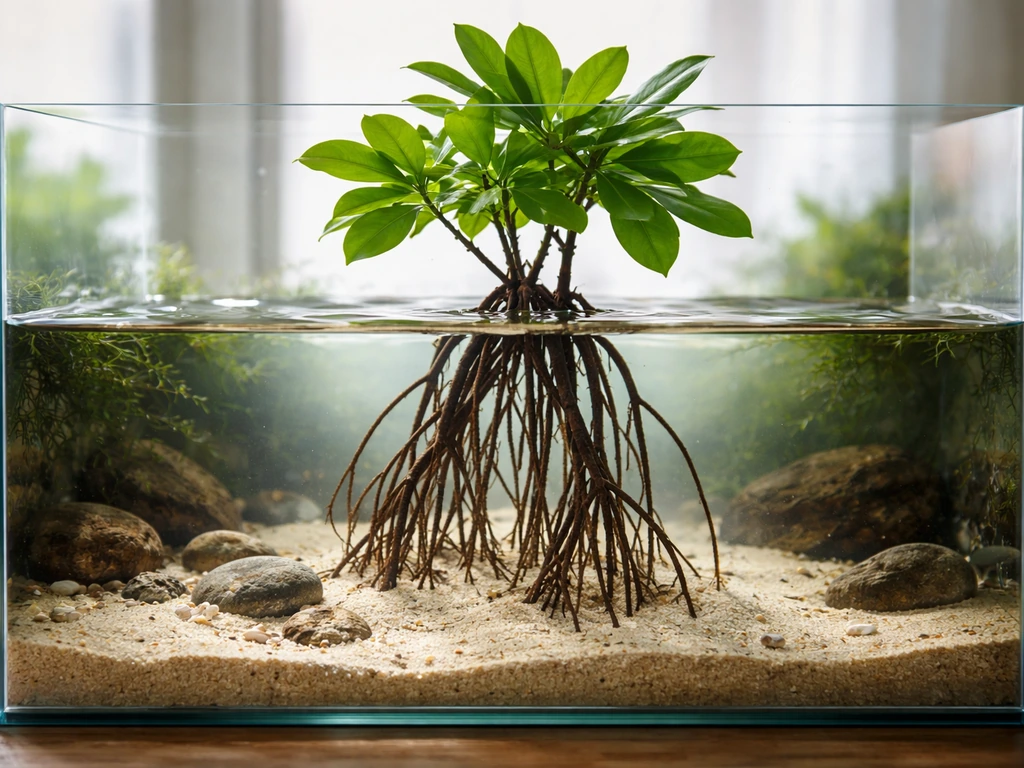
Mangroves grow vertically. A standard 20-gallon tall or 40-gallon breeder works for getting started, but plan for the plant to eventually exceed the tank height. Most hobbyists cut a hole in the lid or use an open-top setup so the trunk and leaves grow into open air above the waterline. The roots need to be submerged or at least in contact with moist substrate, but the canopy absolutely must have access to air and light above the water surface. A sump-style refugium is actually one of the best configurations because you get water volume, open top space, and the main display tank stays clean.
Substrate and root anchoring
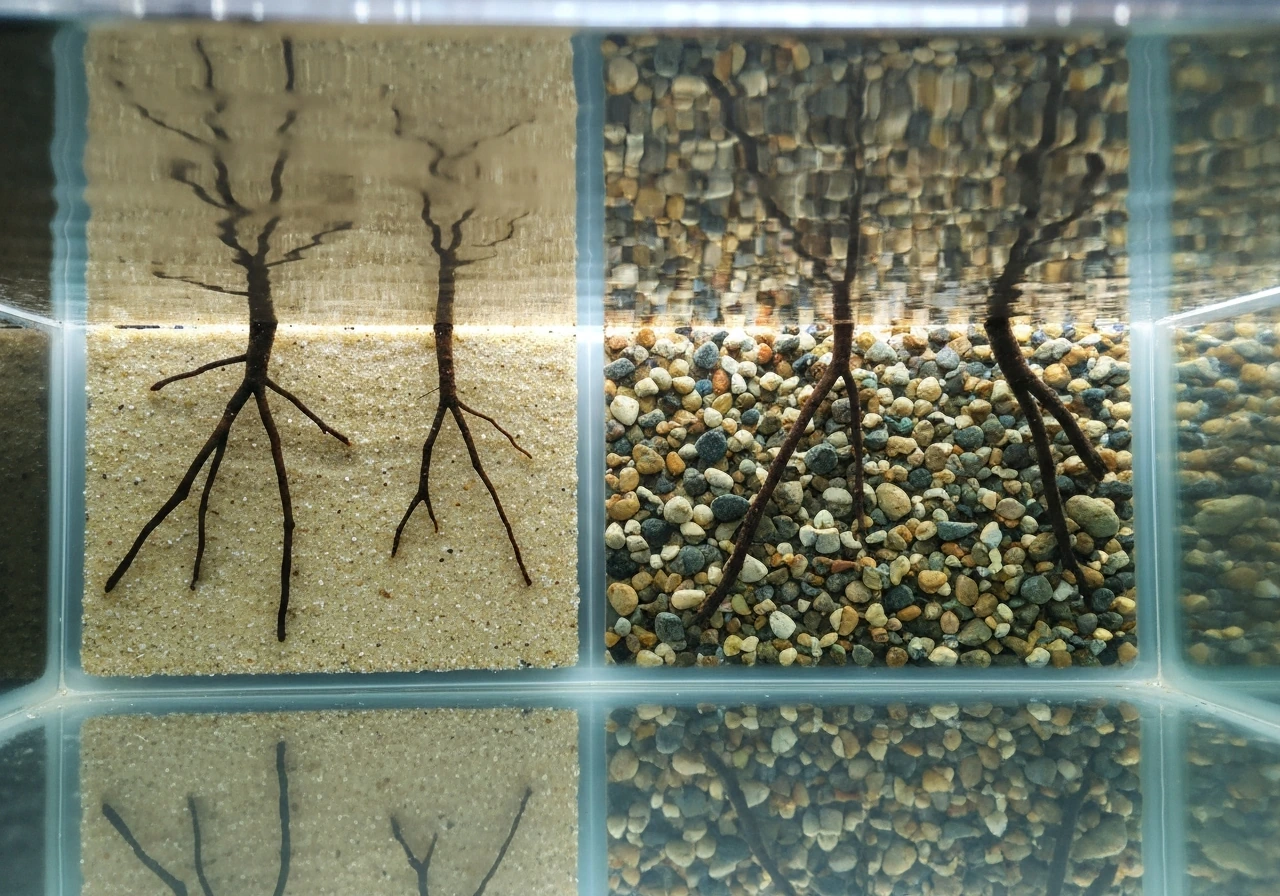
Mangrove roots need something to grip. Fine-grain sand (aragonite or play sand, 2 to 4 inches deep) works well and lets roots penetrate without compacting. Coarse gravel alone is not ideal because roots can slip and the plant will stay unstable for months. Some hobbyists use a mix of sand and small rubble rock, which gives stability while allowing water flow through the root zone. Bare-bottom tanks are not recommended for mangroves unless you are suspending the propagule in the water column temporarily during early germination.
Salinity: the freshwater vs. brackish reality
Here is where most beginners overthink it. You do not need to run a full reef or even a true brackish system. A specific gravity of 1.002 to 1.005 (roughly 2.7 to 6.7 g/L of salt) is a safe starting range that almost any aquarium fish or invertebrate can tolerate and that mangroves genuinely thrive in. Use non-iodized marine salt mix or aquarium sea salt, never table salt, and dissolve it completely before adding it to the tank. For Bruguiera gymnorrhiza you can push up toward 10 to 25 g/L once the plant is established, but starting low is always safer.
If you are running a community freshwater tank and cannot add any salt at all, mangroves can survive short-term but will show signs of stress within a few months. A dedicated low-salinity refugium is a much better long-term solution than trying to retrofit a zero-salinity planted tank.
Water, light, and temperature: dialing in stable conditions
Water parameters
| Parameter | Target Range | Notes |
|---|---|---|
| Salinity (SG) | 1.002–1.010 | Start at 1.002–1.005 for new plants |
| Temperature | 72–82°F (22–28°C) | Stable is more important than hitting a specific number |
| pH | 7.8–8.3 | Slightly alkaline; use aragonite sand to buffer |
| Ammonia / Nitrite | 0 ppm | Mangroves consume nitrate, not ammonia spikes |
| Nitrate | 5–20 ppm | Mangroves help reduce nitrate; don't strip it to zero |
| Water flow | Gentle to moderate | Avoid strong direct flow hitting roots or the trunk |
Lighting
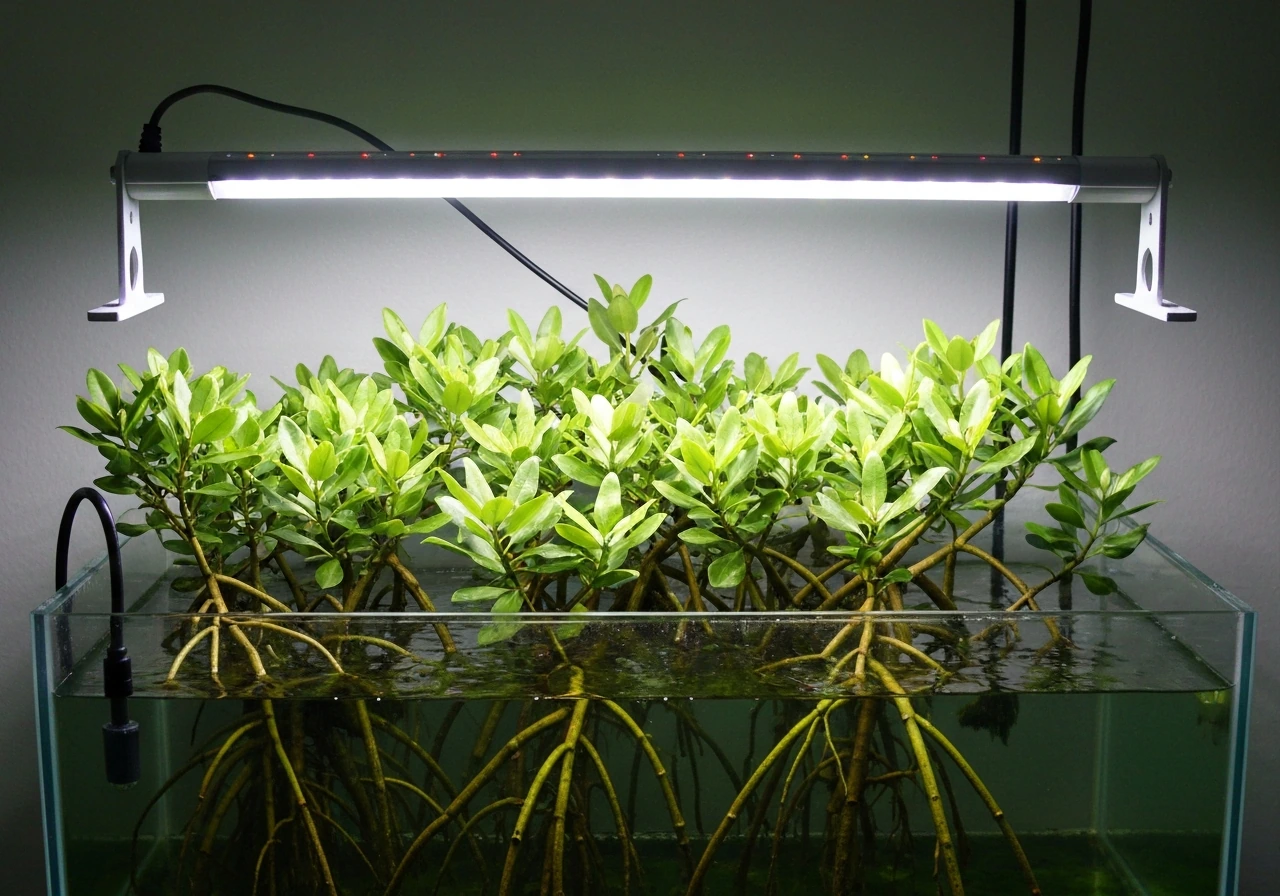
Mangroves are tropical trees and they want real light. A full-spectrum LED or T5 fluorescent fixture positioned 6 to 12 inches above the canopy (not the water surface) works well. Aim for a photoperiod of 12 to 14 hours per day. Intensity matters more than most hobbyists realize: PAR values in the 100 to 200 range at the leaf surface are a reasonable target. Under weak aquarium strip lighting, growth will be painfully slow and the plant will stretch toward any available light source, producing a spindly, weak trunk.
If your tank is near a south-facing window that gets several hours of direct sun, that can supplement your artificial light nicely. Just watch for temperature swings near glass in summer.
Temperature and oxygenation
Keep water temperature between 72 and 82°F. Drops below 65°F will slow growth dramatically and can trigger leaf drop. The root zone also needs oxygenation: mangrove roots in nature are exposed to tidal flushing, so stagnant water around the roots encourages rot. One study on neotropical mangrove seedlings found that root zone hypoxia, or low oxygen tension around the roots, significantly decreased respiration rates and root extension rates in multiple species, including Rhizophora mangle root zone oxygenation. A small powerhead or return pump that creates gentle circulation across the substrate is enough. You do not need a protein skimmer unless you are running higher salinity, but good surface agitation for gas exchange is always a plus.
Feeding, fertilizing, and what to expect for growth
Mangroves are slow growers by aquarium plant standards. In a well-lit, properly salted setup, expect 2 to 4 inches of new growth per month during warm months and slower growth in winter, even indoors. Do not panic and start dumping fertilizer if the plant is not exploding with new leaves in week two.
What to feed and how often
Mangrove roots absorb nutrients directly from the water column and substrate. In an established aquarium with fish, waste and nitrate alone often provide enough nitrogen. If you are running a lightly stocked system, a slow-release root tab fertilizer placed near (not directly under) the root mass every 6 to 8 weeks helps. For water column dosing, a dilute liquid fertilizer formulated for aquarium plants (low phosphate) can be added once weekly at half the recommended dose. Over-fertilizing is a real problem: excess phosphate fuels algae, and excess nitrogen in an already high-nitrate tank creates water quality issues.
Iron is one micronutrient that mangroves use more heavily than most aquarium plants. A chelated iron supplement added at 0.05 to 0.1 ppm weekly keeps leaves a healthy deep green. Yellowing between leaf veins (while veins stay green) is a classic iron deficiency symptom.
Roots vs. water column feeding
- Roots: slow-release root tabs, organic substrate amendments (small amounts of refugium mud), natural detritus from a healthy biofilm
- Water column: dilute liquid all-in-one fertilizer, chelated iron, trace elements if running ultra-pure RO water
- Avoid: ammonia-heavy fertilizers, high-phosphate root tabs, or any copper-based products (toxic to many tank inhabitants)
Acclimation, pruning, and keeping roots and leaves healthy
Acclimating new mangroves to your tank
If you bought a mangrove propagule or seedling that was grown in freshwater and you plan to keep it at low salinity, the transition is fairly easy. Float the propagule in the tank for 30 minutes to equalize temperature, then push the bottom third into your substrate gently. Do not force it. Over the next two to three weeks it will anchor itself.
If you are moving a plant from a higher-salinity system into a lower-salinity aquarium, drop the salinity slowly: no more than 2 g/L per week. Going the other direction (freshwater to brackish), the same rule applies. A drip acclimation approach works well for established plants. Start at a specific gravity of 1.002 to 1.005 as the baseline and adjust from there over several weeks. Rushing this step is one of the most common reasons for leaf drop in the first month.
Pruning and canopy management
Mangroves in aquariums need pruning to stay manageable. Once the plant has several sets of mature leaves, you can trim the growing tip to encourage lateral branching and a bushier shape. Use clean, sharp scissors and cut just above a leaf node. Do not remove more than a third of the canopy at once. After pruning, give the plant two to three weeks before trimming again.
Some hobbyists also trim prop roots that grow too aggressively across the substrate, though this is less critical. Aerial root tips (the small, white root tips you see reaching into the water) should never be cut, as they are the plant's active nutrient uptake zone.
Leaf health and salt gland management
Mangroves excrete excess salt through their leaves via specialized salt glands. In a low-salinity tank this is minimal, but you will occasionally see white crystalline deposits on leaf surfaces. This is normal. Gently wiping leaves with a damp cloth once a week keeps them clean and maximizes light absorption. Do not use any soap or chemicals.
Troubleshooting common aquarium mangrove problems
Leaf drop
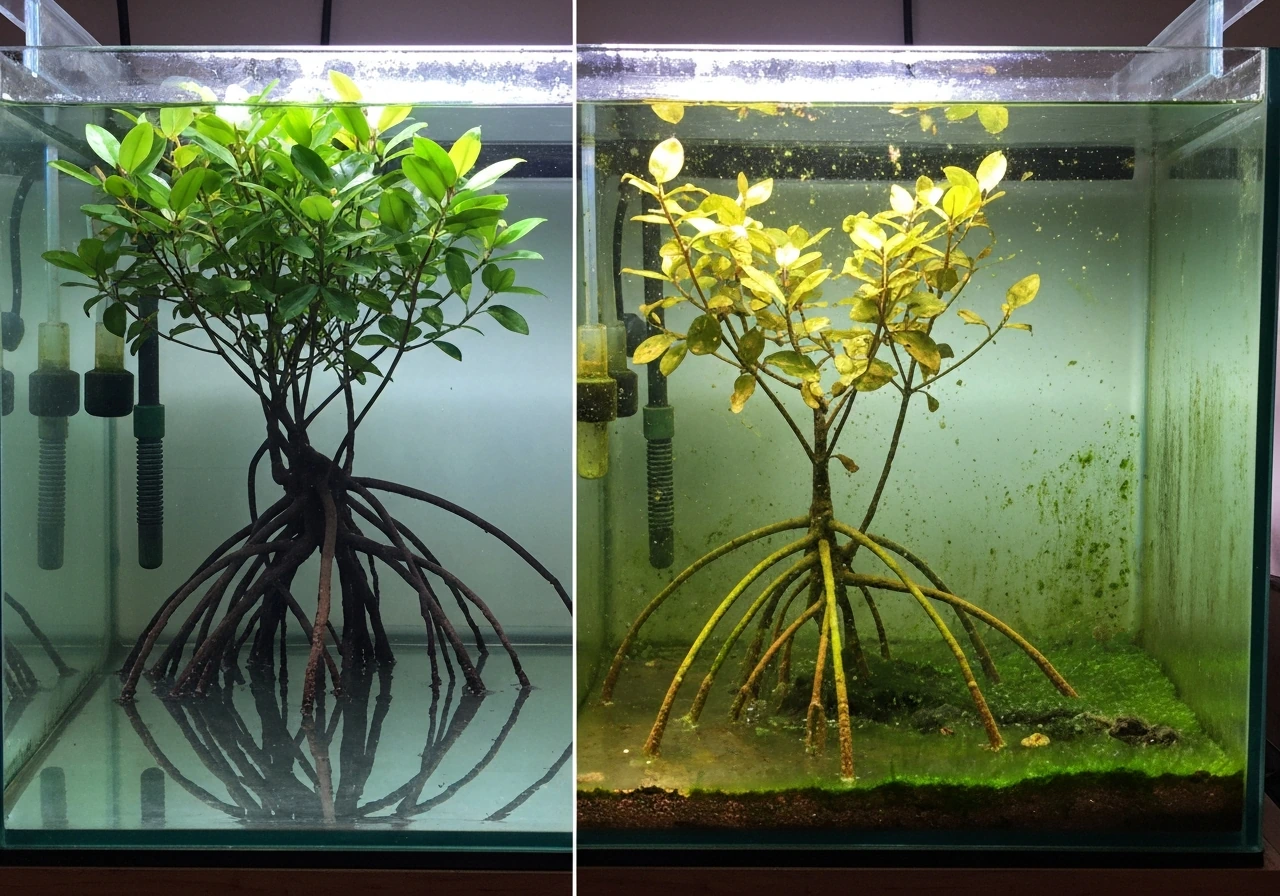
This is the most common complaint. Sudden leaf drop almost always comes down to one of three causes: a salinity swing, a temperature shock, or inadequate light. Check your parameters first before assuming the plant is dying. Some leaf drop during the first two to four weeks after introducing a new plant is completely normal as it adjusts to new conditions. If drop continues past a month, audit your light intensity and daily photoperiod.
Algae buildup on roots and substrate
Green algae on the glass and substrate is common in mangrove setups because the lighting is strong and nutrients run moderate. The mangrove itself competes for nutrients, but early on before it is established, algae wins. If you want a balanced refugium, pairing mangroves with fast-growing surface plants is a proven strategy. Check out how to grow floating plants for species that complement mangroves well in this type of setup, outcompeting algae while the mangrove roots get established.
Slow or stalled growth
If your mangrove puts out zero new leaves for more than six weeks, light is the most likely culprit. Measure PAR at the canopy if you can. If you cannot, simply move the light closer or add a supplemental grow bulb. The second most common cause is low temperature: anything under 70°F and growth essentially stops. Check your heater and make sure it is rated for the tank volume.
Root rot and root dieback
Root rot shows up as brown, mushy root tissue, usually starting at the tips and moving inward. This is almost always caused by stagnant water around the roots, excessively deep substrate that creates anaerobic pockets, or physical damage during planting. Fix flow first: add a small powerhead aimed gently along the substrate surface. If the substrate is compacted, carefully loosen the area around the root zone with a thin rod. Trim visibly dead root sections with sterile scissors and dose with a dilute hydrogen peroxide dip (3% solution diluted 1:10 in tank water) applied directly to the root zone with a syringe.
Pests
Spider mites and scale insects are the most common pests on the above-water canopy. Since the leaves are above the waterline, you can treat them with a dilute neem oil spray (ensure none drips into the water) or simply wipe them off manually. Aphids occasionally appear in humid aquarium rooms. A strong water spray on the leaves outdoors (if you can move the tank) or manual removal is safer than chemical pesticides near an active aquarium.
Poor or no rooting
If a propagule sits in the substrate for six weeks without putting out any roots, it is either too buoyant (try weighing it down gently with a small rubble rock), the substrate is too coarse for root penetration, or the propagule was not viable to begin with. A healthy propagule will feel firm and have a green growing tip. A propagule that is shriveled, smells off, or has a soft tip is unlikely to root.
Getting mangroves to thrive for the long haul
Water changes and parameter monitoring
A 10 to 15 percent weekly water change is the single most important maintenance habit. Evaporation in an open-top tank can raise salinity significantly over a week, so top off with fresh RO or dechlorinated water daily and do your full water change weekly with properly mixed saltwater to keep SG stable. Check salinity with a calibrated refractometer (not a cheap swing-arm hydrometer, which drifts) every time you do a water change.
Equipment upgrades over time
As the plant grows, you will likely need to upgrade lighting. A good LED grow light with a controllable spectrum (particularly strong in the red and blue wavelengths) makes a noticeable difference in canopy density and growth rate after the first year. If you are running a sump refugium, a small protein skimmer rated for your water volume becomes worthwhile once the plant is large enough that you want to push salinity slightly higher for better growth.
When to transfer or upgrade the setup
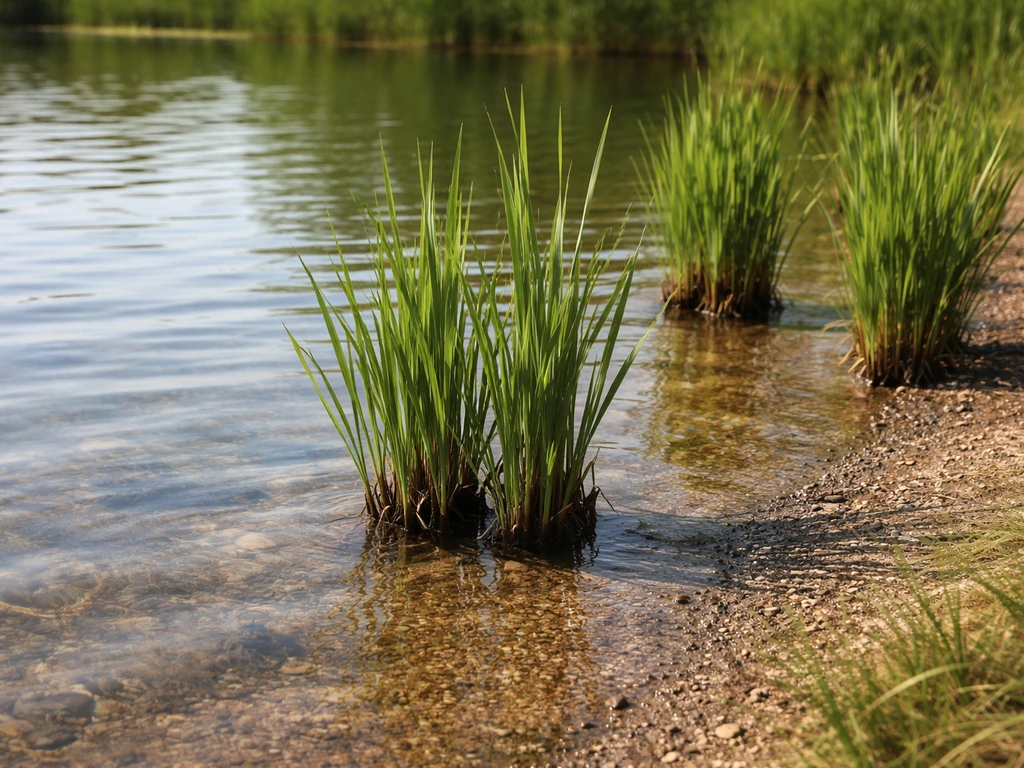
After two to three years of healthy growth, a mangrove in a home aquarium will often outgrow the space. At that point you have three options: prune aggressively and keep it contained, move it to a larger sump or indoor planter pond, or transfer it to an outdoor pond in a warm climate (USDA zones 9b and above). If you are curious about other semi-aquatic plants that can share space with a growing mangrove system, you might find it useful to read about how to grow reeds, which thrive in similar brackish-tolerant setups and add both filtration value and visual texture alongside the mangrove canopy.
Pairing mangroves with other aquatic plants
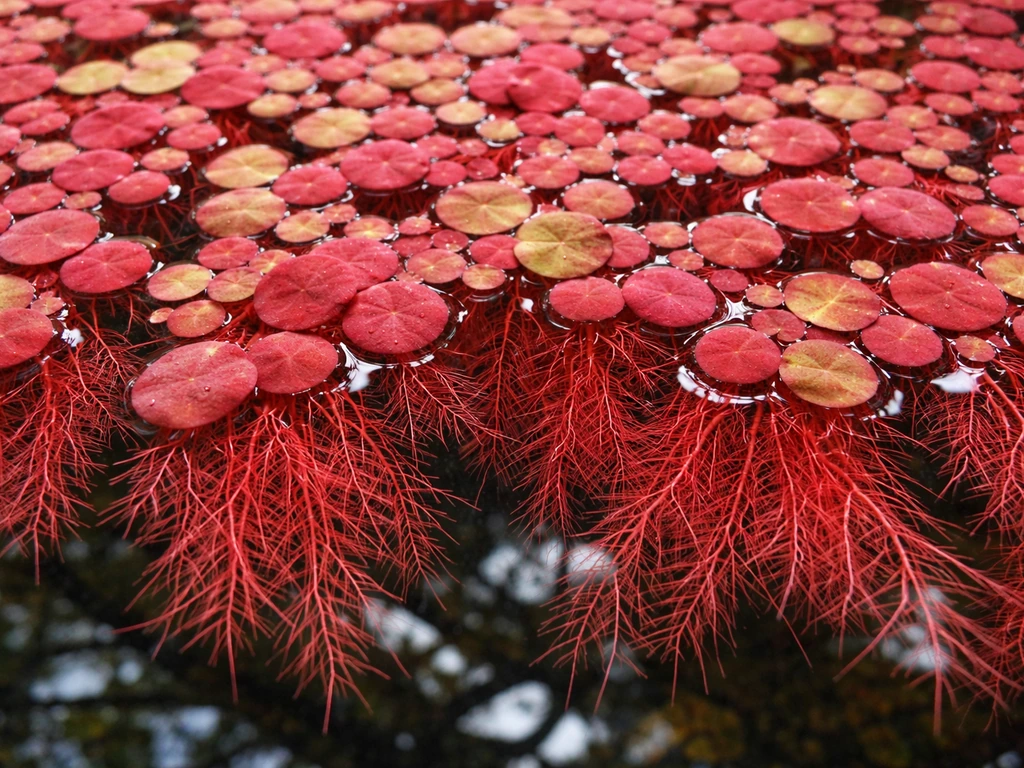
A mangrove refugium does not have to be a one-plant show. Red root floaters and other small surface plants work well in the same low-salinity range and help with nutrient export. If you want to diversify what is growing in your system, how to grow red root floaters is a solid companion read, especially since red root floaters tolerate the gentle brackish conditions that mangroves prefer. Just monitor for shading: floating plants can block light from reaching the mangrove canopy if they spread too densely. For reed-based companion planting in brackish or transitional setups, this guide on growing reeds covers species and spacing that work well alongside mangroves without competition.
Your setup checklist before you buy a plant
- Tank: 20 gallons minimum, open top or lid with cutout for canopy growth
- Substrate: 2 to 4 inches of fine aragonite or play sand
- Salinity: mix non-iodized marine salt to SG 1.002–1.005 before planting
- Lighting: full-spectrum LED or T5, positioned above the canopy, 12–14 hour photoperiod
- Temperature: heater set to 76–78°F, checked with a digital thermometer
- Flow: small powerhead or return pump for gentle circulation across the root zone
- Refractometer: calibrated, for weekly salinity checks
- Species selected: Rhizophora mangle propagule or Bruguiera gymnorrhiza seedling from a reputable aquarium nursery
- Fertilizer plan: chelated iron weekly, root tab near substrate every 6–8 weeks
- Patience: realistic expectation of 2–4 inches of new growth per month in ideal conditions
FAQ
Can I grow mangroves in a zero-salinity freshwater tank (no salt at all)?
Yes, but only as a temporary measure. If you cannot add salt, keep the mangrove in a dedicated low-salinity refugium (or a separate quarantine tub) rather than trying to convert a fully freshwater display. Even then, expect slower growth and more frequent leaf stress, because the plant will not be able to maintain ideal osmotic balance long-term.
What salt should I use, and how do I measure it correctly for low-salinity mangroves?
Use non-iodized marine salt mix or aquarium sea salt, then confirm salinity with a calibrated refractometer. Avoid table salt, and do not rely on cheap swing-arm hydrometers for fine control, since small calibration errors can push you outside the low-brackish range and contribute to leaf drop.
How much water movement do freshwater mangroves actually need, and what’s too much?
From the plant’s perspective, the real “limit” is how consistently you keep the root zone oxygenated and stable. Target gentle surface agitation and a small flow across the substrate, avoid deep beds that trap anaerobic pockets, and perform top-offs and weekly water changes to prevent salinity creep in open-top setups.
Are white crystals on mangrove leaves a sign of a problem, or normal salt secretion?
White salt crystals can indicate evaporative salt buildup or overly concentrated feeding, but they are often normal on leaf glands in low salinity too. If crystals are heavy and you see rising salinity week to week, increase daily top-offs with RO or dechlorinated fresh water and wipe leaves during maintenance to restore light intake.
My propagule won’t root. What are the most common reasons besides “patience”?
If a propagule sits without rooting, first check viability and placement. It may be too buoyant, the substrate may be too coarse, or the propagule could be non-viable. A firm propagule with a green growing tip is your best bet, and gently weighing it down with a small rubble piece can help it establish.
How do I know if my mangrove needs iron, and how do I avoid overdoing it?
Dose iron only when you have a reason, because excess nutrients can fuel algae. If you see yellowing between leaf veins (veins stay greener), apply chelated iron weekly around the low range you use for aquarium plants, and reassess after a couple weeks before increasing dosage.
Do I need to acclimate a mangrove even if my new tank is only slightly less salty?
Mangroves generally hate fast swings, so acclimation matters even when you “already have low salinity.” When moving between different salinities, change gradually (for example, reduce or increase by small increments over weeks), and use drip acclimation for established plants to minimize osmotic shock.
What’s the safest way to prune an aquarium mangrove, and what should I never cut?
Not always, and there are two common missteps. First, cutting too much canopy at once can trigger stress. Second, removing aerial root tips can permanently reduce nutrient uptake. If pruning is needed, trim above a leaf node and never remove more than about one-third of the canopy in a session.
My mangrove looks healthy but grows slowly. What should I troubleshoot first, light, temperature, or nutrients?
It depends on why growth stalled. If canopy growth stops but leaves look intact, temperature and light are the first suspects. If you can, measure PAR at the leaf surface, otherwise raise light height and intensity gradually. If roots look unhealthy, fix flow and substrate compaction before adding fertilizer.
Is sand depth important for mangrove roots, and can too much substrate cause root rot?
For most hobby setups, you want the root zone protected but not sealed. Fine-grain sand supports rooting, while excessively deep beds can create anaerobic conditions. If you mix sand with small rubble, keep the overall depth shallow enough that flow still reaches the root area.
What’s the best step-by-step response to sudden leaf drop in a freshwater mangrove tank?
If leaves suddenly drop, treat it like a parameter audit, not a disease diagnosis. Check salinity with a reliable refractometer, confirm water temperature with an accurate thermometer, and verify lighting photoperiod and intensity before changing multiple variables at once.
Can I grow floating plants with mangroves without starving them of light?
Yes, companions can help but only if they do not shade the mangrove canopy. Floating plants are useful for nutrient export and algae suppression, but keep coverage modest so the mangrove still receives adequate direct light at the leaf surface.