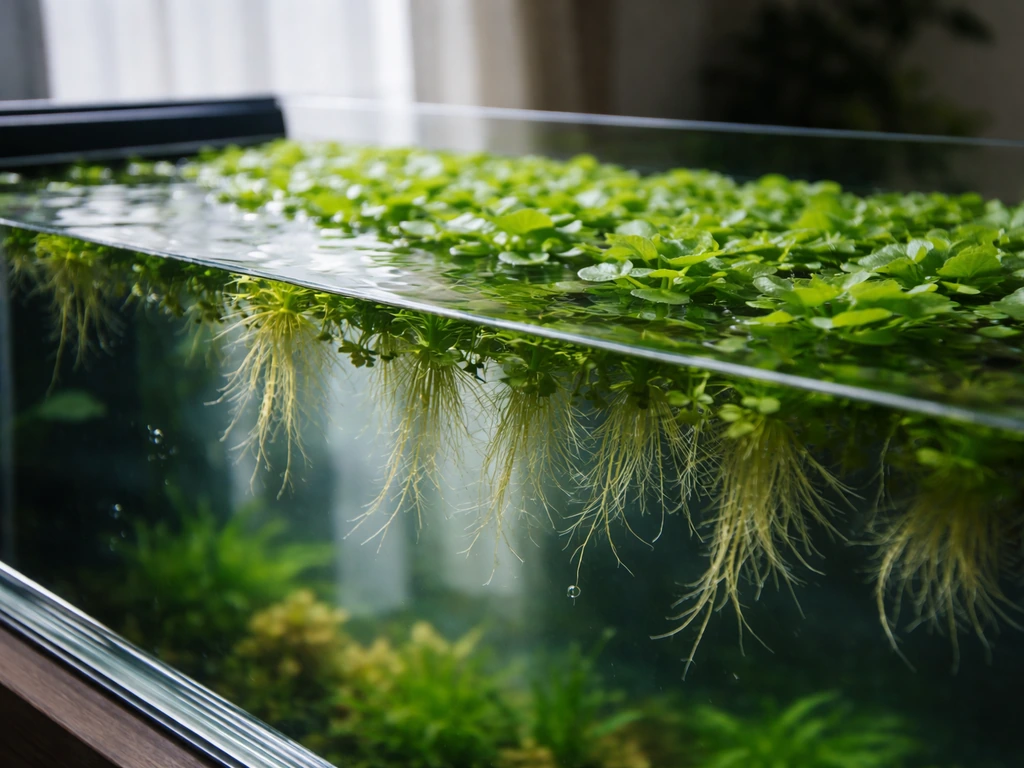
Floating aquarium plants are some of the easiest plants you can grow, but they do fail in predictable ways: wrong light, too much surface agitation, or a nutrient imbalance. Get those three things right and most species like frogbit, water lettuce, salvinia, red root floaters, and duckweed will take off fast, sometimes doubling coverage within a week. This guide walks you through the full setup, how to introduce plants so they actually survive the first two weeks, and exactly what to do when growth stalls or leaves start yellowing.
How to Grow Floating Plants in an Aquarium Step by Step
Marcus Holloway
24 Apr 2026
Choose the right floating aquarium plants
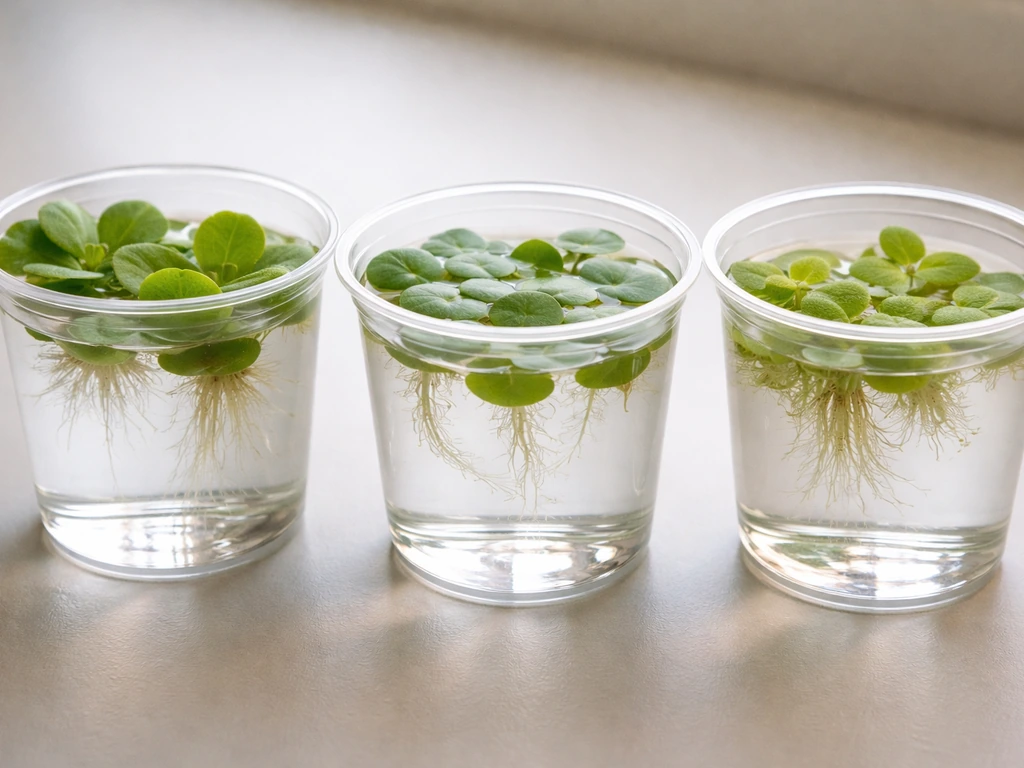
Before you buy anything, match the plant to your tank. Some floaters are low-maintenance and bulletproof for beginners, while others need more stable conditions or specific water chemistry. Here are the most popular options and what to know about each.
| Plant | Growth Rate | Light Needs | Temperature Range | Best For |
|---|---|---|---|---|
| Amazon Frogbit (Limnobium laevigatum) | Fast (can double weekly) | Moderate | 68–82°F | Beginners, shrimp tanks |
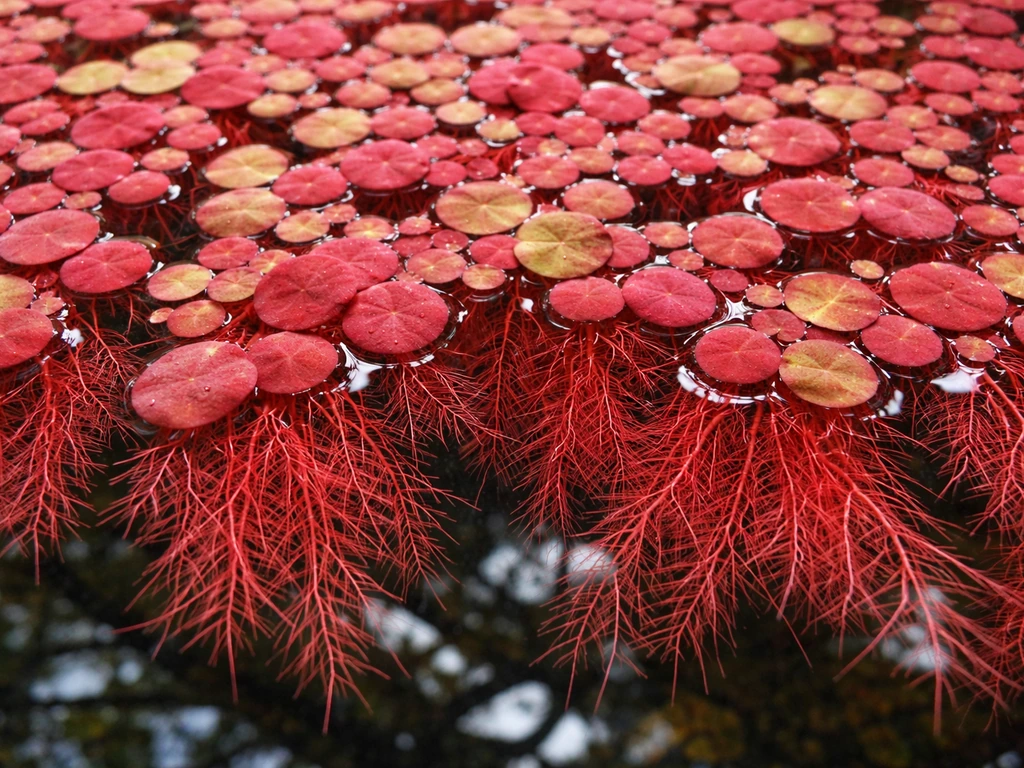
| Red Root Floater (Phyllanthus fluitans) | Moderate–Fast | Moderate–High | 70–82°F | Color accent, shrimp tanks |
| Water Lettuce (Pistia stratiotes) | Moderate–Fast | Moderate–High | 72–82°F | Larger tanks, tropical setups |
| Salvinia minima | Fast | Low–Moderate | 64–82°F | Beginners, low-light tanks |
| Duckweed (Lemna minor) | Very Fast | Low–Moderate | 50–86°F | Nutrient export, fish food |
My personal recommendation for most beginners is Amazon frogbit or salvinia. Both are forgiving, grow quickly so you see results fast, and don't need intense light. Duckweed is tempting because it's cheap and easy to source, but it spreads aggressively and can carpet your entire surface before you realize it's a problem. Water lettuce and red root floaters are great once you have the basics down. If you're also growing red root floaters specifically, there's much more detail worth knowing about that species individually. If you want the best results, follow the species-specific guidance for how to grow red root floaters, especially around light, iron, and surface calmness red root floaters specifically.
One compatibility note worth flagging early: water lettuce (Pistia stratiotes) is considered invasive in many regions. Do not release it into natural waterways or outdoor ponds connected to wild water systems. Keep it indoors and dispose of excess plants responsibly.
Tank and setup for floating plants
Floating plants work in almost any tank size, but a few setup details make a big difference in whether they thrive or struggle. The two biggest mistakes I see are running too much surface agitation and using filters that pull plants into the intake.
Tank size and water type
You can grow floating plants in tanks as small as 5 gallons, though most species do better with a little more room. For water lettuce, aim for at least 20 gallons since the rosettes get large (up to 10 inches across in ideal conditions) and need surface space. Frogbit, salvinia, and red root floaters are happy in nano tanks. Most popular floating plants prefer freshwater tropical conditions, so if you already have a heated freshwater tank, you're good to go.
Controlling surface agitation
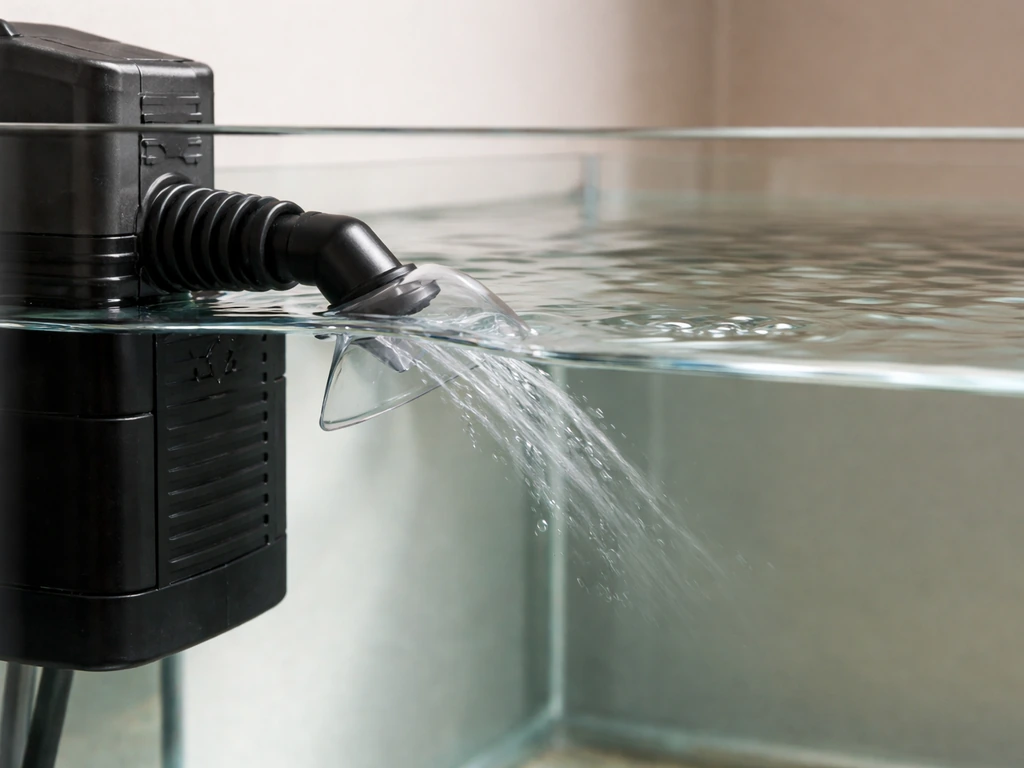
This is the one setup factor that trips people up the most. Floating plants need relatively calm water at the surface. Strong ripples, spray bars aimed at the surface, or powerheads pointed upward will batter the leaves, damage roots, and cause plants to sink or deteriorate over time. Red root floaters are especially sensitive to this. The fix is simple: aim your filter return flow downward or at the glass, not across the surface. A gentle surface movement is fine, even beneficial for gas exchange, but direct turbulence is a problem.
Protect your filter intake
Floating plant roots, especially the long trailing roots of frogbit and water lettuce, will find their way into filter intakes and sponge filters. Use a sponge pre-filter on any intake, and consider floating plant rings (simple plastic or foam corrals) to keep plants contained to a specific area of the surface. These rings serve two purposes: they keep your floaters in a tidy zone away from the filter, and they prevent fast growers like duckweed from taking over the entire surface before you have a chance to prune.
Lighting, temperature, and water conditions
Light
Most floating plants need moderate light positioned directly above the tank. Aim for 8 to 10 hours per day on a timer. The plants sit right at the surface, so they're naturally closer to the light source than submerged plants, which works in their favor. That said, intense high-output lighting pointed directly at red root floaters can actually bleach the leaves rather than deepen their red color.
For salvinia, even lower light levels work reasonably well, making it one of the few floaters suited to tanks without dedicated plant lighting. A standard aquarium LED with a moderate PAR output (around 30 to 50 micromoles per square meter per second at the surface) is enough for frogbit and salvinia. Red root floaters and water lettuce benefit from slightly more.
One thing to watch: as floating plants spread and create a mat, they shade out whatever is growing underneath. This is actually useful for suppressing algae on the back glass and substrate, but it can starve light-hungry submerged plants. Keep surface coverage to about 50 to 70 percent maximum if you have plants below that need light.
Temperature
Stick within the species-appropriate range and you'll rarely have temperature problems. For most popular floaters, 72 to 80°F is the sweet spot. Red root floaters do well between 70 and 82°F. Water lettuce prefers 72 to 82°F and really wants warmth to put out new leaves quickly. Salvinia is more cold-tolerant and can handle temperatures down into the low 60s, though growth slows noticeably below 68°F. Avoid temperature swings: floating plants are sensitive to sudden drops or spikes because they live right at the water surface where temperature fluctuates most.
Water parameters
- pH: 6.5–7.5 covers almost all popular floating species
- Hardness: soft to moderately hard water works for most; frogbit and red root floaters prefer softer water
- Ammonia and nitrite: should always be 0 ppm; floating plants are not a fix for a cycling tank
- Nitrates: 10–30 ppm is a useful range; higher nitrates actually fuel floating plant growth, but above 40–50 ppm you risk algae alongside plant growth
- CO2: not required; floating plants pull CO2 directly from the air at the surface
Starting and planting: acclimation and placement
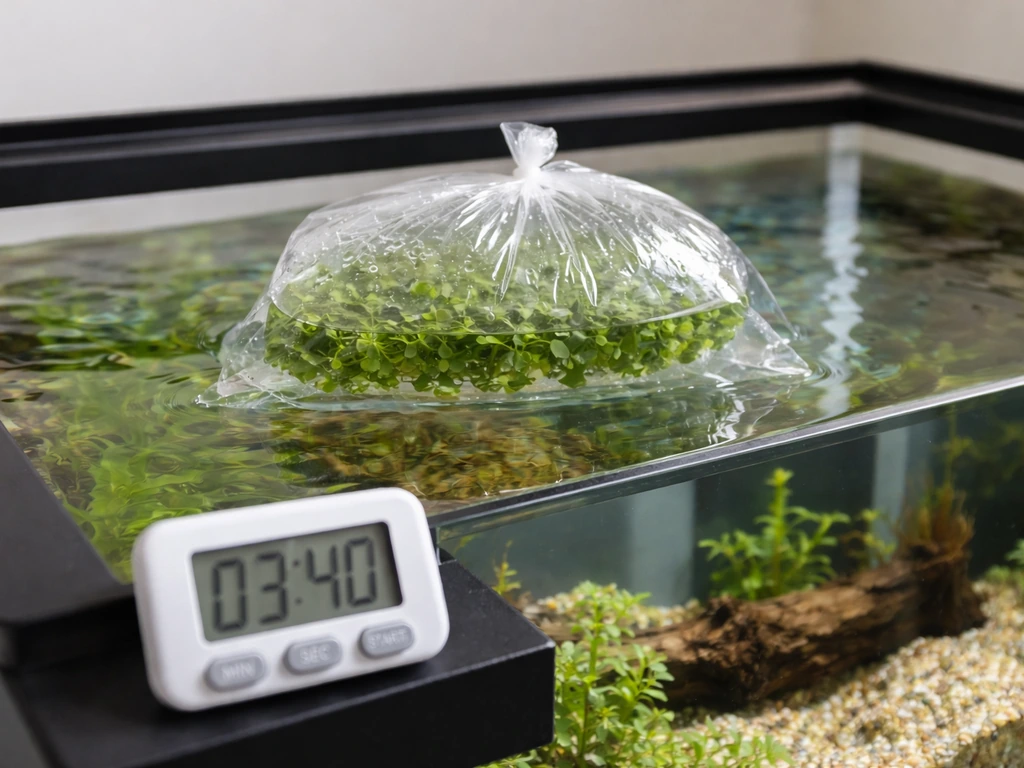
When plants arrive (by mail or from a local store), they're almost always stressed. They've been in a bag, in the dark, possibly in cold water, and without light for hours or days. Don't just dump them in your tank and expect them to thrive immediately. A short acclimation period makes a real difference.
- Float the sealed bag in your tank for 15 to 20 minutes so the water temperature equalizes.
- Inspect plants before adding them: remove any dead, brown, or slimy leaves. Check for pest snails or hitchhiker algae on the roots.
- Rinse gently in dechlorinated water if the shipping water smells bad or is visibly dirty.
- Place plants on the water surface in the calm zone of your tank, away from direct filter outflow.
- For species like frogbit and water lettuce, make sure the rosette center (the growing tip) is above the water and not submerged. These plants will naturally orient themselves, but give them a gentle nudge right-side up if needed.
- For salvinia and duckweed, just scatter a small starter amount on the surface. They don't need any orientation help.
- Leave the lights on for the first few days at your normal photoperiod. Don't blast them with extra light thinking it will help; stable conditions are more important than intensity right after introduction.
Most floating plants don't need to be tied or anchored. They're free-floating by design and attach to nothing. The only exception is if you're using floating rings to corral them, which works more like a fence than an anchor. Some people briefly tie a thread to a plant ring to keep it positioned, but the plants themselves float freely inside it.
Expect a brief melting or transition period of 3 to 7 days where some leaves yellow or die back. This is normal. The plant is adapting to your specific water and light. As long as the growing tips stay green and new leaves emerge within a week, you're on track.
Nutrients and fertilizing for fast growth
Floating plants are root-feeders in the water column, not substrate feeders. Their roots hang down into the water and absorb nutrients directly from it, which is why they're so good at soaking up nitrates and phosphates. Lemna minor also performs as a low-light tolerant floating plant and is commonly profiled with measurable water-column nutrient considerations like nitrate (NO3), phosphate (PO4), potassium (K), and iron (Fe). This is great for water quality but it also means root tabs (the ones you push into the substrate) do almost nothing for floaters. Skip the root tabs entirely.
Liquid fertilizer: yes or no?
In a tank with fish, the fish waste usually provides enough nitrogen and phosphorus to keep floaters growing well. If your tank is lightly stocked or a dedicated plant tank without fish, add a liquid all-in-one fertilizer dosed at half the recommended rate and observe growth. The most important micronutrient for floating plants is iron: a small dose of liquid iron fertilizer (chelated iron, around 0.1 ppm in the water column) noticeably deepens the red color of red root floaters and keeps leaves of other species a healthy dark green. Without enough iron, you'll see pale or yellowish new growth even when nitrates are fine.
Avoiding algae while fertilizing
The risk with fertilizing a tank that has floating plants is that excess nutrients, especially phosphates, will feed algae on the glass and décor. The best approach is to dose conservatively, keep the photoperiod at 8 to 10 hours (not 12+), and let the plants' surface shading do some of the algae suppression work for you. If you see green spot algae or hair algae spiking, reduce fertilizer dose first before changing anything else.
Maintenance: pruning, preventing sinking, and managing coverage
Once floating plants take off, the main job becomes managing how much surface they cover. This is not a set-it-and-forget-it situation, especially with fast growers like frogbit or duckweed.
How often to prune
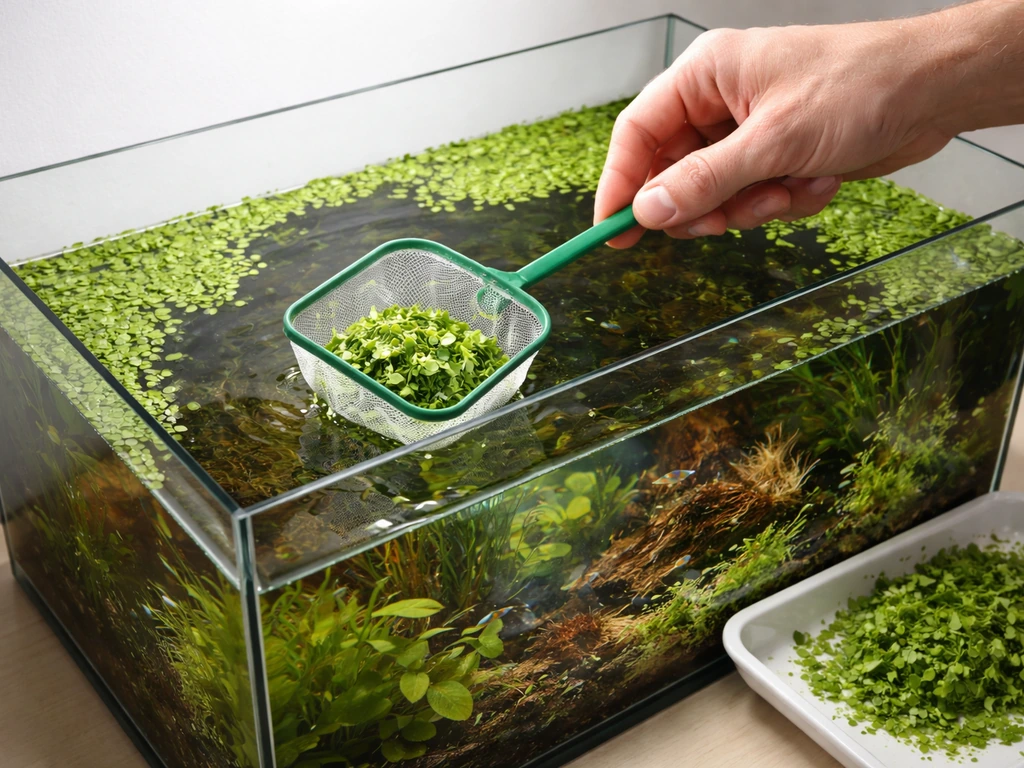
Check surface coverage at least once a week. For frogbit and duckweed in a healthy tank, you may need to remove a portion every 5 to 7 days to keep coverage below 70 percent. Water lettuce grows a little slower but the large rosettes can block almost all light if left unchecked. Just scoop out the excess with your hand or a net and discard or donate it. Never pour excess floating plants down a drain or into outdoor water.
Preventing sinking
Floating plants sink for a few specific reasons, all of which are fixable. The most common cause is water getting trapped in the leaf cups or on top of the leaves, which happens when surface agitation is too strong or when leaves are overcrowded and stacking on top of each other. Reduce flow, give plants more surface space by thinning the mat, and make sure no filter output is directed at the surface. Red root floaters are particularly prone to sinking from surface turbulence. If you notice plants consistently going under, the flow is almost always the culprit.
Preventing die-off from overcrowding
When floating plants pack too tightly together, the lower and inner leaves don't get light and start to rot. This creates a cycle where decaying plant matter pollutes the water and makes conditions worse for the surviving plants. The fix is regular thinning. If you see brown mush in the middle of a frogbit cluster or underneath a dense salvinia mat, that's a sign the colony is too thick. Break it up and remove the dead material.
Troubleshooting common problems and quick fixes
Most problems with floating plants trace back to a small list of causes. Here's how to diagnose and fix them quickly.
| Problem | Most Likely Cause | Fix |
|---|---|---|
| Yellowing leaves (new growth) | Iron or micronutrient deficiency | Add chelated liquid iron; check fertilizer routine |
| Yellowing leaves (old leaves only) | Normal leaf turnover or nitrogen deficiency | Normal if only old leaves; add liquid fertilizer if widespread |
| Plants sinking or flipping over | Too much surface agitation | Redirect filter outflow downward or toward glass |
| No new growth after 2 weeks | Insufficient light or temperature too low | Increase photoperiod to 10 hrs; check heater, raise temp to 75–78°F |
| Roots rotting (brown, slimy) | Poor water quality or very low flow | Check ammonia/nitrite; ensure gentle water movement |
| Algae growing on leaves | Too much light or excess nutrients | Reduce photoperiod; cut fertilizer dose in half |
| Plants spreading too fast | Ideal conditions (this is success) | Thin weekly; use floating rings to contain them |
| Leaves turning translucent or mushy | Temperature shock or water quality spike | Do a 25–30% water change; verify temp stability |
One failure I've seen repeatedly: people buy floating plants for a tank that's still cycling. Floating plants are not a shortcut through the nitrogen cycle. Ammonia and nitrite will kill them just as effectively as they kill fish. Get the tank fully cycled and stable first, then add your floaters.
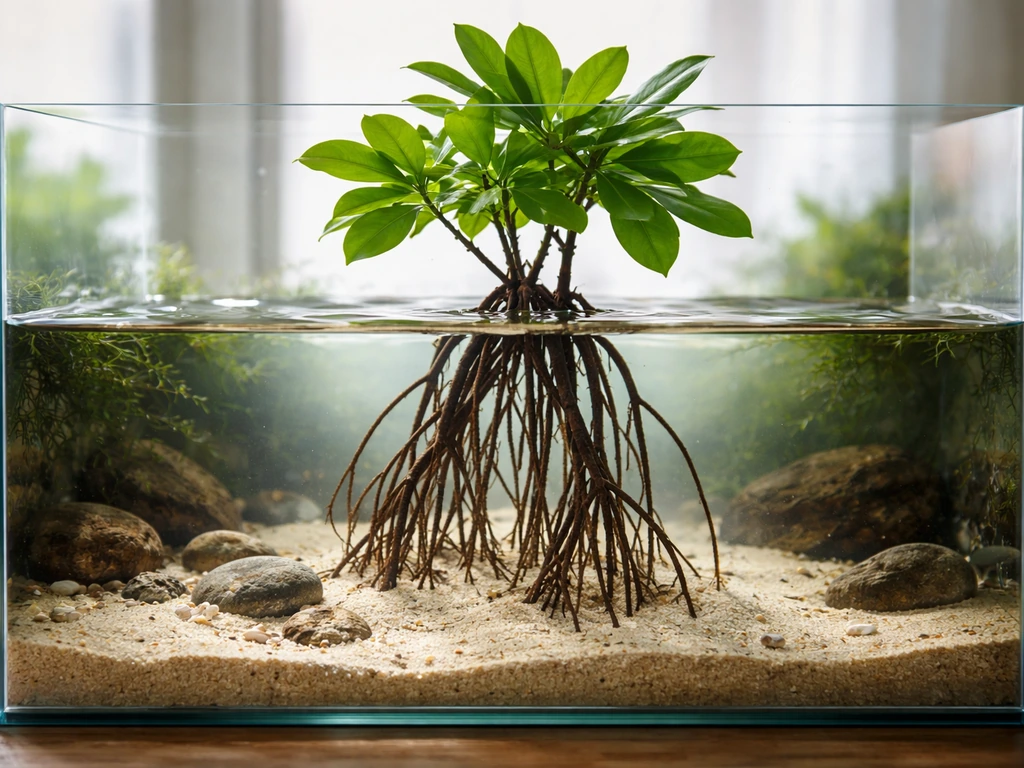
Also worth noting: if you're interested in growing other aquatic plants at the margins, like reeds or mangrove propagules, those have very different setups and requirements compared to fully floating species. Mangroves, including how to grow mangroves in freshwater, have very different requirements than floating aquarium plants, especially for rooting conditions and salinity reeds or mangrove propagules.
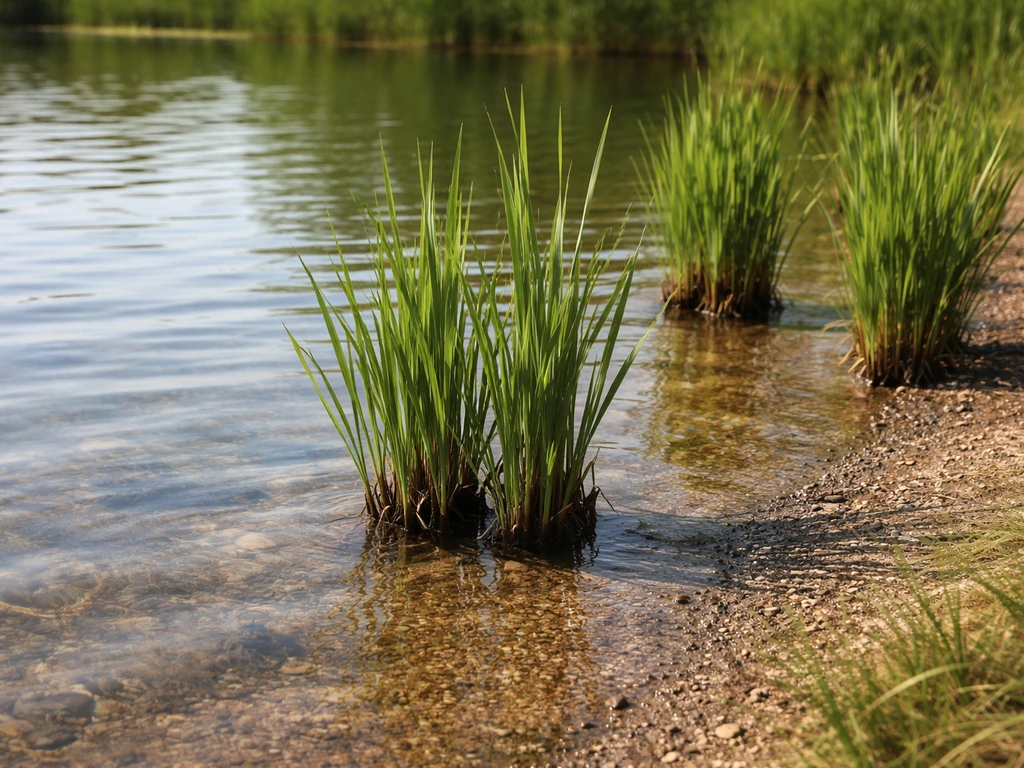
If you want to know aska how to grow reeds, look for reed-specific setup like planting depth, shoreline conditions, and light requirements. If you want to know how to grow reeds, focus on reed-specific setup like planting depth, shoreline conditions, and light requirements. Floating plants are almost entirely managed at the water surface and don't need substrate at all, which makes them uniquely low-effort once the water conditions are dialed in.
Simple growth checklist and next steps
Here's a quick reference you can use today before adding plants and then on an ongoing weekly basis.
Before you add plants (one-time setup)
- Tank is fully cycled: ammonia and nitrite at 0 ppm
- Water temperature is stable within your species' preferred range (72–80°F covers most)
- pH is between 6.5 and 7.5
- Filter return is aimed downward or at the glass, not the surface
- Floating plant ring or corral is in place if needed
- Sponge pre-filter is on the intake
- Light timer is set for 8 to 10 hours per day
Weekly maintenance routine
- Check surface coverage: remove excess plants if coverage is above 60–70%
- Look for yellowing, mushy, or sinking plants and address the cause (see troubleshooting table above)
- Do a 20–25% water change to reset nutrient levels and remove waste
- Dose liquid fertilizer if tank is lightly stocked (half-dose all-in-one; add liquid iron if you're growing red root floaters)
- Check that filter intake is clear of roots and debris
- Rinse sponge pre-filter in tank water (not tap water) if flow seems reduced
That's genuinely all it takes to grow healthy floating plants on an ongoing basis. The hardest part is the first two weeks while plants acclimate and you dial in your light and flow settings. After that, your biggest job is keeping up with how fast they grow. If you're starting with frogbit or salvinia, expect to be thinning them within 2 to 3 weeks of a good start. That's the goal: growth fast enough that pruning becomes your main concern.
FAQ
Can I add floating plants before my aquarium cycle is finished?
Yes, but only if the tank is already cycled and stable. Floating plants will fail quickly in tanks with active ammonia or nitrite, even if the temperature and light seem right. Before adding floaters, confirm you have 0 ammonia and 0 nitrite (and stable nitrate) for at least several days, then introduce floaters gradually to avoid sudden nutrient swings.
How can I tell if my filter flow is too strong for floating plants?
Aim for the most gentle circulation that still gives mild surface movement. A practical test is to observe the leaf tips, if they constantly flutter, get pressed down repeatedly, or form foam lines, flow is too strong. Redirect the outflow to the glass or downward, and avoid spray bars aimed at the surface.
My floaters are not growing, how do I know if it is light, nutrients, or something else?
Fast growers can still die back from nutrient issues, but the pattern helps you diagnose. Pale or yellow new growth that improves after adding a small amount of liquid iron points to an iron limitation, while overall slowing with no color change often points more to low light. If you see heavy algae alongside slower growth, reduce fertilizer first before adding more nutrients.
Should I use root tabs or substrate fertilizer for floating plants?
Do not add root tabs for floaters, even if you see roots hanging down. Root-feeder plants take nutrients from the water column, so root tabs largely miss the target. If you want to fertilize, use a liquid fertilizer strategy (conservative dosing) and, when needed, add chelated iron to the water column.
How much fertilizer should I dose when I have floating plants?
For most tanks, start with about half the label dose of a balanced liquid fertilizer, then adjust based on plant response and algae. Keep the photoperiod around 8 to 10 hours, because longer lighting increases nutrient demand and algae risk. If hair algae or green spot algae spikes, cut fertilizer dose before increasing plant coverage.
Do I need to quarantine floating plants before adding them to my main aquarium?
Quarantine is especially important if you are buying duckweed, salvinia, or red root floaters because hitchhikers and pests are common in bulk plant shipments. Rinse gently in dechlorinated water, then hold plants in a separate container with the same temperature and mild light for a short period before introducing them to the display. Inspect the underside of leaves and look for tiny snails or larvae.
What should I do if the middle of my floater mat turns brown or mushy?
Keep coverage under control and do not let decaying pockets form under a dense mat. Thin the plants regularly, remove brown or mushy sections immediately, and gently separate tightly packed clusters so inner leaves get light again. Also check surface calmness, because sinking plus rot often means both crowding and turbulence are happening together.
My tank has few fish. How do I avoid starving floating plants without causing algae?
In a lightly stocked fish tank, you may need to add nutrients, but start small and watch for algae. Overfeeding fish can also work, but it increases waste load and can destabilize water parameters, which can stress plants. If you prefer plant tank dosing, dose conservatively, maintain the correct light schedule, and consider supplementing iron specifically when new growth is pale.
What does yellowing mean in floating plants, and when is it normal?
If they are turning yellow, the quickest checks are light schedule, surface calmness, and iron availability. Yellow new growth with otherwise normal conditions often indicates iron deficiency, so a small chelated iron dose can help. If yellowing happens right after installation and new tips stay green, that is often normal transition from shipping stress.
Can I grow floating plants in a nano tank, and do I need different care?
Yes, floaters can absolutely be used in a small nano tank, but the key is matching species to surface area and flow. For example, water lettuce needs much more surface room than frogbit or salvinia, so you may need to start with fewer plants or switch species if you cannot thin regularly. Keep surface movement gentle and plan on more frequent pruning in small tanks.
What is the safest way to dispose of extra floating plants?
Never dump excess floating plants into drains or outdoor waterways. Instead, discard them in the trash after draining, or donate them to another aquarium hobbyist if you can confirm there is no pest risk. Keeping water lettuce strictly indoors is also important because it can be invasive in many regions.