Hornwort (Ceratophyllum demersum) is one of the fastest-growing aquatic plants you can put in a tank or water system, and it thrives with very little fuss. If yours is sitting there looking stagnant, it almost always comes down to one or two fixable variables: light, nutrients, or flow. This guide walks you through the full setup from scratch and gives you specific numbers to dial in so you stop guessing and start seeing real growth.
How to Grow Hornwort Fast: Setup, Care, and Fixes
Marcus Holloway
9 Apr 2026
What you're actually growing
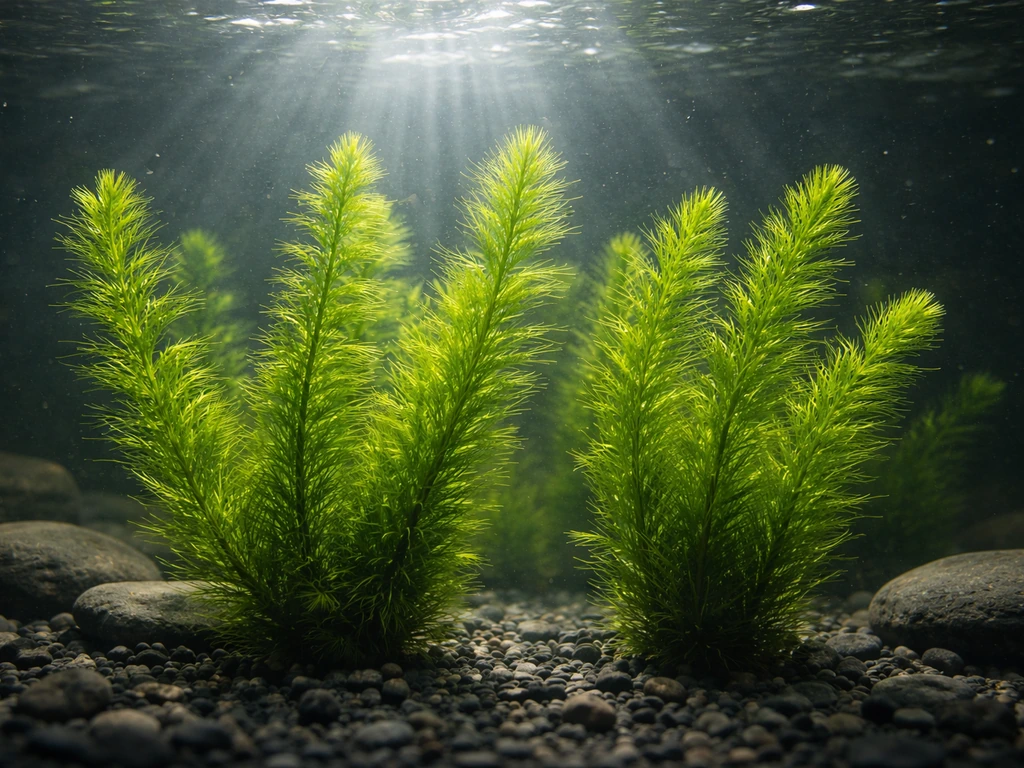
Hornwort (Ceratophyllum demersum) is a submerged, rootless aquatic plant sometimes called coontail or rigid hornwort. It's sold as bunched stems at most fish and aquatic plant shops. What makes it unusual compared to most aquarium plants is that it has no true roots, so it doesn't need substrate to survive. It can float freely at the surface, drift mid-column, or be gently weighted down near the bottom. That flexibility is a huge advantage if you're running a bare-bottom tank, a hydroponic-style water system, or a pond setup.
Because hornwort pulls everything it needs directly from the water column through its needle-like leaves, it's a powerful nutrient absorber. Research on Ceratophyllum demersum confirms it can actively sequester phosphorus and nitrogen from the water, which is great for water quality but also means it needs those nutrients replenished if you want it to keep growing fast. It propagates by fragmentation, meaning every cutting you make is a potential new plant. That's your primary tool for multiplying your stock quickly.
When you buy hornwort, you're typically getting a bunch of stems around 20–30 cm long. Remove the rubber band or lead weight immediately. Let the plant float for the first day or two while it adjusts to your water parameters before you decide where to place it permanently. Rushing the placement before acclimation is one of the first mistakes beginners make.
Water conditions that actually matter
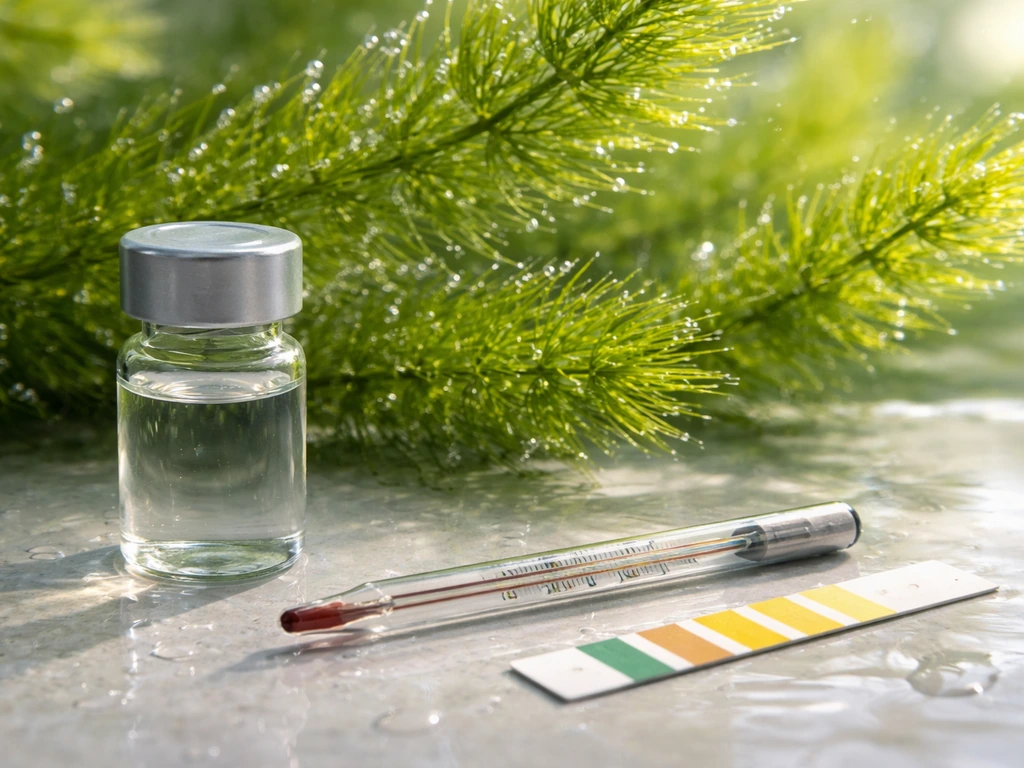
Hornwort is genuinely adaptable, but "adaptable" doesn't mean "will thrive in anything." Here are the parameters that drive fast, healthy growth:
| Parameter | Tolerated Range | Sweet Spot for Fast Growth |
|---|---|---|
| Temperature | 10–28 °C (50–82 °F) | 20–25 °C (68–77 °F) |
| pH | 6.0–9.0 | 6.5–7.5 |
| Hardness | Soft to very hard | Moderate (GH 6–12 dGH) |
| Dissolved Oxygen | Tolerant | 8–12 mg/L |
| Flow | Slow to moderate | Gentle circulation, no strong current |
Temperature is the easiest win. Hornwort does grow in cooler water (down to 10 °C), but it noticeably accelerates in the 20–25 °C range. If your tank runs cold, warming it up a few degrees can make a visible difference within a week. On the pH side, anywhere between 6 and 9 is technically survivable, but the 6.5–7.5 range keeps nutrient availability optimal and prevents any stress-related slowdowns.
Flow is something people overlook. Hornwort naturally comes from slow-moving or still water, so strong powerheads or high-flow returns will batter the stems, cause shedding, and slow growth. Gentle surface movement is ideal: enough to distribute nutrients and maintain dissolved oxygen around 8–12 mg/L (studies on Ceratophyllum demersum confirm this range supports healthy photosynthesis and respiration), but not so much that it's constantly agitated. A sponge filter or a spray bar pointed at the glass wall rather than directly at the plants usually works well.
Getting the lighting right
Hornwort is classified as a low-light plant, and that's technically accurate, but low light doesn't mean maximum growth. It means it won't melt or die in dim conditions. If you want fast growth, you want to push the light higher while staying within the plant's comfort zone.
A practical brightness target is 30–50 μmol/m²/s at the water surface, which roughly translates to about 2–3 watts per gallon if you're using older wattage-based rules of thumb. Tropica's profile for Ceratophyllum demersum uses 0.5 W/L as their lighting proxy, which aligns with a moderate output LED or T5 setup positioned a few inches above the waterline. If your light is weak or mounted too high, this is the single most common reason hornwort just sits there doing nothing.
Photoperiod matters just as much as intensity. Run your lights 8–12 hours per day. I personally land on 10 hours as a solid middle ground: enough to drive vigorous growth without tipping the tank into an algae bloom. Use a timer so it's consistent. Irregular photoperiods stress aquatic plants more than most people realize.
Placement within the tank also affects how fast hornwort grows. Floating hornwort at the surface gets the most light and will outpace submerged stems noticeably. The trade-off is that a thick floating mat will shade everything below it, including other plants and submerged portions of the hornwort itself. If you're running hornwort alongside other plants like moneywort in an aquarium, keep the hornwort thinned out at the surface so it doesn't steal all the light from your lower-growing species.
Nutrients and CO2: what hornwort actually needs
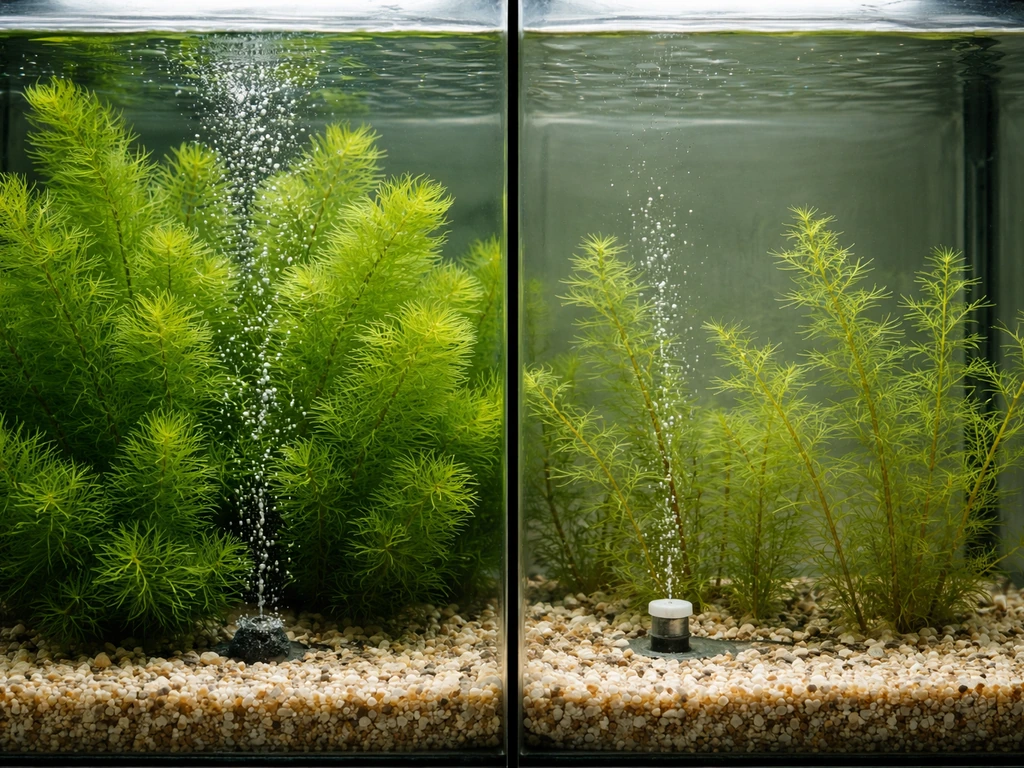
Here's where a lot of people get confused: hornwort is often described as a plant that needs no fertilizer. That's true in a tank with active fish, because it pulls nitrogen from fish waste and uneaten food. But in a lightly stocked or newly set-up system, the water column may not have enough nutrients to sustain rapid growth, and that's when deficiencies show up as yellowing, slow extension, or sparse foliage.
If your tank is well-stocked, hornwort will likely feed itself. If it's not, or if growth stalls, add a liquid water-column fertilizer with nitrogen and iron. Because hornwort has no roots, root tabs do nothing for it. Liquid fertilizers dosed weekly are the right approach. Aquarium Co-Op recommends regular nutrient dosing specifically for hornwort because its fast growth can drain nutrients quickly, so don't underdose if you have a lot of it. Hornwort is also documented to absorb phosphorus efficiently from enriched water, which is worth knowing: if you're using it in a nutrient-heavy system for water quality, it will actively compete with algae for phosphorus, which is a net positive.
CO2 injection is not required for hornwort to grow or stay healthy, but it is an accelerator. If you're already running pressurized CO2 for other plants in your setup, hornwort will benefit and grow noticeably faster. If you're not, don't add a CO2 system just for hornwort. It's not worth the cost or complexity for a plant that already grows fast without it. Focus on light and nutrients first.
If you're running hornwort in a hydroponic-style system or a dedicated aquatic grow setup rather than a traditional aquarium, the same rules apply. Keep nutrients cycling through the water column, maintain gentle flow, and give it adequate light. Hornwort can outperform many other aquatic macrophytes in semi-aquatic grow systems precisely because it doesn't need a rooting medium. Comparing it with something like water dropwort in a hydro setup shows just how different nutrient delivery strategies can be between rooted and rootless aquatic plants.
Planting, anchoring, and routine care
Starting from cuttings
Hornwort propagates through vegetative fragmentation: cut a stem, and both the cutting and the parent plant will continue to grow. To start new plants, simply trim stems to your desired length (10–20 cm works well) and either float them or anchor them loosely in the tank. Each cutting will begin extending from the tip within days under good conditions. This is also how you manage an established plant that's getting too large: trim it, keep the best cuttings, and either replant them or pass them on.
For growing hornwort in an aquarium specifically, you have two options for placement. Floating is the easier route and gives faster results because the plant gets maximum light. Anchoring requires weighting the stem base with a small plant weight or tucking the end loosely into a dense substrate, but because hornwort has no true roots, it won't root down the way a stem plant like a hygrophila would. It's just held in place mechanically.
Routine pruning and maintenance
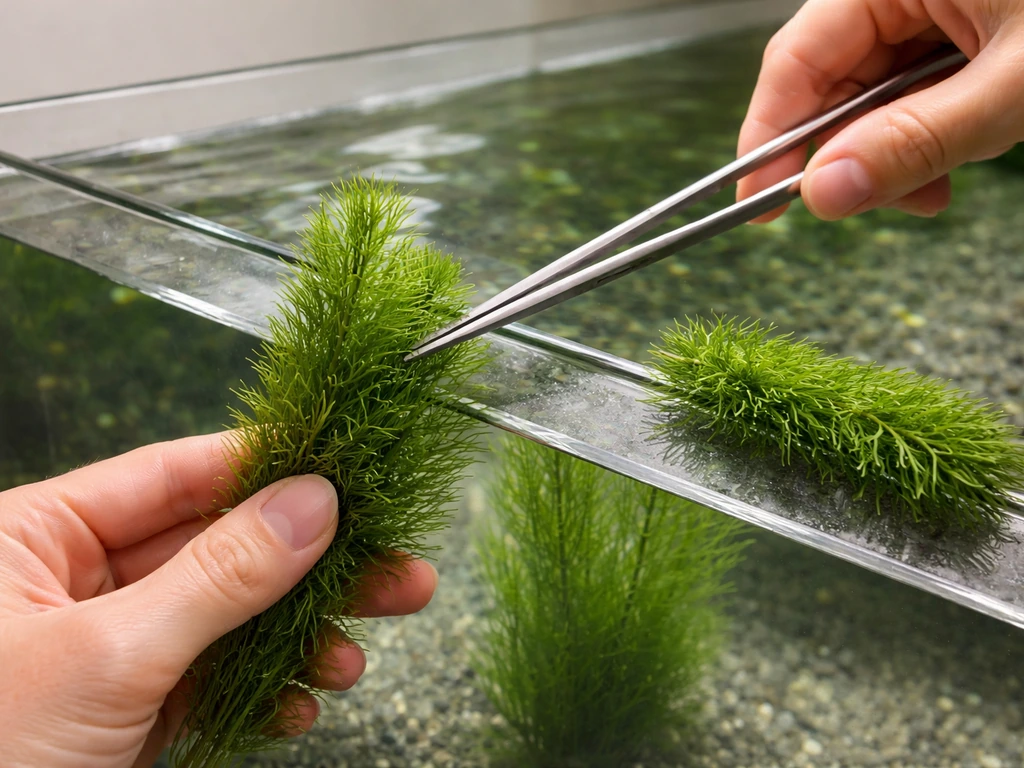
Once hornwort is growing fast, it needs regular trimming, sometimes weekly. Left unchecked, a single bunch can double in length in a few weeks and start shading everything else in the tank. Trim from the top or side, cut the stems cleanly with scissors, and either remove the trimmings or replant them. Do not let large amounts of trimmed hornwort rot in the tank; it releases nutrients back into the water and can trigger algae blooms. Consistent pruning also encourages denser, bushier growth rather than a single long stringy stem.
Water changes are part of routine care too. Even though hornwort absorbs nutrients efficiently, weekly 25–30% water changes keep conditions stable and prevent waste buildup. In a healthy, balanced system, hornwort essentially does a lot of your water-quality work for you, similar to how frogbit works as a floating plant to export nutrients through its leaf mass.
Why your hornwort isn't growing (and how to fix it)
Hornwort is described as an easy, fast grower, which is true under the right conditions. But when conditions are off, it can just sit there, shed its needles, or slowly dissolve. Here are the most common culprits:
- Light is too low or photoperiod is too short: This is the most common cause. If your light is dim or running fewer than 8 hours per day, hornwort will survive but not grow meaningfully. Increase intensity toward 30–50 μmol/m²/s and set a consistent 10-hour photoperiod.
- Light change causing shedding ("melt"): If you've just moved hornwort from a high-light to a low-light environment, or vice versa, expect a shedding period of 1–2 weeks while it adjusts. The needles drop and the stems may look bare. This is acclimation, not death. Keep conditions stable and new growth will resume.
- Nutrient deficiency in a lightly stocked tank: Yellowing tips and slow extension usually mean the water column is low in nitrogen or iron. Dose a liquid all-in-one fertilizer weekly until growth resumes.
- Excess phosphorus or imbalanced nutrients: Paradoxically, too much phosphorus relative to nitrogen can promote algae over plant growth. Hornwort will absorb phosphorus, but algae may outcompete it if lighting is inconsistent. Keep your NPK ratio balanced.
- Too much flow or turbulence: Strong current physically damages hornwort and causes needle drop. Switch to a gentler filter outlet or reposition your spray bar.
- Algae competition: Green spot algae or hair algae on hornwort stems blocks light to the plant's foliage. Manual removal and a tightened photoperiod (reduce to 8 hours temporarily) usually resolve this.
- Water temperature too low: Hornwort below 15 °C will grow very slowly. Raise the temperature to at least 20 °C for noticeable improvement.
- Overcrowded mat blocking its own light: If floating hornwort forms a thick mat, the lower stems get shaded and die back while the top grows. Thin the mat regularly to let light penetrate.
One thing I've noticed: people often diagnose the wrong problem. They add CO2 when the actual issue is dim lighting, or they add fertilizer when the problem is flow stress. Work through the list systematically. Fix light first, then nutrients, then flow. Most slow-growth problems resolve within two weeks of addressing the correct variable.
Algae is worth its own mention because hornwort and algae often compete directly. Hornwort floating at the surface will shade the water below, which naturally suppresses algae growth, but if your light is too intense for too long, algae will colonize the hornwort itself. This is the same dynamic you'd manage with other surface plants; for comparison, growing pennywort involves the same light-algae balancing act when it spreads across the surface.
How to grow hornwort faster: the real acceleration tactics
If you want to maximize growth rate, here's the honest priority list. These are ranked by impact and ease of implementation:
- Float it at the surface: Floating hornwort under a direct light source will grow significantly faster than submerged hornwort competing for light. If you have multiple stems, float at least some of them.
- Optimize temperature to 22–25 °C: This is the sweet spot where hornwort's metabolism runs fastest. If you're running a cold tank, a small heater upgrade pays off quickly.
- Run a 10–12 hour photoperiod with adequate intensity: Hit that 30–50 μmol/m²/s target consistently. A good quality LED planted tank light on a timer is all you need.
- Dose liquid fertilizer weekly: In a lightly stocked system, nitrogen and iron are often the limiting factor. Add a water-column fertilizer every 7 days and watch growth accelerate.
- Add CO2 if you're already set up for it: CO2 injection noticeably boosts growth rate. It's not necessary, but if you have the equipment, hornwort will respond well.
- Propagate actively: Don't wait for stems to get unmanageable. Trim regularly and replant cuttings. Each new cutting that roots (mechanically anchors) and starts growing extends your total plant mass faster than waiting for existing stems to elongate.
- Keep phosphorus in check: Hornwort absorbs phosphorus well, but high phosphorus without matching nitrogen drives algae rather than plant growth. Test your water and balance accordingly.
What a realistic success timeline looks like
Under good conditions (temperature 22–25 °C, 10-hour photoperiod at adequate intensity, weekly fertilization), here's what to expect:
| Timeframe | What You Should See |
|---|---|
| Days 1–5 | Minimal visible change; plant is acclimating to your water parameters. Some minor needle drop is normal. |
| Week 1–2 | Tip growth begins. Stems start extending from the growing tips. Floating stems show growth first. |
| Week 3–4 | Noticeable stem elongation (several centimeters per week under ideal conditions). First pruning may be needed. |
| Month 2+ | Established, fast-growing colony. Regular trimming needed every 1–2 weeks. Propagation from cuttings is reliable and rapid. |
If you're not seeing tip growth by the end of week two, revisit your lighting setup first. That's almost always the bottleneck. Hornwort is genuinely one of the fastest aquatic plants available, but it still needs the basics dialed in. Once it's growing, it will surprise you with how fast it takes over if you don't stay on top of the pruning.
For growers interested in expanding their aquatic plant collection alongside hornwort, plants like liverwort in water-based systems and saltwort in aquatic setups offer interesting contrasts in growth habit and care requirements, and they're worth exploring once you've got your hornwort thriving.
FAQ
Can I plant hornwort under other plants, or will it block their growth?
Yes. For the fastest growth, keep hornwort mostly near the brightest zone (often the surface), then thin it out so it does not form a thick mat that blocks light and slows the rest of your tank.
What’s the best way to increase light intensity without shocking hornwort?
Do it gently and gradually. If you must change from low light to your target brightness, increase intensity over several days to a week to reduce needle shedding, which is common when lighting jumps too quickly.
How strict do I need to be about pH stability when growing hornwort?
Hornwort can handle a wide pH range, but sudden swings are the real problem. Match new water to tank pH during water changes (and when acclimating fresh cuttings) to avoid temporary slow growth or shedding.
My hornwort isn’t growing, but it looks healthy. What should I check first?
If the tips are not extending but the plant is still green, treat it as a setup issue rather than immediately adding CO2. Most “no growth” cases are dim lighting, then nutrient starvation, then flow stress.
Should I add CO2 specifically for hornwort to get faster growth?
Don’t target carbon as the primary fix. Since hornwort already grows quickly without CO2, start by dialing in light and nutrients, then only add CO2 if you are already running it for other plants and can keep flow and oxygen stable.
Why does my tank sometimes get algae after I prune hornwort?
Use trimming as your growth control tool. Cut back regularly and remove a portion of the biomass (rather than letting it pile up), because heavy rot from leftover trimmings can cause ammonia and fuel algae.
If my tank is low-tech, can I fertilize hornwort heavily to speed it up?
Yes, but start small. In a new or lightly stocked tank, begin liquid water-column fertilizing conservatively and watch for changes over 1 to 2 weeks, because excess nutrients can boost algae faster than hornwort can assimilate them.
What flow rate is “too much” for hornwort, and how do I tell?
Keep flow low but not stagnant. If you see stems repeatedly getting battered or losing needles, reduce direct pump impact, aim a return at the glass or diffuser outflow, and add gentle circulation to prevent dead spots.
Can I root hornwort into gravel or sand to make it stay in place?
Avoid burying it like a rooted plant. Because it has no true root system, it won’t establish from the base into substrate, and buried stems often rot or shed needles if they are trapped and starved of light.
How do I use hornwort to improve water quality without causing algae problems?
If you use it for nutrient export, treat pruning as a nutrient-management cycle. Remove some biomass during regular trims, and keep lighting in check so algae does not colonize the hornwort surface.
My hornwort is covered in algae. Should I dose chemicals or fix the setup?
Algae can grow on hornwort when light is strong and persistent, especially on surface-floating mats. Thinning the hornwort, balancing photoperiod, and removing excess biomass usually works better than adding algae treatments immediately.
Hornwort is shedding needles, does that mean it’s dying?
If it sheds needles, look at recent changes. The most common causes are abrupt light increases, strong direct flow, or nutrient deficiency during early establishment, and the plant often rebounds once conditions stabilize.
Should I wait before placing hornwort where it will stay permanently?
For new plants, the first days matter. Let cuttings float temporarily for acclimation, then move them to your chosen spot once temperature and lighting match the tank environment to reduce shock.
Can I grow hornwort in a tub or semi-hydro setup, and will it grow as fast as in an aquarium?
Yes, but expect slower establishment if conditions are cold and low light. Aim for the same temperature and brightness targets as your aquarium, and keep the water nutrient cycling steady since hornwort depends on the water column for uptake.