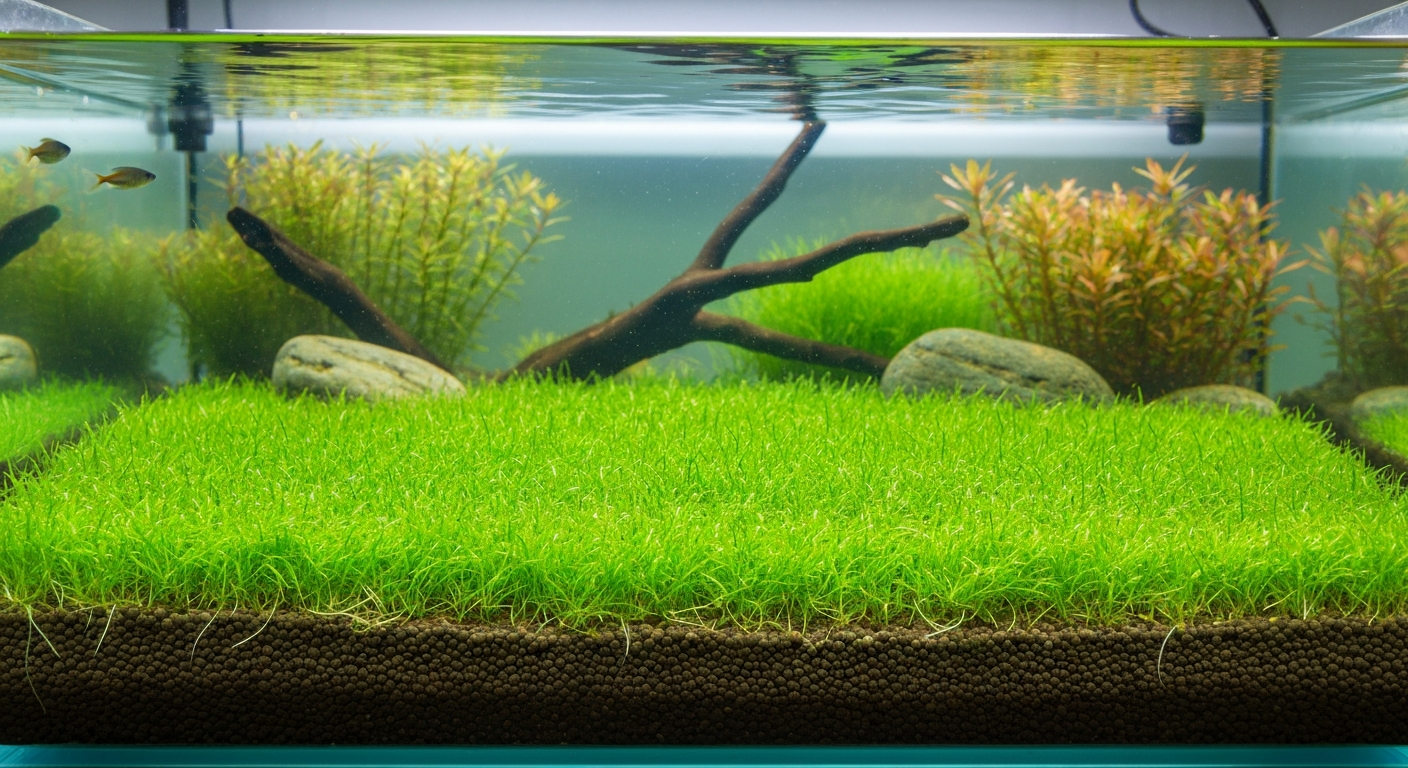
You can grow a dense hairgrass carpet in 4 to 8 weeks with pressurised CO2, a quality aquasoil, and enough light hitting the substrate. Without CO2, expect a slower process of several months and a carpet that tends to grow upward rather than spread. The species most commonly sold for carpeting are Eleocharis parvula (dwarf hairgrass), Eleocharis acicularis 'Mini', and standard E. acicularis, each behaves slightly differently, so picking the right one for your tank size and setup matters before you buy your first cup.
How to Grow Hair Grass in Aquarium: Complete 8-Week Guide
Marcus Holloway
22 Jul 2026
What is hairgrass and which Eleocharis species should you choose?
Hairgrass is the common name for aquatic plants in the Eleocharis genus, a group of fine-leaved, grass-like plants that spread by horizontal runners (stolons) to form a low, lawn-like carpet across the aquarium floor. The trade labeling is honestly a mess. Many bags and cups sold as 'E. parvula' are actually E. acicularis or a closely related taxon, the two species look similar, both grow in similar conditions, and hobbyists often only discover the difference when one grows taller than expected. The key distinction to focus on is size, not species name.
| Species / Form | Typical Submerged Height | Carpet Speed | Best Use |
|---|---|---|---|
| Eleocharis parvula (dwarf hairgrass) | 3–6 cm | Moderate to fast with CO2 | Small to medium foreground carpets |
| Eleocharis acicularis 'Mini' | 2–5 cm | Fast with CO2 | Nano tanks and competition-style layouts |
| Eleocharis acicularis (standard) | 10–20 cm (trimmed lower) | Moderate | Mid-foreground or taller carpet effect |
| Eleocharis vivipara | 20–40+ cm | Slow spreader | Accent plant, not a carpeting choice |
For most beginners building a foreground carpet, I recommend tissue-culture cups of Eleocharis acicularis 'Mini' or E. parvula, whichever your supplier stocks reliably. The 'Mini' cultivar (widely available from Tropica and similar labs) stays compact and spreads aggressively under good conditions. If you see it labeled inconsistently at your local fish store, ask what height it reaches at maturity: anything under 6 cm submerged qualifies as a true carpeting form. Standard E. acicularis works too but will need regular trimming or it creeps upward rather than staying tight to the substrate.
Quick success checklist before you plant
Before you spend money on plants or rearrange your tank, run through this list. I've seen more hairgrass failures come from skipping the basics than from any exotic technique. Every item here corresponds to a section below with full details.
- Choose a carpeting Eleocharis form (E. parvula, E. acicularis 'Mini') — confirm mature height before buying
- Use a fine-grain, nutrient-rich aquasoil substrate at 2–4 cm depth in the foreground zone
- Hit medium to high light at the substrate level: aim for 50–100+ µmol·m⁻²·s⁻¹ PAR
- Run pressurised CO2 at 20–30 ppm dissolved (use a drop-checker to verify)
- Keep water parameters in range: temperature 20–27°C, pH 6.0–7.5, GH 4–10 °dGH
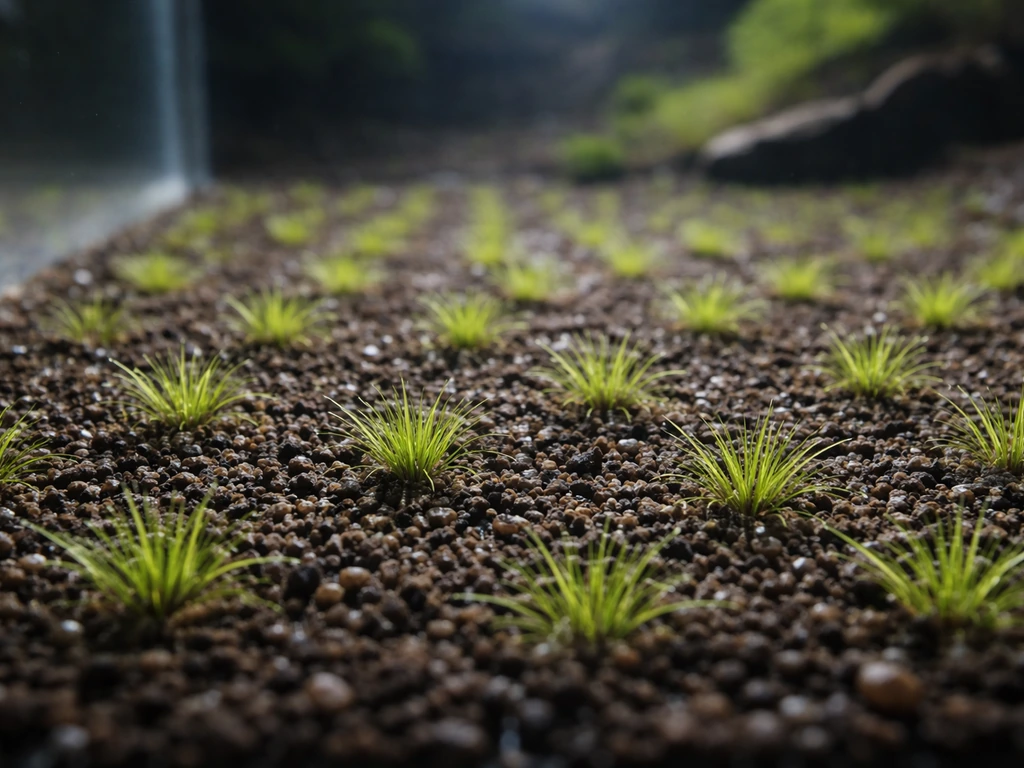
- Plant tissue-culture plugs in a grid at ~2–3 cm spacing, crown just below the substrate surface
- Dose macro and micro fertilisers from day one — root tabs if using inert substrate
- Maintain 4–6x tank turnover per hour for moderate flow across the carpet
- Do a 50% water change weekly to reset nutrient levels and reduce algae pressure
- Expect visible carpeting in 4–8 weeks with CO2; without CO2, allow 3–6 months minimum
Equipment and materials you'll need
This isn't a list padded for length, everything here genuinely moves the needle for hairgrass success. The items marked as 'essential' apply to both low-tech and high-tech setups. CO2 equipment is technically optional but is the single biggest lever for fast carpeting results.
- Substrate: nutrient-rich aquasoil (ADA Amazonia, Tropica Aquarium Soil, Fluval Stratum, UNS Controsoil) — fine-grain is critical for runner penetration
- Optional substrate base layer: laterite or similar nutrient base capped with fine sand or powder if not using full aquasoil
- Root tabs: essential if using inert gravel or sand
- Curved tweezers (20–30 cm): the only practical tool for planting fine grass plugs into substrate
- Trimming scissors (straight or curved blade): for shaping the carpet once established
- CO2 pressurised system: regulator, solenoid with timer, diffuser or inline reactor (highly recommended for fast carpeting)
- CO2 drop-checker with 4 dKH reference solution and bromothymol blue dye: to monitor dissolved CO2 levels
- Light: LED or T5 fixture capable of delivering medium-high PAR at substrate level (50–100+ µmol·m⁻²·s⁻¹ for carpeting)
- Light timer: to run a consistent photoperiod (8–10 hours per day)
- Filter and circulation pump sized to 4–6x (to 6–8x) tank volume turnover per hour
- Liquid fertiliser: all-in-one or separate macro (N, P, K) and micro (Fe, Mn, trace elements) products
- Test kits or digital meter: pH, CO2 drop-checker, GH/KH, nitrate — at minimum test pH and KH weekly
Setting up the aquarium: substrate, depth, flow, and hardscape
Substrate choice and depth
Aquasoil is not optional if you want fast, reliable results. The buffering capacity, nutrient content, and fine grain structure of products like ADA Amazonia or Tropica Aquarium Soil give hairgrass exactly what it needs: a substrate it can root into within days and enough fertility to fuel early runner production. I've tried hairgrass over plain sand with root tabs and it eventually works, but the establishment phase is noticeably slower and the carpet fills in patchier. If budget forces you toward inert substrate, use a nutrient base layer under a 1–2 cm fine-sand cap and place root tabs every 10–15 cm in the planting zone.
Depth matters more than people think. A foreground carpet zone of 2–4 cm aquasoil is the sweet spot, deep enough for roots to anchor and runners to travel horizontally without hitting the tank base, but not so deep that anaerobic pockets form and damage roots. For mid-ground and sloped aquascapes, the back can be deeper (5–8 cm) to support taller background plants, but keep the foreground carpet zone at 2–4 cm.
Flow and filtration
Aim for 4–6 times tank volume per hour as a minimum flow rate for a planted hairgrass tank, and closer to 6–8x if the tank is stocked with fish. The goal is gentle, even circulation across the substrate, enough to carry CO2 and nutrients to the carpet without creating a current that uproots newly planted plugs or kicks substrate up continuously. I angle my filter output along the back wall or toward the surface rather than directly at the foreground. Once the carpet is established and rooted, it handles quite strong flow without issues.
Hardscape placement
Place rocks and driftwood before you plant. Hairgrass runners spread outward and will eventually grow under and around hardscape, which looks natural, but you can't reposition a rock without uprooting weeks of runner growth. If you're building an island or path effect with hairgrass, lay out the full hardscape, confirm you're happy with it, then plant into the substrate around it. Leave at least 3–4 cm of clear substrate around rock bases so the plants have room to anchor before they encounter the obstruction.
Water parameters and target ranges
Hairgrass is more adaptable than many planted-tank guides suggest, but it does best in soft to moderately hard, slightly acidic to neutral water. Hard, alkaline tap water above pH 7.8 is the condition I see cause the most slow growth and yellowing in beginner tanks. If your tap water is hard, aquasoil will buffer pH down over its first few months, another reason to use it.
| Parameter | Target Range | Notes |
|---|---|---|
| Temperature | 20–27°C (68–80°F) | E. acicularis tolerates cooler (down to ~15°C) but growth slows |
| pH | 6.0–7.5 | 6.5–7.0 is the sweet spot; above 7.5 growth slows noticeably |
| GH (General Hardness) | 4–10 °dGH | Moderate softness preferred; above 12 °dGH watch for stunted growth |
| KH (Carbonate Hardness) | 2–6 °dKH | Relevant for CO2 drop-checker calibration; too high resists pH buffering |
| Nitrate (NO3) | 10–30 mg/L | Deficiency causes pale, slow growth; excess fuels algae |
| Phosphate (PO4) | 0.5–2 mg/L | Don't drive to zero — hairgrass needs phosphate |
| Temperature (low-tech option) | 20–25°C | Cooler temps can slightly reduce algae pressure without CO2 |
Lighting: intensity, spectrum, and schedule
Light is what drives the carpet to stay compact and spread laterally. When light is insufficient, hairgrass grows upward reaching for it, you get a tall, wispy stand of grass instead of a tight lawn. For a proper carpeting effect, you need medium to high PAR at substrate level, especially in a tank that is 30 cm or deeper. Low-tech tanks without CO2 can get away with moderate light (30–50 µmol·m⁻²·s⁻¹) and slower results; high-tech setups with CO2 and fertiliser benefit from 50–100+ µmol·m⁻²·s⁻¹ at the substrate surface.
| Setup Type | Substrate PAR Target | Expected Carpet Speed | Risk |
|---|---|---|---|
| Low-tech (no CO2) | 30–50 µmol·m⁻²·s⁻¹ | Several months, may stay tall | Low algae risk if underfertilised |
| Medium-tech (liquid CO2 / Excel) | 40–70 µmol·m⁻²·s⁻¹ | 2–4 months for fill | Moderate algae risk |
| High-tech (pressurised CO2) | 50–100+ µmol·m⁻²·s⁻¹ | 4–8 weeks for dense carpet | Higher algae risk without nutrients balanced |
For spectrum, a full-spectrum LED in the 6500–7000K range works well. Many modern planted tank LEDs (Chihiros, Twinstar, Fluval Plant 3.0, etc.) hit the right PAR numbers if positioned correctly. The most common mistake is running a light rated for a larger tank over a smaller setup at full intensity from day one, this invites algae before the plants are established enough to compete. I always start new tanks at 60–70% intensity and ramp up over 2–3 weeks as the plants take hold.
Run an 8–10 hour photoperiod on a timer. Consistency matters more than total hours, a 9-hour stable schedule every day outperforms irregular lighting that varies by 2–3 hours. If algae becomes a problem, drop to 7–8 hours before cutting fertiliser or CO2.
CO2: when it's necessary, target levels, and delivery options
CO2 is not mandatory to grow hairgrass, but it is the most impactful single upgrade you can make for fast carpeting. Without it, hairgrass can take 3–6 months to produce a dense carpet, and in harder or warmer water it may never carpet densely at all, just grow as individual clumps. With pressurised CO2 at 20–30 ppm dissolved, the same plants can carpet completely in 4–8 weeks under good light and nutrients. Carpeting timelines (practical benchmarks): in high‑light + pressurised CO₂ + aquasoil setups, many hobby/pro‑scapers report visible dense carpeting of Eleocharis in ~4–8 weeks; in low‑tech or no‑CO₂ setups expect slower, vertical/taller growth and timelines of several months to a year for a dense carpet if it establishes at all Dwarf Hairgrass carpet timelines — Gensou Aquascaping. That is a significant difference if you're putting effort into a planted layout.
Target 20–30 ppm dissolved CO2 in the water column during the photoperiod. The easiest way to verify this without a dedicated meter is a drop-checker: fill it with 4 dKH reference solution and bromothymol blue dye, hang it in the tank, and check the color. For setup details and best practices (use a 4 dKH reference solution with bromothymol blue, green ≈ 20–30 ppm, run CO₂ with a solenoid/timer and monitor fish behaviour), see Best Aquarium CO₂ Drop Checkers & How They Work, AquaCrafter (guide) Best Aquarium CO₂ Drop Checkers & How They Work — AquaCrafter (guide). Green means you're in the target range (~20–30 ppm). Yellow means too much CO2 (reduce injection rate or aeration). Blue means too little (increase injection rate). Always watch your fish: gasping at the surface or hanging near the outlet is a warning sign to reduce CO2 immediately.
- Pressurised CO2 system (regulator + solenoid + diffuser or inline reactor): the most reliable delivery method, best for serious setups
- Set the solenoid timer to turn CO2 on 1 hour before lights on and off 1 hour before lights go out
- Inline reactor (on filter outlet): dissolves CO2 more efficiently than a surface diffuser, works well in tanks over 60 litres
- Ceramic diffuser: affordable entry option, produces fine bubbles — works best in tanks under 100 litres with moderate flow
- DIY yeast CO2: inconsistent pressure and concentration, not recommended for carpeting hairgrass — too unreliable
- Liquid carbon supplements (Seachem Excel, Easy Carbon): helpful in low-tech tanks, but do not replicate the carpet-forming speed of pressurised CO2
Fertilisation: macros, micros, dosing schedules, and examples
Hairgrass feeds heavily through its roots, which is why substrate quality matters so much. But in an active carpeting setup with CO2 and high light, the water column also needs regular nutrient replenishment. Deficiency in any major element will stall carpet growth or cause yellowing faster than you expect in a high-energy setup.
Root versus water column dosing
If you're using a nutrient-rich aquasoil, root-zone nutrition is largely covered for the first 6–12 months. After that, or if you're on inert substrate from the start, place root tabs directly under the carpet zone every 10–15 cm and replace them every 3–4 months. For water column dosing, a combination of macronutrients (N, P, K) and micronutrients (iron, manganese, trace elements) dosed on a regular schedule is the approach used in almost every successful planted tank. Iron deficiency shows up as pale new growth in hairgrass before any other symptom, if the tips are going white or very pale yellow, add a chelated iron dose immediately.
Beginner dosing: all-in-one liquid fertilisers
If you're new to planted tanks, start with an all-in-one liquid fertiliser (Tropica Premium, Seachem Flourish, Easy Green, etc.) and follow the manufacturer's dose 2–3 times per week. These products keep things simple by combining macros and micros. They work well in medium-tech setups and will support hairgrass growth without the need to manage separate bottles. The limitation is that in high-tech, high-demand setups these products can run short on nitrogen or potassium, so watch for deficiency signs after the first month.
Advanced dosing: Estimative Index (EI) approach
For high-light, pressurised CO2 setups where you want maximum carpet speed, the Estimative Index (EI) method doses separate macros and micros on a rotating schedule and relies on a large weekly water change (50%) to reset nutrient levels rather than constant testing. Weekly target concentrations in an EI-style setup are approximately 20–30 mg/L nitrate, 1–2 mg/L phosphate, and 20–30 mg/L potassium. Dose macros three times per week (e.g. Monday, Wednesday, Friday) and micros on alternating days (Tuesday, Thursday, Saturday), then do a 50% water change on Sunday before the next cycle begins.
| Day | Action |
|---|---|
| Monday | Dose macro fertiliser (N, P, K salts or macro liquid) |
| Tuesday | Dose micro fertiliser (Fe, Mn, trace elements) |
| Wednesday | Dose macro fertiliser |
| Thursday | Dose micro fertiliser |
| Friday | Dose macro fertiliser |
| Saturday | Dose micro fertiliser |
| Sunday | 50% water change — reset nutrient baseline |
You don't need to test every week with EI if you're doing the water changes consistently. The philosophy is: dose enough that deficiency is never the limiting factor, then use the water change to prevent excess buildup. This approach is well-suited to Eleocharis carpeting because it keeps iron and trace elements available at the root level while the water change removes any accumulated algae-fueling surplus.
Step-by-step planting guide
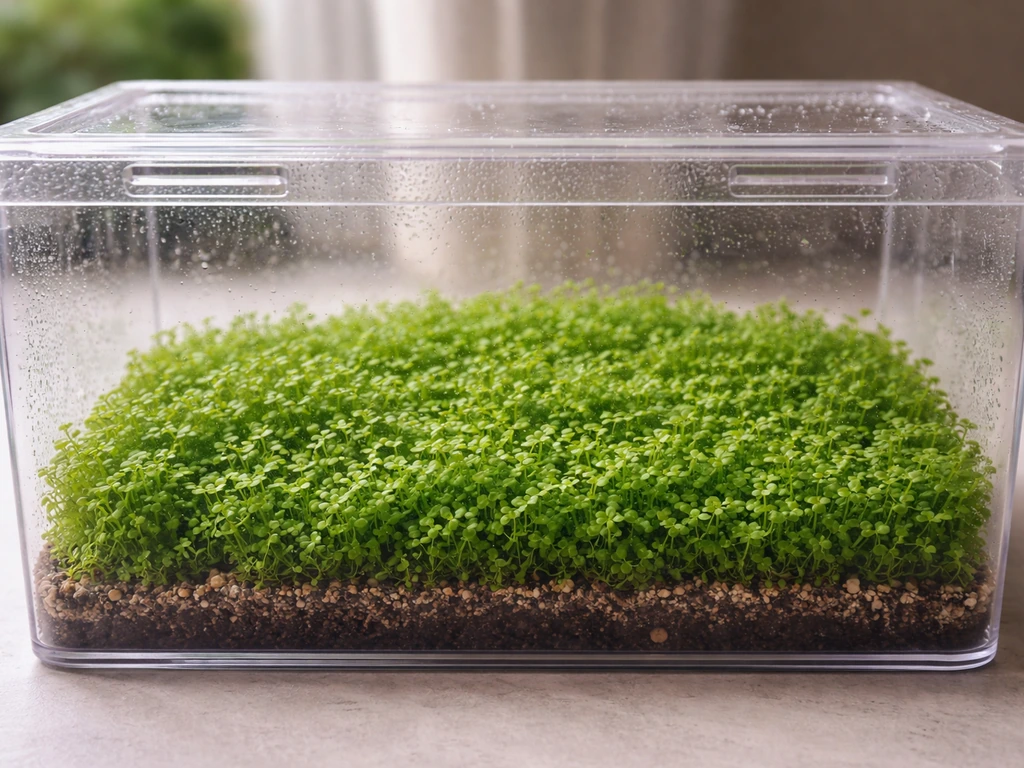
Hairgrass from tissue-culture cups is the cleanest starting point, it arrives free of algae spores, snails, and disease, which matters a lot in a new setup that hasn't established plant competition yet. Tissue-culture plants come in a gel medium that you need to remove before planting.
- Remove the plant from its cup and place it in a bowl of tank water. Gently tease the gel away from the roots with your fingers — rinse thoroughly, the gel left in substrate can cloud water and invite bacteria
- Divide the portion into small plugs of 8–15 blades each. Smaller divisions establish individual root systems faster and produce runners sooner than planting one large clump
- Use curved tweezers to plant each plug in a grid pattern across your foreground substrate, spacing plugs 2–3 cm apart. Tighter spacing (2 cm) gives faster visual fill; wider spacing (3 cm) costs less plant material but takes longer to carpet
- Insert the plug so the crown (where blades meet roots) sits just at or slightly below the substrate surface — about 1 cm depth. Too deep buries the crown and causes rot; too shallow and flow or fish activity dislodges the plug before it roots
- Press the substrate gently around each plug with your tweezers or fingertip to ensure contact between roots and substrate
- After planting, fill the tank slowly to avoid disturbing plugs. A plate or plastic bag on the substrate surface while filling helps
- Turn CO2 on at your target injection rate and lights on at 60–70% intensity for the first week
- Expect 5–10 days for initial rooting, then look for the first horizontal runners appearing from the base of established plugs
Growing from runners, pots, and seed
Beyond tissue-culture cups, you may encounter hairgrass sold as potted plants (in rock wool) or occasionally as bare-root bunches. Potted plants work the same way as tissue culture, remove the rock wool completely before planting, as it compresses roots and slows establishment. Bare-root bunches are trickier because they're often multiple plants bundled together with a lead weight; separate all individual plantlets and plant them singly at 2–3 cm spacing.
Growing from seed is possible with some Eleocharis species and is a lower-cost route for covering large areas. The process requires a moist, emerged setup (similar to a dry-start method) where seeds are broadcast over wet aquasoil, kept humid, and germinated before the tank is flooded. This connects closely with emersed growing technique, if you're interested in that route, the same principles used when growing Monte Carlo emersed apply well to hairgrass seed germination, since both need consistent surface moisture, humidity, and light before transitioning to submerged growth. For a step-by-step walkthrough on starting hairgrass from seed, see my guide on how to grow small leaf grass aquarium from seed which covers germination, humidity control, and the flood transition. For step-by-step instructions on how to grow Monte Carlo emersed, see our how to grow Monte Carlo emersed guide.
Emersed versus submerged growing
The dry-start method (DSM) is a technique where you plant hairgrass into a moist, unflooded substrate and allow it to grow in emerged (above-water) form for several weeks before flooding the tank. This approach can dramatically accelerate carpet coverage, hairgrass grows faster emerged, spreads runners more aggressively without water resistance, and the roots are deeply established by the time you flood. The trade-off is that the emerged leaves will melt back when submerged, which looks alarming but is normal. New, submerged-adapted leaves grow from the established root network within 1–2 weeks of flooding.
To run a dry start: plant your hairgrass plugs into wet aquasoil in an empty or minimally filled tank, mist the surface twice daily to maintain humidity, cover loosely with plastic wrap or a glass lid to hold moisture, and run lighting for 10–12 hours per day. After 3–5 weeks of emerged growth and visible runner spread, slowly flood the tank over 2–3 days. Keep CO2 running from the flood date and don't be alarmed by the initial melt, the roots will push new growth within 7–14 days.
Maintenance and carpet care
Once your carpet is established, trimming is the main maintenance task. Use straight or curved aquascaping scissors to trim the carpet to your desired height, typically 2–4 cm for a tight lawn effect. Trim regularly (every 2–4 weeks depending on growth rate) rather than allowing it to grow tall and then making a drastic cut. Heavy cuts stress the plant and can cause temporary thinning. After trimming, turn flow up briefly or use a net to collect clippings before they decay on the substrate.
Hairgrass propagates itself continuously via runners, so your main job is directing that spread rather than encouraging it. If you want to fill a new area, you can physically transplant runner tips into the target zone. If runners are spreading into areas you don't want covered (behind hardscape, into gravel paths), simply trim or pull them at the substrate level.
Timeline: what to expect and when
| Week / Period | High-Tech Setup (CO2 + Aquasoil) | Low-Tech Setup (No CO2) |
|---|---|---|
| Week 1–2 | Initial rooting, first runners emerging from plug bases | Rooting phase, little visible spread |
| Week 3–4 | Runners visible between plugs, carpet beginning to fill in | Slow runner production, may grow upward |
| Week 5–8 | Dense carpet coverage across planted area in most cases | Partial coverage if conditions are good |
| Month 2–3 | Full carpet with regular trimming schedule established | Visible carpet forming, still patchy |
| Month 3–6 | Mature carpet, maintenance trimming every 2–4 weeks | Possible full coverage in ideal conditions |
| 6+ months | Stable carpet requiring only routine trimming and fertilising | Dense carpet achievable with patience |
Troubleshooting common hairgrass problems
Melting and browning after planting
Some melt in the first 1–2 weeks after planting is completely normal, especially with tissue-culture plants transitioning from emerged to submerged growth. The emerged leaves die off and the plant produces new submerged-adapted leaves from the roots. If browning continues past 3 weeks with no new growth, check whether the crowns are too deep (rotting), CO2 is insufficient, or nutrients are deficient. Healthy roots are white to pale cream, blackened or mushy roots indicate anaerobic conditions or overburied crowns.
Growing tall instead of spreading
This is the most common complaint and it almost always comes down to insufficient light at the substrate level. The plant stretches upward toward light rather than spreading horizontally. Check your PAR at the substrate with a meter if possible, or try raising light intensity. Adding CO2 (or increasing CO2 to 20–30 ppm if already running it) also stimulates horizontal runner production. In low-light, no-CO2 tanks, some upward growth is unavoidable, the best strategy is regular trimming to keep the carpet at desired height.
Algae on the carpet
Green thread algae and staghorn algae are the most common invaders in hairgrass carpets. Both usually indicate a CO2 fluctuation or light/nutrient imbalance. Check that CO2 is consistent throughout the photoperiod (the drop-checker should stay green for the full light period), confirm you're doing weekly water changes, and verify your light duration isn't exceeding 10 hours. Spot-treat thread algae by gently twisting it out with a toothbrush or pipette-dosing Excel directly onto affected areas. If staghorn algae appears on blades, it's almost always a CO2 deficiency signal.
Patchy or slow spread
Patchy carpet with gaps that aren't filling in usually points to nutrient deficiency (especially iron or phosphate), inadequate flow bringing nutrients to those areas, or substrate that's too compacted for runners to penetrate. Check phosphate and iron levels first. If the carpet is filling in on the sides but not the middle, the issue is often flow, a shadow zone where detritus accumulates and oxygen is lower. Repoint a powerhead to improve circulation in that zone. If you're on inert substrate, add root tabs directly under the sparse areas.
Hairgrass versus other carpet plants: a practical comparison
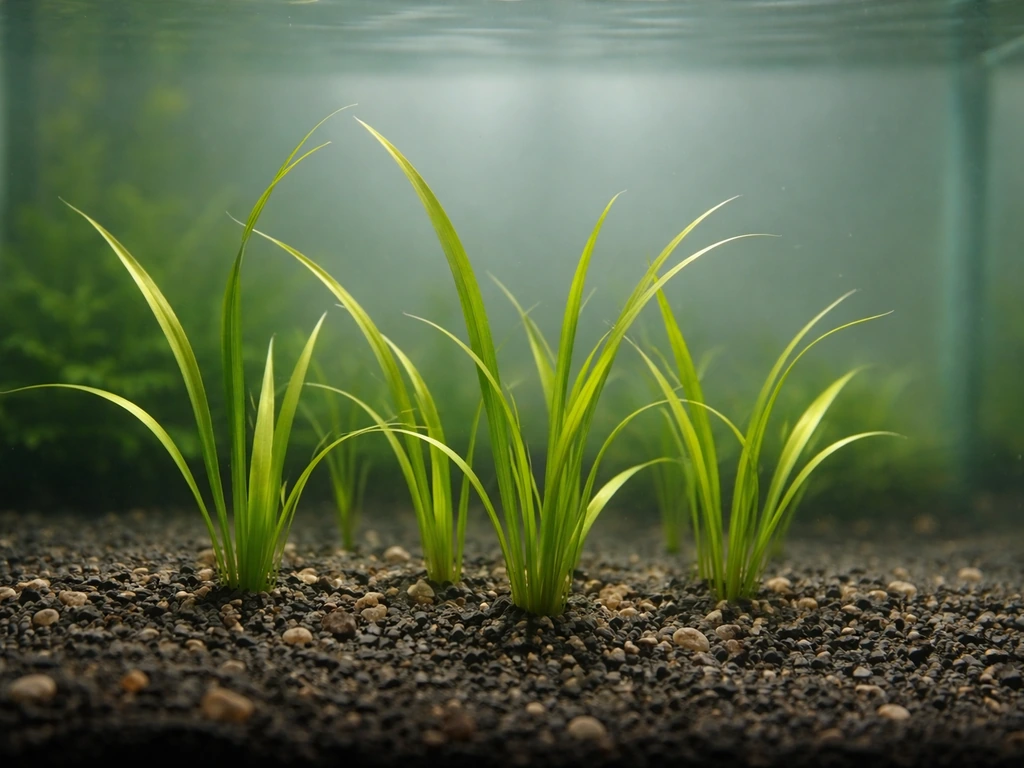
Hairgrass is not the only carpet option, and it's worth knowing where it fits relative to alternatives you'll encounter while researching. Vallisneria, for instance, is often grouped loosely with grass-like aquarium plants but behaves very differently, it grows much taller, spreads by runners above the substrate, and is far better suited to background or midground use than a foreground carpet. For detailed guidance on preparing and maintaining Vallisneria, see our guide on how to grow vallisneria in aquarium (internal resource). If you're looking at Vallisneria for any reason, understand that it occupies a completely different niche from Eleocharis.
| Plant | Carpet Height | CO2 Required? | Difficulty | Best For |
|---|---|---|---|---|
| Eleocharis parvula / 'Mini' | 3–6 cm | Strongly recommended | Beginner–intermediate | Classic foreground lawn |
| Eleocharis acicularis (standard) | 10–20 cm trimmed | Recommended | Beginner | Taller foreground or mid-carpet |
| Monte Carlo (Micranthemum tweediei) | 2–4 cm | Required for carpeting | Intermediate | Dense fine-leaf carpet, grows well emersed first |
| Cow grass (Monosolenium / similar) | Variable | Helpful | Beginner | Texture variation, less formal lawn |
| Small-leaf grass from seed | Variable by species | Helpful | Beginner (setup) / patient | Budget large-area carpet |
| Vallisneria spp. | 30–100+ cm | Not required | Beginner | Background / tall midground — not a carpet plant |
Monte Carlo is the closest competitor to hairgrass for a fine foreground carpet. It produces a denser, rounder-leaf look versus the linear grass blades of Eleocharis, and it responds especially well to emersed pre-growing before flooding, a technique that also works with hairgrass as described above. If you want the most natural-looking grass effect, Eleocharis wins. If you want the densest possible low mat with a moss-like texture, Monte Carlo is worth considering alongside it.
Realistic expectations and final advice
The biggest lesson I've taken from growing hairgrass is that the setup phase determines almost everything. A tank with proper substrate, CO2 dialled in, and good light before the first plug goes in will carpet predictably in 4–8 weeks. A tank where you're troubleshooting equipment while the plants are already in can easily drag on for months with disappointing results. See our guide on how to grow cow grass in aquarium for a step-by-step walkthrough tailored to carpeting species. Invest the time upfront to get water chemistry stable, CO2 consistent, and light at the right intensity, then plant and let the system work.
Be patient with the first two weeks, melting is normal, slow early spread is normal. What you're watching for is new growth from the base of each plug and the first few runner tips extending outward. Once you see that, you know the carpet is underway. From there, stay consistent with your fertiliser schedule, keep up the weekly water changes, and resist the urge to change multiple variables at once if something looks off. Adjust one thing at a time, give it 5–7 days to respond, and you'll have a carpet worth photographing within two months.
FAQ
Which Eleocharis species should I choose for a carpet and how do trade names affect selection?
Choose based on final height and growth speed: Eleocharis parvula (dwarf) and Eleocharis acicularis ‘mini’ (marketed mini cultivars) are best for low carpets (3–6 cm). Standard E. acicularis grows taller (10–20 cm) unless kept trimmed. Trade names are inconsistent—many lots labelled ‘parvula’ may be acicularis or hybrids—so buy from reputable tissue-culture suppliers or ask for expected mature height.
What substrate and layout do I need for a healthy hairgrass carpet?
Use a fine-grained nutrient aquasoil or nutrient base (laterite/soil) capped with fine sand or powder for anchoring. Target 2–4 cm of quality aquasoil in the foreground or a root-nutrient layer under a thin cap. If using inert sand/gravel, place root tabs under each planting area to supply long-term nutrients.
What lighting and CO2 conditions produce the fastest, most compact carpet?
Aim for moderate→high light for compact carpets. Practical PAR targets: ~30–50 µmol·m⁻²·s⁻¹ for moderate, ~50–100+ for high‑tech carpets (adjust per tank depth). Pressurised CO2 (target ~20–30 ppm dissolved) strongly accelerates runner production and densification. Run CO2 with a solenoid/timer (on ~1 hour before lights, off ~1 hour before lights out) and use a drop‑checker to monitor.
How should I plant hairgrass (plugs, runners, seeds)?
Plugs/tissue-culture: remove gel, divide cups into small portions and plant in a grid with curved tweezers ~1.5–3 cm spacing (closer speeds fill). Press the crown gently into substrate. Runners: plant mother plants spaced and allow stolons to form; avoid burying the crown. Seed: not common—requires emersed germination or careful submerged sowing; better for advanced growers. For dense early coverage, plant more densely and trim runners as they spread.
When should I use the dry‑start (emersed) method vs. direct submerged planting?
Dry‑start (emersed) helps carpets establish quickly in low‑tech setups and can reduce initial algae; keep substrate moist with high humidity until runners form, then slowly flood to submerge. Direct submerged planting is faster with CO2 and high light; use tissue-culture plugs or small clumps and expect an initial adjustment (some 'melting' of emersed leaves). Monte Carlo uses emersed dry-start often—transition to submerged gradually once roots and runners are robust.
What fertilization regimen works best for hairgrass carpets?
High‑energy carpets commonly use an EI-style approach: maintain ample macronutrients (nitrate, phosphate, potassium) and daily/regular micronutrients. Typical EI weekly targets (example high-tech): NO3 ~20–30 mg/L, PO4 ~1–2 mg/L, K ~20–30 mg/L (dose as salts; reset with large weekly water change). Ensure trace elements (Fe, Mn, etc.) and root feeding (root tabs) if substrate is inert. Adjust dosing to plant response and algae pressure.