Anubias is never going to sprint. That's the honest starting point. But "growing Anubias fast" is a real and achievable goal if you understand what fast actually means for this plant, and then systematically remove every brake on its growth. The practical target for Anubias nana under good conditions is roughly one new leaf per month. Under optimized conditions, you might push that to two leaves per month on an established rhizome. You won't get stem-plant speed, but you can absolutely stop your Anubias from sitting there doing nothing for six months at a stretch.
How to Grow Anubias Fast: Care, Light, Nutrients Tips
Marcus Holloway
20 Apr 2026
What "fast" actually means for Anubias
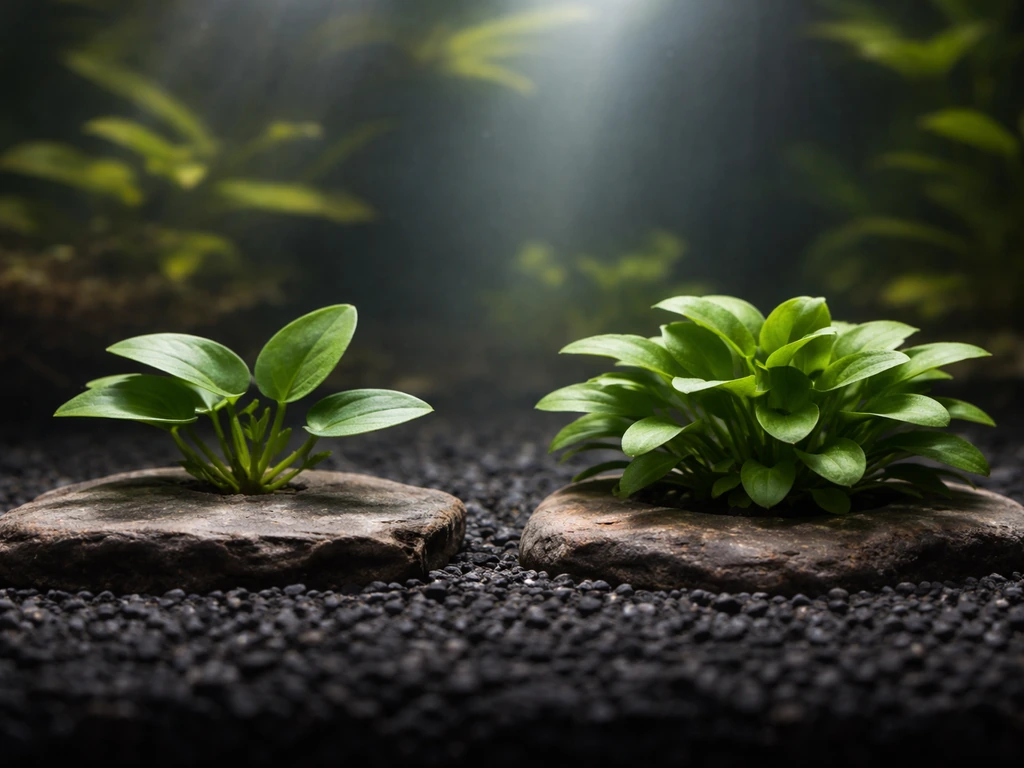
Anubias barteri var. nana is rated as very slow-growing across almost every aquatic plant database. The standard baseline is about one new leaf per month under typical aquarium conditions. That's not a failure, that's the plant's biology. Anubias grows from a creeping rhizome, and each leaf is long-lived, which is part of why new leaf emergence is slow and deliberate compared with fast stem plants like hornwort or rotala.
When hobbyists talk about making Anubias grow faster, they usually mean one of three things: getting a recently purchased plant out of its "melt and do nothing" acclimation phase sooner, achieving consistent one-leaf-per-month growth rather than stalling for months at a time, or pushing a healthy established rhizome toward two leaves per month. All three are realistic with the right setup. What you won't get is visible daily growth or the kind of explosion you see with faster species. Set that expectation now and you'll actually be able to track your progress accurately.
Water parameters that keep growth moving
Anubias is famously tolerant of a wide parameter range, which sometimes tricks people into thinking parameters don't matter for growth speed. They do. The plant can survive in bad conditions, but it will essentially stall. For consistent growth, aim for temperature in the 72 to 82°F (22 to 28°C) range. I've kept Anubias at 68°F and it just sat there looking fine but producing almost nothing for months. Bringing the tank up to 76 to 78°F made a noticeable difference. Cold water slows metabolism, and this plant doesn't have speed to spare.
Keep pH between 6.0 and 7.5, and general hardness around 3 to 8 dGH. Within those ranges, the plant isn't under ionic stress and can actually direct its energy into growth rather than basic survival. Soft, slightly acidic to neutral water is the sweet spot. If you're running hard, alkaline tap water and wondering why your Anubias looks stuck, try buffering it down toward neutral pH.
| Parameter | Target Range | Why It Matters |
|---|---|---|
| Temperature | 72–82°F (22–28°C) | Drives metabolic rate; cold water stalls growth |
| pH | 6.0–7.5 | Affects nutrient availability and cellular function |
| GH (General Hardness) | 3–8 dGH | Prevents ionic stress that slows growth |
| Nitrate (NO3) | 10–50 mg/L | Primary nitrogen source for new leaf tissue |
| Potassium (K) | 5–30 mg/L | Key macronutrient for cellular processes |
Getting lighting right: enough to grow, not enough to invite algae
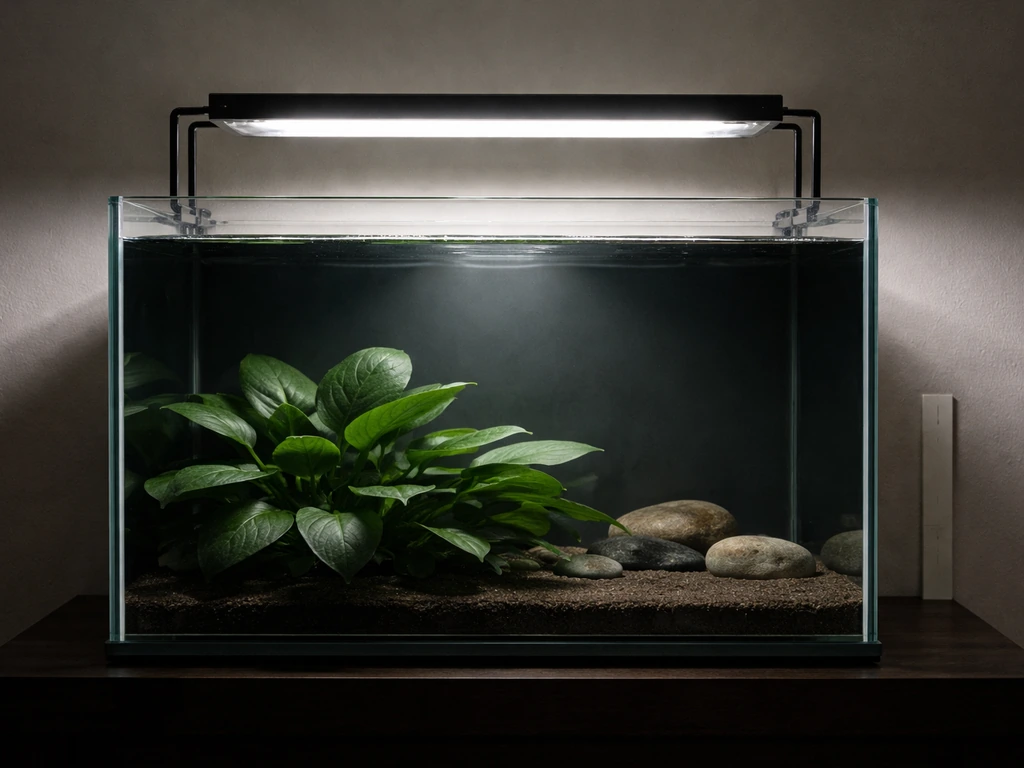
Anubias can survive under very low light, roughly 0.25 W/L, all the way up to strong light above 1 W/L. But survivability and growth are different things. Too little light and you get almost zero new growth. Too much direct bright light and you get green spot algae coating those slow, long-lived leaves, which effectively shades the plant and tanks the photosynthesis rate anyway.
The practical sweet spot for faster growth is low-to-medium light, positioned so the Anubias gets filtered or indirect coverage rather than sitting directly under the hotspot of a high-output LED. If you're running a planted tank with higher light for other plants, place your Anubias in the shaded zones, behind driftwood or under taller plants. This is one of those cases where the plant's well-known "shade plant" reputation is actually practical advice, not just marketing for low-tech tanks.
- Aim for 6 to 8 hours of light per day on a timer, not 10 to 12 hours, which mostly grows algae on Anubias leaves
- Use full-spectrum white or slightly warm-white LEDs (6500K to 7000K range works well)
- Position Anubias nana in shaded or mid-tank areas rather than directly under the light beam
- If you see green spot algae forming on leaves, that's a signal your light is too intense for the spot where the plant sits, not necessarily for the whole tank
- Don't crank light intensity trying to force faster growth; it doesn't translate to more leaves, it translates to more algae
Fertilization: what to dose, what to skip
Anubias is an epiphyte, meaning it feeds almost entirely from the water column through its leaves and roots, not from a nutrient-rich substrate like a sword plant or vallisneria. This makes liquid fertilizers more relevant than substrate root tabs. If your tank has good bioload from fish, you're already providing some nitrogen and phosphorus naturally. But potassium and micronutrients are often depleted faster than fish waste replaces them, and a deficiency in either will stall your Anubias.
Target nitrate in the 10 to 50 mg/L range and potassium in the 5 to 30 mg/L range. A balanced all-in-one liquid fertilizer (like Seachem Flourish Comprehensive or Tropica Specialised Nutrition) dosed weekly at the label rate is usually enough to maintain those levels in a lightly stocked tank. In a heavily stocked tank where nitrates run high naturally, you mainly need to supplement potassium and micros. The mistake most people make is under-dosing everything out of fear of algae, leaving the plant starved. The other mistake is mega-dosing, which absolutely does cause algae. Dose at the label rate, test after two weeks, and adjust based on plant response and nitrate readings.
Iron deserves a specific mention. Anubias can show yellowing between the veins of new leaves when iron is low, which is a classic micronutrient deficiency. If you see that pattern, add a chelated iron supplement like Seachem Flourish Iron separately, targeting 0. Aqulator discusses Seachem Flourish Iron dosing and maintenance guidance, including a target/maintenance iron level of about 0.10 mg/L targeting 0.1 mg/L. 1 mg/L. Don't skip this if you're trying to push growth, because iron deficiency is one of the quieter reasons Anubias nana stalls even when everything else looks fine.
CO2 and water circulation: when they actually help
Carbon dioxide is the single nutrient most planted tanks are deficient in. In a non-injected aquarium, ambient dissolved CO2 from fish respiration and surface exchange is typically just a few parts per million. Optimal photosynthesis for aquatic plants generally requires 20 to 30 mg/L of dissolved CO2. That's a meaningful gap, and closing it does noticeably improve Anubias growth rate, even though this plant is still going to be slow by any standard.
If you're running a low-tech tank without CO2 injection, the best move is to maximize the other factors: good nutrients, right temperature, reasonable light, and no rhizome issues. CO2 injection will help but isn't mandatory for Anubias the way it is for demanding foreground plants. If you do add CO2, a DIY yeast reactor or a small pressurized system targeting 20 to 25 mg/L dissolved CO2 is enough. Use a drop checker with 4dKH reference solution to monitor; aim for green (approximately 30 ppm), and avoid yellow (too much CO2) or blue (too little). Don't ramp up CO2 rapidly, as sudden swings stress the plant and can trigger melt.
Water circulation matters too. Gentle flow across the leaves improves CO2 and nutrient contact at the leaf surface, which directly supports photosynthesis. A circulation pump or powerhead pointed to create gentle, indirect flow near your Anubias is a cheap upgrade that helps noticeably. Avoid blasting the plant with strong direct flow, as this causes physical stress and can dislodge plants tied to hardscape.
Planting and tie-down: the rhizome rules that actually matter
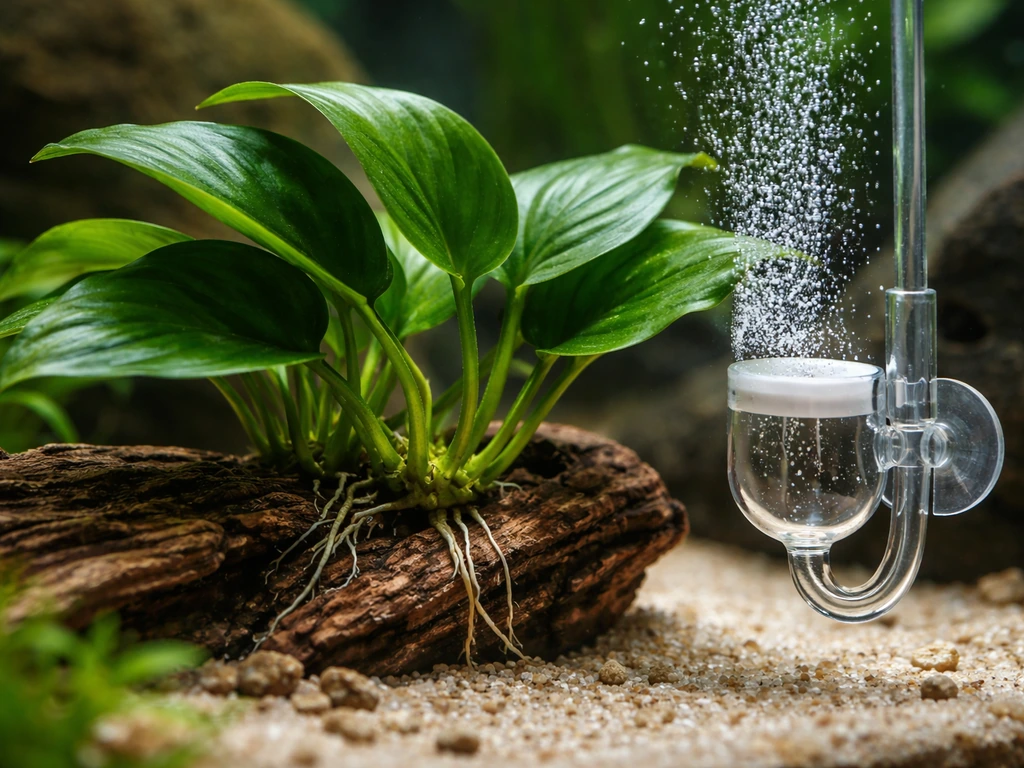
This section fixes the most common reason Anubias stops growing entirely. Anubias is not a substrate plant. It grows from a rhizome, which is a horizontal stem that the leaves and roots emerge from. That rhizome must stay exposed to the water.
Burying it in gravel or sand is the single fastest way to rot and kill an Anubias. Aquasabi's epiphyte care guidance also warns that placing epiphytes like Anubias into sand, gravel, or soil can lead to rhizome rot, so keeping the rhizome accessible is the best practice [Burying it in gravel or sand is the single fastest way to rot and kill an Anubias. ](https://www. aquasabi.
com/aquascaping-wikiaquatic-plantsepiphytes). I've seen people lose plants within two weeks of planting them incorrectly, then wonder why their "hardy" Anubias died.
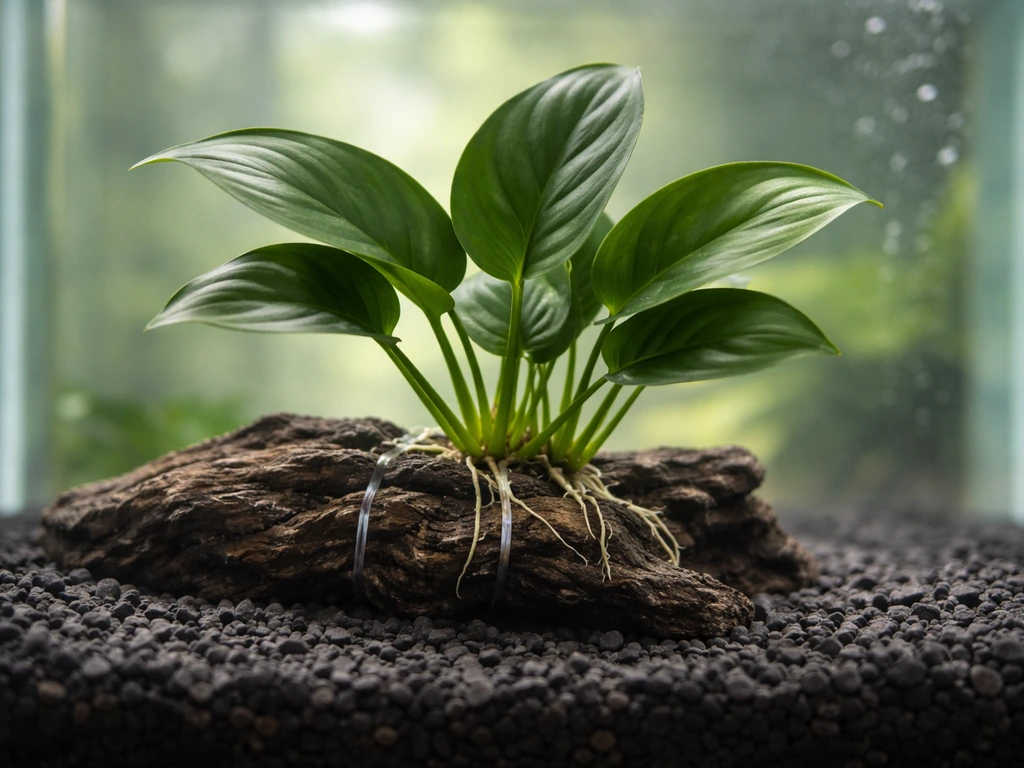
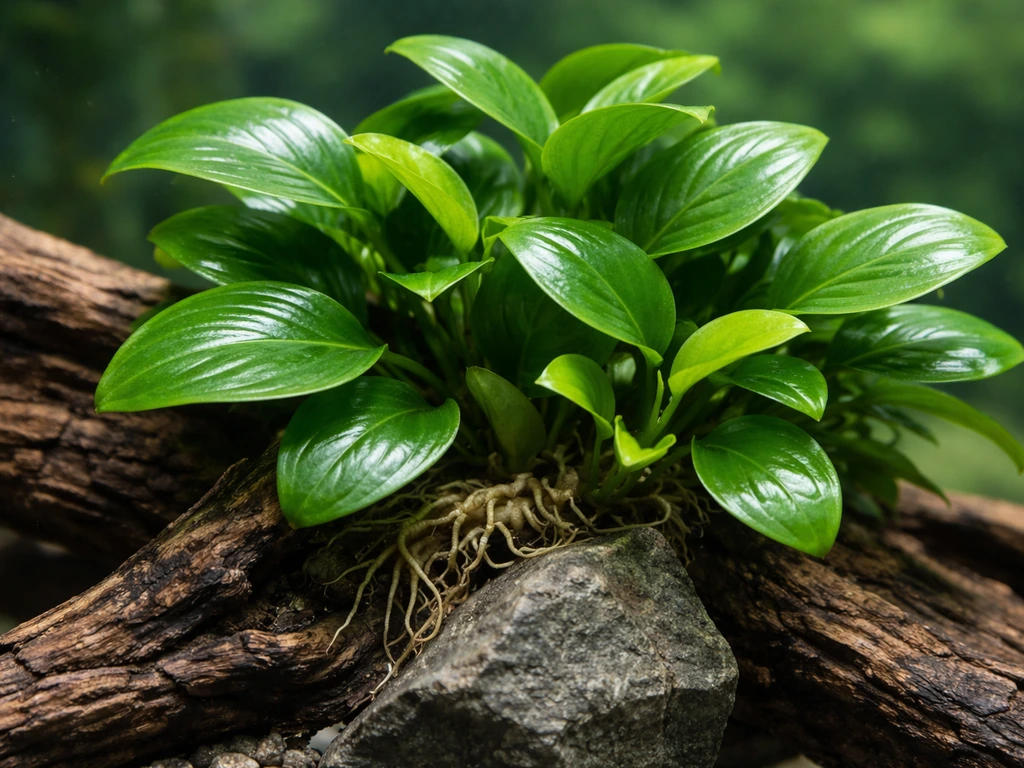
The correct method is to attach the Anubias to a piece of driftwood, a rock, or another piece of hardscape, with the rhizome sitting on top of the surface. Roots will naturally grip and anchor into the hardscape or spread into the substrate below. Use nylon thread or thin fishing line to tie the rhizome gently but firmly to the surface until it anchors on its own, which usually takes two to four weeks. Cotton thread is sometimes suggested but it breaks down too quickly in water, leaving the plant loose before the roots have gripped.
- Choose a piece of driftwood or rock with a rough surface; Anubias roots grip textured surfaces much better than smooth ones
- Place the rhizome flat against the surface so it has maximum contact area
- Wrap nylon thread or thin fishing line around the rhizome and hardscape in a loose figure-8 pattern; tight enough to hold, not tight enough to cut into the rhizome
- Make sure the roots can hang freely downward or into any adjacent substrate; don't trap them under the rhizome
- Leave all leaves and the growing tip (front end of the rhizome) completely free and exposed to the water
- Check attachment every few days for the first two weeks; if the rhizome shifts, re-tie before roots start to develop in the wrong position
For Anubias nana specifically, the rhizome stays compact and short compared with larger Anubias barteri varieties, so you don't need a huge attachment surface. A small piece of driftwood or even a smooth river rock works fine. The compact rhizome is also why nana is popular for nano tanks, though it grows at the same pace regardless of tank size.
Troubleshooting slow or stalled Anubias (nana included)
If your Anubias has produced zero new leaves in two months or is actively losing leaves, something specific is wrong. If you want to grow Anubias faster, start by checking the rhizome is fully exposed and not rotting, then confirm temperature, light, and nutrients line up with what this plant needs how to grow anubias. Here's how to diagnose it systematically rather than just doing random tank changes and hoping.
| Symptom | Likely Cause | Fix |
|---|---|---|
| No new leaves for 2+ months after purchase | Normal acclimation; new plants often melt old leaves first | Wait 4–6 weeks, ensure rhizome is exposed, check params |
| Leaves yellowing and falling off | Rhizome buried, nutrient deficiency, or temp below 72°F | Unbury rhizome, dose fertilizer, raise temp to 76–78°F |
| Rhizome turning brown/mushy | Rhizome rot from burial or poor circulation | Trim mushy tissue with clean scissors, reattach correctly to hardscape |
| Green spot algae on leaves | Light too intense for the position | Move plant to shaded area or reduce light duration to 6–7 hours |
| New leaves pale yellow or interveinal chlorosis | Iron deficiency | Dose chelated iron to 0.1 mg/L, maintain with liquid ferts |
| Plant looks fine but no growth after 3+ months | CO2 or nutrient limitation | Test NO3 (target 10–50 mg/L), add liquid fertilizer, consider CO2 |
| Leaves covered in hair algae or green algae | High nutrients + high light combo | Reduce light hours, spot-treat with hydrogen peroxide or Excel |
| Rhizome detaches from hardscape | Thread broke or roots never gripped | Re-tie with fresh nylon thread, check surface texture |
One thing I want to call out specifically: it's normal for a newly purchased Anubias to lose its first set of leaves in the first two to four weeks. The plant was grown emersed (above water) at the farm, and those leaves often can't survive submersion. This looks alarming but isn't a failure. The rhizome is still alive and will push out new submersed-adapted leaves once it acclimates. The mistake is panicking, uprooting the plant, and changing its position while it's already stressed.
Temperature swings are another underappreciated growth killer. If your tank drops to 68°F at night because the heater isn't keeping up, the cumulative cold stress over weeks genuinely suppresses rhizome activity. A reliable heater with a glass thermometer cross-check (not just the heater's built-in reading) is worth the money.
Your faster-growth checklist and timeline
Here's the practical sequence to follow if you're starting fresh or resetting an underperforming Anubias setup. Don't change everything at once. Work through the list and give each change time to show results before layering on the next one.
- Week 1: Check and correct rhizome placement first. If it's buried even partially, detach the plant, trim any mushy rhizome tissue, and reattach to hardscape with nylon thread. This single fix resolves more stalled-growth cases than anything else.
- Week 1: Set a reliable heater to hold 76–78°F (24–26°C) consistently. Cross-check with a separate thermometer. Stable warmth matters more than hitting a perfect number.
- Week 1–2: Start dosing a balanced all-in-one liquid fertilizer at the label rate once per week. Test nitrate after two weeks; target 10–50 mg/L. If you're under 10 mg/L, increase dosing slightly.
- Week 2: Review your lighting. Reduce photoperiod to 6–8 hours if you're running longer. Move the Anubias to a medium-light or shaded zone if it's sitting directly under a strong LED.
- Week 3–4: Add gentle water circulation near the plant if you don't have it. A small powerhead or adjusting an existing filter output to create indirect flow is enough.
- Week 4–6: If no new leaf is visible after a month and all of the above are correct, consider adding a DIY CO2 system targeting 20–25 mg/L dissolved CO2. Monitor with a drop checker.
- Ongoing: Check for algae on leaves monthly. Green spot algae means light is too intense for that spot. Hair algae means nutrients and light are out of balance. Address both before they shade the plant.
- Month 2+: By this point you should see at least one new leaf emerging from the growing tip. If not, recheck rhizome health, water temperature, and nutrient levels systematically.
A realistic timeline: newly purchased Anubias nana typically spends two to four weeks acclimating and possibly melting old leaves. After that, a properly set up plant should show a new leaf tip within four to six weeks. Once established and with optimized conditions, you can expect one to two new leaves per month. That's genuinely fast for this species, and it's achievable without exotic equipment or complex chemistry.
If you're also working on faster-growing species like acropora or nannochloropsis alongside this, the principles overlap more than you'd think: stable parameters, consistent nutrition, and eliminating physical stress on the organism are the levers that move growth rate across almost every aquatic species. Once you understand the same basics of stable parameters and low stress, you can apply them directly to how to grow Acropora fast as well. The difference with Anubias is just that its ceiling is lower, so every lever you leave in the wrong position hurts more proportionally.
The bottom line is that growing Anubias fast is really about growing it without interference. growing Anubias fast is really about growing it without interference. Remove the common mistakes, dial in the parameters above, and the plant will perform at the top of its natural range. That's the best outcome available, and it's more than enough to produce a healthy, growing plant that rewards your setup.
If you want a similar hands-on approach for a harder pest to keep, check out how to grow aiptasia next. If you want a similar hands-on approach for a harder pest to keep, check out how to grow aiptasia next, or compare it with how to grow sea anemone for another related aquarium challenge.
FAQ
How do I measure whether my Anubias is actually growing faster, instead of just changing color?
Use the rhizome and leaf count, not visible “growth” day to day. Anubias adds growth in slow intervals, so track whether you get a new leaf tip within 4 to 6 weeks after acclimation, then whether you reach 1 to 2 leaves per month once stable. If nothing appears after that window, treat it as a setup issue, not bad luck.
Will increasing light and fertilizer always make Anubias grow faster?
It can, but only as a side effect of fixing something else. If you’re increasing light or nutrients, more algae may appear first, and algae shading can actually reduce Anubias growth. Focus on indirect placement and label-rate dosing, then remove or reduce algae that settles on the leaves, since it blocks light at the leaf surface.
My Anubias is melting, should I reposition it to encourage faster growth?
Do not move it during early acclimation. After purchase, allow 2 to 4 weeks for melting and submersed adaptation, and avoid uprooting or rotating it unless the rhizome is buried or physically damaged. If you need to change placement, do it once and then leave it alone for at least a few weeks.
What’s the most common mistake that makes Anubias stop growing for months?
Yes, by checking the rhizome position and the attachment method. If the rhizome is buried or covered in substrate, it can rot even when the rest of the tank seems “fine.” Ensure the rhizome is above the substrate, tied to hardscape, and that roots can anchor naturally instead of being forced into gravel.
Do Anubias need root tabs or can I grow them fast with only liquid fertilizer?
Anubias can form new leaves without deep substrate, but it still benefits from water-column feeding. If you rely only on substrate tabs, growth can stall because the plant’s energy comes primarily from what it captures through leaves and roots from the water. Use liquid fertilizer strategy and test nitrate and potassium to confirm you are not underfeeding micros or potassium.
What should I do if my Anubias looks healthy but keeps stalling, and I also have algae?
If your tank is already producing algae, don’t immediately add more nutrients to chase growth. Instead, confirm CO2 (if using), confirm potassium and iron are not low, then verify lighting is not too intense directly on the leaves. Also test for nitrate consistency, since extreme swings or chronically very low nitrate can limit plant growth.
How can I tell if my CO2 is too low or too high for faster Anubias growth?
Don’t guess at CO2. If you inject, use a drop checker with a known reference (4 dKH) and aim for the green zone, around the target ppm. If you see melt, leaf spotting, or sudden slowdown, it often correlates with CO2 swings, so reduce the adjustment rate rather than lowering dose drastically overnight.
My heater is set correctly, but why is Anubias still slow to grow?
Yes, by matching temperature stability to the plant’s metabolism. A heater that “should” hold temperature is not enough, confirm with a glass thermometer, especially at night. Even if Anubias looks fine visually, repeated dips toward the high 60s can suppress rhizome activity and delay new leaf emergence.
If my Anubias has pale new leaves, how do I know whether it’s iron versus something else?
Watch for leaf yellowing between veins on new growth, that pattern often points to iron or another micronutrient issue rather than nitrogen deficiency. Treat with a chelated iron supplement carefully at about 0.1 mg/L target and avoid stacking multiple micronutrient products at once, since overdosing can fuel algae without fixing the real limiting factor.
Can I grow Anubias fast in a low-tech, low-light setup?
In most cases, no. Anubias can grow in low to medium light, but the faster-growth goal requires moving it out of “survival-only” conditions. Place it where it receives indirect or filtered light, then keep the rest of the tank’s high-light intensity away from the leaves to avoid green spot algae that shades the plant.